
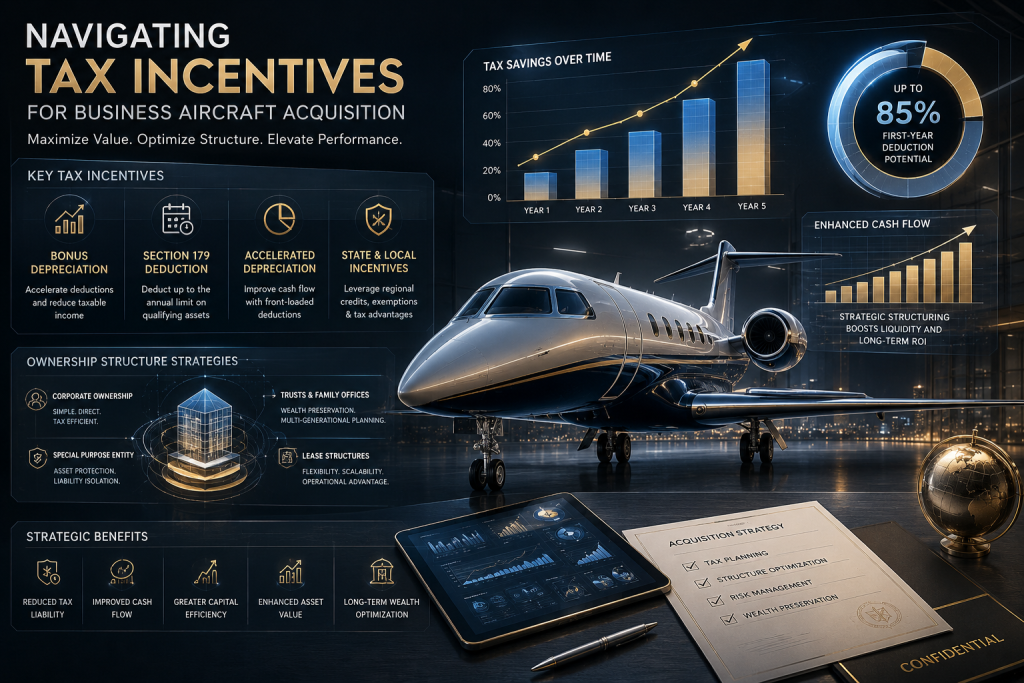
Acquiring a business aircraft is often viewed through the lens of mobility, efficiency, privacy, and executive productivity. However, sophisticated buyers understand that the financial structure of an acquisition can be just as important as the aircraft itself. Strategic use of tax incentives can significantly reduce acquisition costs, improve cash flow, and enhance long-term asset performance. For corporations, family offices, entrepreneurs, and ultra-high-net-worth individuals, understanding the available opportunities is an essential part of any aircraft acquisition strategy.
The challenge is that aviation taxation is complex. Regulations vary by jurisdiction, aircraft usage, ownership structure, and operating model. What appears to be a straightforward purchase can become financially inefficient if tax considerations are addressed too late in the process.
This guide explores the major tax incentives available to business aircraft buyers, explains how they work, and outlines the strategic considerations that help maximize value while maintaining compliance.
By: PrivateJetio Aviation Advisory Team
Why Tax Planning Matters Before Aircraft Acquisition
Many aircraft buyers focus heavily on aircraft selection, financing, maintenance history, and operational costs. While these factors are important, tax planning can influence the total cost of ownership by millions of dollars over the life of an aircraft.
A properly structured acquisition may provide:
- Significant first-year tax deductions
- Improved cash flow
- Enhanced return on investment
- Reduced taxable income
- Greater flexibility for future disposition
- Stronger asset management outcomes
Conversely, poor planning can eliminate opportunities that may never be recovered after the transaction closes.
The most successful aircraft acquisitions involve aviation advisors, tax professionals, legal counsel, and financing specialists working together before a purchase agreement is signed.
Understanding Business Aircraft Tax Incentives
Business aircraft tax incentives are government-approved mechanisms designed to encourage investment in productive assets used for commercial or business purposes.
Aircraft can qualify for favorable tax treatment when they are operated primarily for legitimate business activities. The specific benefits depend on jurisdictional regulations, usage percentages, ownership arrangements, and documentation requirements.
While every buyer’s circumstances differ, several incentives consistently influence acquisition decisions.
The Economic Purpose Behind Tax Incentives
Governments recognize that business aviation supports economic growth through:
- Job creation
- Manufacturing investment
- Corporate productivity
- International trade
- Infrastructure development
As a result, tax codes frequently include provisions that reward capital investment in business aircraft.
These incentives are not loopholes. They are policy tools designed to stimulate economic activity while encouraging companies to invest in productive transportation assets.
Bonus Depreciation and Its Strategic Impact
One of the most discussed incentives in business aviation is bonus depreciation.
Bonus depreciation allows qualifying aircraft owners to deduct a substantial portion of an aircraft’s cost during the first year of ownership rather than spreading deductions over many years.
For many buyers, this can produce a significant reduction in taxable income immediately after acquisition.
Why Bonus Depreciation Matters
Imagine a corporation purchasing a large-cabin business jet. Without accelerated deductions, tax benefits may be spread across a lengthy depreciation period.
With bonus depreciation, a significant percentage of the aircraft’s value may be deductible much earlier, potentially generating substantial cash flow advantages.
These savings can be reinvested into operations, expansion initiatives, or additional strategic assets.
Requirements for Qualification
Qualification typically depends on factors including:
- Business use percentage
- Ownership structure
- Date of acquisition
- Service commencement timing
- Regulatory compliance
Because regulations evolve regularly, buyers should review current legislation before relying on projected deductions.
Section 179 Deduction and Aircraft Acquisitions
Another important consideration is the Section 179 deduction.
This provision allows eligible businesses to deduct qualifying asset purchases up to specified limits rather than depreciating the entire cost over time.
While often associated with equipment purchases, certain aircraft transactions may also qualify depending on operational circumstances and applicable rules.
Benefits of Section 179
The advantages include:
- Immediate expense recognition
- Enhanced cash flow
- Reduced taxable income
- Faster return on capital investment
- Improved budgeting flexibility
For growing enterprises, these benefits can support broader expansion strategies while reducing the financial impact of a major aircraft purchase.
Aircraft Depreciation Schedule Fundamentals
Every aircraft owner should understand the aircraft depreciation schedule applicable to their acquisition.
Depreciation recognizes that assets lose value over time and allows owners to deduct portions of the asset cost throughout its useful life.
Standard Depreciation Approaches
Common methods include:
- Straight-line depreciation
- Accelerated depreciation
- Modified accelerated cost recovery systems
- Jurisdiction-specific depreciation frameworks
The chosen method affects annual deductions, financial reporting, and long-term tax obligations.
Strategic Considerations
Accelerated approaches may deliver stronger early-year benefits, while traditional schedules can create more predictable deductions over an extended period.
The optimal strategy depends on:
- Current profitability
- Future income projections
- Financing structure
- Exit plans
- Corporate tax position
Structuring Ownership for Maximum Efficiency
The aircraft ownership structure selected during acquisition can dramatically influence tax outcomes.
Ownership options often include:
- Direct corporate ownership
- Holding companies
- Special purpose entities
- Trust arrangements
- Leasing entities
- Family office structures
Each model creates different tax implications.
Direct Ownership
Direct ownership offers simplicity and operational control. However, it may not always provide the most efficient treatment for liability management or tax optimization.
Special Purpose Entities
Many sophisticated owners establish dedicated entities specifically for aircraft ownership.
These structures can help separate liabilities, simplify accounting, and support more efficient asset management strategies.
Leasing Structures
Some organizations place aircraft within leasing entities and then lease usage rights to operating companies.
Depending on jurisdiction and operating arrangements, leasing models may offer meaningful financial and tax advantages.
Business Aviation Tax Benefits Beyond Depreciation
Depreciation is only one component of the broader tax landscape.
Numerous business aviation tax benefits may apply throughout the aircraft ownership lifecycle.
Operational Expense Deductions
Qualifying business expenses may include:
- Crew salaries
- Maintenance costs
- Insurance premiums
- Hangar fees
- Navigation charges
- Training expenses
- Fuel costs
Proper documentation is critical for substantiating deductions.
Interest Deductibility
When aircraft acquisitions are financed, interest payments may qualify for deduction under applicable regulations.
The resulting tax savings can reduce the effective cost of financing and improve acquisition economics.
State and Local Considerations
Some jurisdictions offer exemptions, credits, or reduced tax rates designed to attract aviation investment.
These incentives can significantly affect acquisition location decisions.
Tax Planning Strategies for Aircraft Buyers
Effective tax planning strategies begin long before an aircraft purchase is finalized.
Elite buyers frequently conduct tax modeling before selecting a specific aircraft model.
Timing the Acquisition
Transaction timing can influence:
- Depreciation eligibility
- Tax year deductions
- Financing outcomes
- Cash flow projections
Acquiring an aircraft near year-end may create opportunities for accelerated deductions when structured appropriately.
Forecasting Future Income
The value of deductions often depends on taxable income levels.
Businesses experiencing strong profitability may realize greater benefits from accelerated tax treatment than organizations operating at lower income levels.
Aligning Tax and Operational Objectives
The best acquisition structures balance:
- Operational flexibility
- Regulatory compliance
- Financial efficiency
- Risk management
Tax considerations should support business objectives rather than dictate them entirely.
Business Use Versus Personal Use
One of the most critical issues in aviation taxation involves distinguishing business use from personal use.
Tax authorities closely scrutinize aircraft operations.
Importance of Accurate Documentation
Owners should maintain detailed records including:
- Passenger manifests
- Flight logs
- Trip purposes
- Meeting documentation
- Corporate schedules
Clear records help demonstrate legitimate business usage.
Consequences of Non-Compliance
Insufficient documentation may result in:
- Reduced deductions
- Tax assessments
- Penalties
- Interest charges
- Increased audit risk
The financial consequences can be substantial.
International Considerations for Global Operators
Aircraft frequently operate across multiple jurisdictions.
Global operations introduce additional complexity regarding:
- VAT treatment
- Importation rules
- Customs requirements
- Cross-border leasing
- Foreign ownership restrictions
VAT and Indirect Tax Planning
For operators in Europe and other VAT jurisdictions, planning opportunities may exist depending on aircraft use and ownership arrangements.
Improper structuring can result in unexpected liabilities.
Cross-Border Aircraft Registration
Registration jurisdiction can influence operational flexibility and taxation.
Sophisticated buyers often evaluate registration, ownership, and operational structures simultaneously rather than making isolated decisions.
The Role of Financing in Tax Optimization
Financing decisions affect more than monthly payments.
They can also influence tax outcomes.
Debt Financing
Financed acquisitions may preserve liquidity while generating interest deductions.
Many corporations prefer leveraging capital rather than deploying cash reserves into aircraft purchases.
Lease Financing
Lease structures may offer flexibility while aligning payments with business usage patterns.
Depending on jurisdiction, leasing arrangements can produce distinct accounting and tax advantages.
Cash Purchases
Although straightforward, cash acquisitions may not always represent the most efficient approach from a tax and capital allocation perspective.
Sophisticated buyers evaluate multiple scenarios before determining the optimal funding strategy.
Common Mistakes Aircraft Buyers Make
Several recurring errors reduce the effectiveness of otherwise valuable tax incentives.
Waiting Too Long to Engage Advisors
Many buyers negotiate aircraft transactions before consulting aviation tax specialists.
By that stage, opportunities may already be limited.
Choosing the Wrong Ownership Structure
An inappropriate ownership model can create unnecessary tax exposure and operational inefficiencies.
Ignoring Long-Term Exit Planning
Tax planning should consider eventual resale.
Acquisition strategies that maximize short-term benefits may create challenges later.
Poor Documentation
Documentation failures remain one of the most common causes of disputes during audits.
Consistent recordkeeping is essential.
How Family Offices Approach Aircraft Tax Planning
Family offices often view aviation assets differently than traditional corporate operators.
Their priorities may include:
- Wealth preservation
- Privacy
- Legacy planning
- Asset protection
- Multi-generational usage
As a result, family office structures frequently integrate aviation taxation into broader wealth management strategies.
Aircraft ownership decisions become part of a larger framework involving trusts, holding companies, investment vehicles, and estate planning initiatives.
Building a Comprehensive Acquisition Strategy
Successful acquisitions integrate multiple disciplines.
Tax efficiency alone does not create value.
Instead, buyers should evaluate:
- Aircraft mission requirements
- Operating costs
- Financing options
- Residual value projections
- Regulatory considerations
- Tax implications
- Exit strategies
The most successful owners approach aircraft acquisition as a strategic investment rather than simply a transportation purchase.
Why Professional Aviation Tax Guidance Matters
Aviation taxation is highly specialized.
General accountants may not possess deep expertise regarding aircraft operations, depreciation rules, international structures, or aviation-specific compliance requirements.
An experienced aviation advisory team can help buyers:
- Evaluate ownership structures
- Model tax scenarios
- Assess depreciation opportunities
- Coordinate legal and accounting teams
- Support compliance efforts
- Protect long-term asset value
For high-value transactions, professional guidance often produces savings that far exceed advisory costs.
Conclusion
The acquisition of a business aircraft represents far more than a transportation decision. It is a capital investment with significant financial, operational, and strategic implications. Understanding business aircraft tax incentives can dramatically improve acquisition economics while supporting long-term wealth preservation and operational efficiency.
From bonus depreciation and Section 179 deduction opportunities to sophisticated ownership structures and advanced tax planning strategies, informed buyers can unlock substantial value when acquisitions are structured correctly from the beginning.
Every aircraft transaction presents unique circumstances. The most effective approach combines aviation expertise, tax planning, legal guidance, and operational analysis into a unified acquisition strategy.
For executives, corporations, family offices, and private investors considering a private jet acquisition, engaging specialized aviation advisors before signing a purchase agreement can be one of the most profitable decisions in the entire ownership journey.
Contact PrivateJetio for a confidential consultation to evaluate acquisition structures, tax considerations, ownership strategies, and long-term aircraft investment planning.
FAQ
1. What tax benefits are available when purchasing a business aircraft?
Potential benefits may include bonus depreciation, Section 179 deduction opportunities, operational expense deductions, interest deductions, and other jurisdiction-specific incentives depending on aircraft use and ownership structure.
2. Does a private jet qualify for bonus depreciation?
A private jet may qualify if it meets applicable regulatory requirements regarding business use, ownership, and service commencement. Eligibility should always be reviewed with qualified advisors.
3. How much business use is required for tax deductions?
Requirements vary by jurisdiction and incentive type. Maintaining accurate records of business-related flights is essential to substantiate deductions.
4. Is leasing better than purchasing for tax purposes?
Not necessarily. The optimal structure depends on cash flow objectives, ownership goals, tax position, operational requirements, and long-term asset strategy.
5. Why should buyers consult aviation tax specialists before acquiring an aircraft?
Aircraft transactions involve unique regulatory and tax considerations. Specialized advisors can help maximize available incentives while reducing compliance risks and protecting long-term asset value.
References:
Internal Revenue Service (IRS)
https://www.irs.gov
National Business Aviation Association (NBAA)
https://nbaa.org
Federal Aviation Administration (FAA)
https://www.faa.gov
European Union Taxation and Customs Union
https://taxation-customs.ec.europa.eu
International Civil Aviation Organization (ICAO)
https://www.icao.int


