
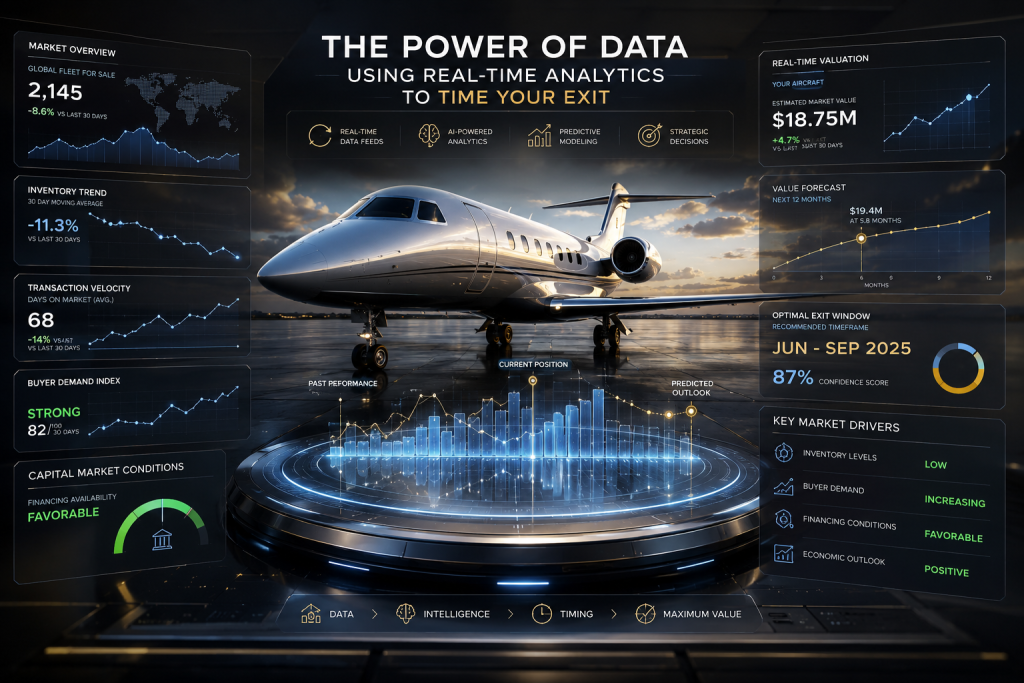
The Power of Data: Using Real-Time Analytics to Time Your Exit
In private aviation, fortunes are often made or lost long before a transaction closes. While many aircraft owners focus on acquisition timing, experienced investors understand that the true financial outcome of ownership is often determined by the exit. The difference between selling an aircraft six months too early or six months too late can represent millions of dollars in value.
Today’s aviation marketplace operates in a radically different environment than it did a decade ago. Advanced data platforms, predictive analytics, artificial intelligence, and real-time market monitoring have transformed how sophisticated owners evaluate opportunities. Rather than relying on instinct or broker opinions alone, elite buyers and sellers now leverage data-driven intelligence to identify the optimal moment to divest an asset.
For ultra-high-net-worth individuals, family offices, corporate flight departments, and aviation investment groups, real-time analytics have become an essential component of a successful aircraft exit strategy.
Understanding how these tools work and how they can be applied to maximize returns can significantly improve long-term aviation portfolio performance.
By: PrivateJetio Aviation Advisory Team
Why Timing Matters More Than Most Owners Realize
Aircraft ownership is unlike traditional real estate or financial investments.
Every aircraft experiences a unique depreciation curve influenced by factors that include:
- Market demand
- New model introductions
- Economic conditions
- Regulatory changes
- Fuel prices
- Maintenance status
- Fleet demographics
- Financing availability
The challenge is that these variables rarely move independently.
A seemingly healthy market can change rapidly when manufacturers introduce new aircraft models. Similarly, a shortage of available inventory can temporarily elevate resale values even during uncertain economic conditions.
Owners who rely solely on historical performance often miss critical market shifts that are visible only through real-time data monitoring.
The objective is not simply to sell.
The objective is to sell when the market is willing to pay a premium.
The Evolution of Aviation Decision-Making
Historically, aircraft sales decisions were based on relatively simple indicators.
Owners would evaluate:
- Aircraft age
- Total flight hours
- Maintenance events
- Broker recommendations
- General market sentiment
While these metrics remain important, modern aviation market intelligence offers a far more comprehensive picture.
Today’s data ecosystems can monitor:
- Live aircraft listings
- Inventory fluctuations
- Buyer demand trends
- Aircraft utilization rates
- Financing conditions
- Charter activity levels
- Regional market shifts
- Fleet retirement patterns
This allows owners to identify opportunities long before they become obvious to the broader market.
The result is a strategic advantage that can materially improve transaction outcomes.
Real-Time Analytics: The New Competitive Advantage
The most successful aviation investors now treat aircraft ownership as a dynamic asset class rather than a static transportation tool.
Real-time analytics provide continuous visibility into changing market conditions.
Instead of reviewing quarterly reports, owners can observe evolving market signals as they occur.
Several categories of data are particularly valuable.
Inventory Monitoring
One of the strongest indicators of future pricing movement is inventory supply.
When inventory levels decline while demand remains stable, pricing power generally shifts toward sellers.
Conversely, rising inventory often signals increasing competition and potential downward pressure on values.
Real-time monitoring allows owners to identify:
- Shrinking market supply
- Aircraft shortages
- Emerging buyer competition
- Category-specific demand spikes
For example, if large-cabin jet inventory drops significantly across North America and Europe, sellers may gain leverage even before transaction prices begin increasing.
Buyer Demand Analysis
Demand indicators often provide early warning signals.
These include:
- Aircraft search activity
- Inquiry volume
- Charter demand
- Broker engagement rates
- Financing requests
An increase in buyer activity typically precedes actual transaction growth.
Owners who recognize these patterns can position assets before demand reaches its peak.
Transaction Velocity
Transaction velocity measures how quickly aircraft are moving through the marketplace.
When aircraft begin selling faster than historical averages, it often indicates tightening supply conditions.
High transaction velocity can signal:
- Strengthening demand
- Limited inventory
- Growing buyer confidence
- Future value appreciation
Owners monitoring these indicators gain valuable insight into whether conditions favor holding or selling.
How Predictive Models Improve Exit Decisions
Modern analytics platforms do more than report historical data.
They increasingly predict future outcomes.
Predictive modeling uses statistical analysis and machine learning to identify likely market scenarios based on current conditions.
For aircraft owners, this capability is extremely powerful.
Instead of asking:
“What is my aircraft worth today?”
They can ask:
“What is my aircraft likely to be worth six months from now?”
This distinction fundamentally changes decision-making.
Forecasting Depreciation Curves
Every aircraft follows a depreciation pattern.
However, actual market performance often deviates from expected trends.
Predictive models evaluate:
- Historical sales activity
- Fleet age distributions
- Manufacturer production rates
- Market demand cycles
- Economic indicators
This enables more accurate forecasts of future value movement.
A small shift in depreciation expectations can dramatically impact optimal exit timing.
Anticipating Competitive Inventory
Owners frequently underestimate the importance of future competition.
An aircraft may command premium pricing today because few comparable models are available.
However, upcoming lease expirations, fleet upgrades, or corporate divestitures can quickly flood the market with competing inventory.
Real-time systems can identify these developing risks.
This creates an opportunity to sell before pricing pressure emerges.
The Role of Private Jet Valuation Analytics
Traditional valuation reports provide a snapshot.
Advanced private jet valuation systems provide a moving picture.
Rather than relying on periodic appraisals, sophisticated owners increasingly use dynamic valuation models.
These systems continuously update values based on:
- Market listings
- Completed transactions
- Regional demand
- Economic conditions
- Aircraft specifications
This approach allows decision-makers to track value changes with greater precision.
More importantly, it reduces reliance on outdated assumptions.
Moving Beyond Generic Appraisals
Many appraisals rely heavily on historical comparable sales.
The problem is that market conditions can change rapidly.
Real-time valuation tools incorporate current activity rather than solely historical benchmarks.
As a result, owners gain a more accurate understanding of actual market value.
This becomes especially important during periods of volatility.
Monitoring Residual Value Risk
Residual value analysis is one of the most critical aspects of aviation investing.
Residual value determines how much of an aircraft’s purchase price can ultimately be recovered upon sale.
Factors influencing residual value include:
- Manufacturer reputation
- Fleet size
- Product support
- Technology relevance
- Maintenance status
- Market demand
Continuous monitoring enables owners to identify declining residual value conditions before they significantly impact resale opportunities.
Market Signals That Often Precede Peak Selling Windows
Elite aviation investors watch for recurring signals that historically precede strong exit environments.
These indicators rarely appear in isolation.
Instead, they emerge as part of broader market patterns.
Common examples include:
Declining Inventory with Rising Demand
This combination often creates strong seller leverage.
As inventory contracts and buyers compete for fewer aircraft, transaction values typically strengthen.
Increased Charter Utilization
Higher charter activity often indicates growing demand for aviation access.
Over time, charter users frequently transition into ownership.
This can expand the buyer pool and support aircraft resale market activity.
Strong Financing Conditions
Accessible financing increases purchasing power.
When lenders actively support aviation transactions, buyer participation generally rises.
Higher liquidity often contributes to stronger valuations.
New Wealth Creation Cycles
Periods of significant wealth creation can rapidly increase private aviation demand.
Technology booms, strong equity markets, and business expansion cycles often generate new aircraft buyers.
Owners who monitor macroeconomic trends can identify favorable exit environments before they fully develop.
Aviation Asset Management and Exit Optimization
The most sophisticated aircraft owners no longer view their aircraft as isolated assets. Instead, they approach ownership through the lens of aviation asset management, treating aircraft as components of a broader investment portfolio.
This shift in perspective has changed how exit decisions are made.
Rather than asking whether an aircraft is still operationally suitable, portfolio-minded owners evaluate whether the capital tied to that aircraft is generating the highest possible return relative to alternative opportunities.
Real-time analytics play a critical role in answering that question.
By continuously monitoring asset performance, market conditions, and future demand projections, owners can identify the precise moment when retaining an aircraft becomes less advantageous than redeploying capital elsewhere.
The Opportunity Cost of Delayed Exits
One of the most overlooked risks in aviation ownership is opportunity cost.
Every month an owner delays a sale beyond the optimal exit window, they may experience:
- Accelerated depreciation
- Increased maintenance exposure
- Reduced buyer demand
- Lower financing availability
- Greater inventory competition
These factors often compound simultaneously.
An aircraft that appears to be maintaining value may actually be underperforming when compared to alternative investment opportunities.
Data-driven ownership strategies help quantify these risks and remove emotion from the decision-making process.
Capital Preservation Through Analytics
Preserving capital is often more important than maximizing gross sale price.
A common mistake among aircraft owners is holding an asset in pursuit of a slightly higher future valuation while exposing themselves to significantly larger downside risks.
Real-time analytics allow owners to evaluate:
- Potential value appreciation
- Downside depreciation scenarios
- Maintenance exposure forecasts
- Market liquidity trends
- Competitive inventory projections
This creates a more balanced and informed approach to exit planning.
How Fleet Optimization Influences Exit Timing
Corporate operators and family offices often manage multiple aircraft across different mission profiles.
In these environments, exit decisions become even more complex.
Fleet optimization requires continuous evaluation of:
- Utilization patterns
- Operating costs
- Mission efficiency
- Passenger requirements
- Capital allocation priorities
Data analytics enable operators to determine whether each aircraft remains strategically aligned with organizational objectives.
Identifying Underperforming Assets
Many aircraft remain in service despite declining strategic value.
Common warning signs include:
- Falling utilization rates
- Increasing maintenance expenses
- Reduced mission efficiency
- Lower charter demand
- Weakening market interest
When these indicators appear together, they often suggest that an aircraft should be considered for disposition.
Real-time monitoring helps identify these trends before they become financially damaging.
Transitioning to Newer Aircraft
Aircraft technology continues to evolve rapidly.
Manufacturers regularly introduce improvements in:
- Fuel efficiency
- Cabin comfort
- Range capability
- Connectivity
- Sustainability performance
As newer aircraft enter the market, older models can experience accelerated depreciation.
Data-driven owners monitor manufacturer announcements, production schedules, and order backlogs to anticipate these shifts.
In many cases, selling before a major product launch protects residual value and strengthens negotiating leverage.
The Importance of Aircraft Market Trends
No aircraft operates in a vacuum.
Every asset is influenced by broader aircraft market trends that affect supply, demand, and pricing.
Understanding these trends is essential for successful exit planning.
Economic Cycles and Aviation Demand
Private aviation demand often correlates with economic performance.
Periods of economic expansion typically generate:
- Business growth
- Wealth creation
- Increased executive travel
- Higher aircraft acquisition activity
During these phases, resale markets often strengthen.
Conversely, economic uncertainty can reduce buyer confidence and lengthen transaction timelines.
Owners who monitor economic indicators alongside aviation-specific data gain a more complete understanding of future market conditions.
Geographic Demand Shifts
Demand frequently migrates between regions.
For example:
- North America may experience inventory shortages.
- Europe may see increasing corporate demand.
- The Middle East may witness expanding ultra-long-range aircraft activity.
- Asia-Pacific markets may create new buyer opportunities.
Real-time analytics help identify where demand is strongest and where aircraft can command premium pricing.
This information often influences marketing strategy and transaction structure.
Regulatory and Environmental Factors
Regulatory developments increasingly influence aircraft valuations.
Emerging environmental standards, sustainable aviation initiatives, and operational restrictions can impact future demand.
Forward-looking owners monitor these developments carefully.
Aircraft that remain compliant and attractive under evolving regulations often maintain stronger residual values.
Using Aviation Market Intelligence to Reduce Uncertainty
Every aircraft transaction involves uncertainty.
The goal of aviation market intelligence is not to eliminate uncertainty completely but to reduce it to manageable levels.
Data provides visibility into variables that were previously difficult to measure.
Examples include:
- Buyer sentiment
- Regional demand shifts
- Inventory pipelines
- Financing conditions
- Transaction velocity
- Charter utilization trends
When combined, these data points create a comprehensive market picture.
Building a Market Intelligence Framework
Successful owners establish ongoing intelligence programs rather than conducting occasional reviews.
A structured framework often includes:
- Weekly inventory analysis.
- Monthly valuation reviews.
- Quarterly market trend assessments.
- Charter demand monitoring.
- Manufacturer activity tracking.
- Economic indicator evaluation.
This disciplined approach allows owners to detect opportunities early and act decisively.
The Advantage of Independent Analysis
Many aircraft owners rely heavily on brokers for market information.
While experienced brokers provide valuable insights, independent data analysis offers additional benefits.
Independent analytics:
- Reduce confirmation bias.
- Validate market assumptions.
- Improve negotiating leverage.
- Support objective decision-making.
The most successful exits typically combine broker expertise with data-driven intelligence.
The Human Factor: Why Emotion Often Destroys Value
Aircraft ownership frequently carries emotional significance.
For entrepreneurs, the aircraft may represent decades of business success.
For family offices, it may symbolize prestige, convenience, and legacy.
These emotional factors can complicate rational decision-making.
Common mistakes include:
- Holding too long due to attachment.
- Rejecting reasonable offers.
- Waiting for unrealistic valuations.
- Ignoring deteriorating market conditions.
Data serves as an objective counterweight to emotion.
By grounding decisions in measurable facts rather than personal preference, owners can make more financially disciplined choices.
Recognizing Emotional Bias
Several forms of bias commonly appear during exit planning:
- Anchoring bias based on original purchase price.
- Overconfidence in future appreciation.
- Loss aversion.
- Status quo bias.
Real-time analytics help challenge these assumptions with evidence-based insights.
The result is a more strategic and financially rational exit process.
Creating a Data-Driven Aircraft Exit Strategy
The most effective aircraft exit strategy begins years before an aircraft is actually sold.
Owners who wait until they are ready to sell often discover that opportunities have already passed.
Instead, sophisticated aviation investors continuously evaluate exit conditions throughout the ownership cycle.
An effective framework includes:
Establishing Exit Objectives
Every owner should define:
- Target holding period
- Minimum acceptable return
- Desired residual value
- Replacement strategy
- Capital redeployment goals
Clear objectives make it easier to recognize favorable market opportunities when they emerge.
Monitoring Key Performance Indicators
Critical metrics may include:
- Aircraft utilization
- Market inventory levels
- Transaction velocity
- Charter demand
- Financing activity
- Valuation changes
- Maintenance forecasts
Tracking these indicators consistently creates a reliable decision-making foundation.
Preparing for Market Windows
The best sales opportunities often emerge unexpectedly.
Owners who maintain:
- Current maintenance records
- Updated valuations
- Organized documentation
- Strong broker relationships
can act quickly when market conditions become favorable.
Prepared sellers typically outperform reactive sellers.
The Future of Aircraft Exits: From Reactive Sales to Predictive Decisions
The aviation industry is entering an era where predictive intelligence will become a defining competitive advantage.
Historically, aircraft owners reacted to market conditions after they became visible. By the time inventory levels increased, financing conditions tightened, or values softened, opportunities had already begun to disappear.
Modern analytics are changing that reality.
Advanced platforms increasingly combine:
- Artificial intelligence
- Machine learning
- Market forecasting
- Transaction analysis
- Behavioral demand modeling
- Economic intelligence
- Fleet utilization monitoring
These technologies allow owners to identify emerging trends before they become widely recognized.
The result is a transition from reactive decision-making to predictive strategy.
The Rise of Predictive Ownership Models
In the coming years, elite aircraft owners will increasingly operate using predictive ownership frameworks.
Rather than asking whether an aircraft should be sold today, they will evaluate probability-based scenarios such as:
- Expected value in six months
- Expected value in twelve months
- Probability of market appreciation
- Probability of inventory expansion
- Risk-adjusted holding costs
- Alternative capital deployment opportunities
This approach mirrors strategies used by institutional investors in private equity, hedge funds, and real estate.
Aircraft ownership is increasingly becoming a sophisticated asset management discipline.
Why Data Outperforms Market Sentiment
Market sentiment is valuable.
However, sentiment without evidence can become dangerous.
Aviation history is filled with examples of owners who delayed transactions because “the market felt strong,” only to experience substantial value declines when conditions changed unexpectedly.
Data creates accountability.
It forces decision-makers to evaluate measurable indicators rather than assumptions.
For example, an owner may believe demand remains strong.
However, analytics may reveal:
- Rising inventory levels
- Slower transaction velocity
- Reduced financing activity
- Increasing time-on-market figures
These signals often appear months before pricing declines become obvious.
Owners who recognize them early gain a substantial advantage.
Real-World Scenario: The Difference Timing Can Make
Consider two owners of similar super-midsize aircraft.
Both aircraft are well-maintained, similarly equipped, and positioned in comparable markets.
Owner A decides to sell based primarily on intuition and anecdotal market commentary.
Owner B uses a structured analytics framework.
The analytics reveal:
- Inventory is near a five-year low.
- Buyer inquiries are increasing.
- Financing conditions remain favorable.
- Charter demand is accelerating.
- Several competing aircraft are expected to enter the market within the next six months.
Based on these indicators, Owner B initiates a sale immediately.
Six months later:
- Additional aircraft enter the market.
- Buyer leverage increases.
- Average transaction times lengthen.
- Valuation pressure begins to emerge.
Although both aircraft eventually sell, Owner B captures stronger pricing, faster execution, and lower carrying costs.
The difference may represent hundreds of thousands or even millions of dollars depending on the asset category.
This is the practical power of data-driven timing.
Why Elite Owners Work With Aviation Consultants
Data alone is not enough.
The most valuable outcomes occur when analytics are combined with experienced interpretation.
Aviation markets are influenced by numerous interconnected variables, including:
- Manufacturer strategies
- Economic conditions
- Geopolitical developments
- Regulatory changes
- Fleet replacement cycles
- Charter market dynamics
Interpreting these factors requires expertise.
Professional aviation consultants help owners:
- Analyze market signals.
- Evaluate valuation forecasts.
- Assess disposition timing.
- Structure sale strategies.
- Reduce transaction risk.
- Maximize capital recovery.
For many owners, the cost of expert guidance is insignificant compared to the financial impact of poor timing.
A single strategic decision can influence the outcome of an aircraft transaction by a substantial margin.
Turning Market Intelligence Into Action
Information has little value without execution.
Many owners gather data but fail to act when opportunities emerge.
Successful sellers establish decision-making frameworks before market windows appear.
Key principles include:
- Define exit objectives early.
- Monitor market indicators continuously.
- Track competing inventory.
- Review valuations regularly.
- Evaluate alternative capital uses.
- Prepare documentation in advance.
- Engage advisors before selling becomes urgent.
- Act decisively when conditions align.
This disciplined approach transforms market intelligence into measurable financial results.
Conclusion
The most successful aircraft owners understand that acquisition is only half of the investment equation.
The exit determines the ultimate financial outcome.
In today’s increasingly sophisticated aviation environment, intuition alone is no longer sufficient. Real-time analytics, predictive forecasting, aviation market intelligence, and continuous valuation monitoring provide unprecedented visibility into market conditions.
Owners who embrace these tools gain the ability to anticipate change rather than react to it.
They identify opportunities before competitors.
They reduce exposure to depreciation risk.
They preserve capital more effectively.
And they maximize transaction outcomes when the time comes to sell.
Whether managing a single aircraft, a family office aviation portfolio, or a corporate fleet, a data-driven aircraft exit strategy has become one of the most important advantages available in modern private aviation.
The question is no longer whether data should influence your exit strategy.
The question is whether your competitors are already using it.
Request a Strategic Aircraft Exit Consultation
Every aircraft has an optimal exit window, but identifying that window requires more than a valuation report.
At Private Jetio, we help aircraft owners, family offices, corporations, and aviation investors evaluate real-time market conditions, forecast future value trends, and develop exit strategies designed to maximize financial outcomes.
If you are considering selling, upgrading, restructuring a fleet, or evaluating market timing, request a confidential consultation with our advisory team to explore your options before the market moves.
Frequently Asked Questions
How often should aircraft owners review exit opportunities?
At minimum, owners should conduct a strategic review annually. However, high-value aircraft owners and fleet operators often monitor market conditions quarterly or even monthly to identify emerging opportunities.
What is the biggest mistake aircraft owners make when selling?
Many owners wait too long. Emotional attachment, overconfidence in future appreciation, or lack of market visibility often results in missed opportunities and lower eventual sale prices.
Can real-time analytics accurately predict aircraft values?
No forecast is perfect, but modern predictive models provide significantly more insight than traditional historical valuation methods. They help owners understand probabilities and emerging trends rather than relying solely on past sales data.
Why is inventory important when timing an aircraft sale?
Inventory directly influences supply and demand dynamics. Lower inventory levels generally increase seller leverage, while rising inventory can place downward pressure on valuations.
Should owners rely entirely on data when deciding to sell?
No. Data should support decision-making, not replace judgment. The strongest outcomes typically come from combining analytics with experienced aviation advisory expertise.
References
- FAA Aircraft Registry
https://www.faa.gov - National Business Aviation Association (NBAA)
https://nbaa.org - International Civil Aviation Organization (ICAO)
https://www.icao.int - General Aviation Manufacturers Association (GAMA)
https://gama.aero - Corporate Jet Investor
https://www.corporatejetinvestor.com
Author
Private Jetio Research & Advisory Team
Specializing in aircraft acquisition consulting, aviation asset strategy, market intelligence, valuation analysis, ownership optimization, and private aviation advisory services for ultra-high-net-worth individuals, corporations, and family offices worldwide.


