
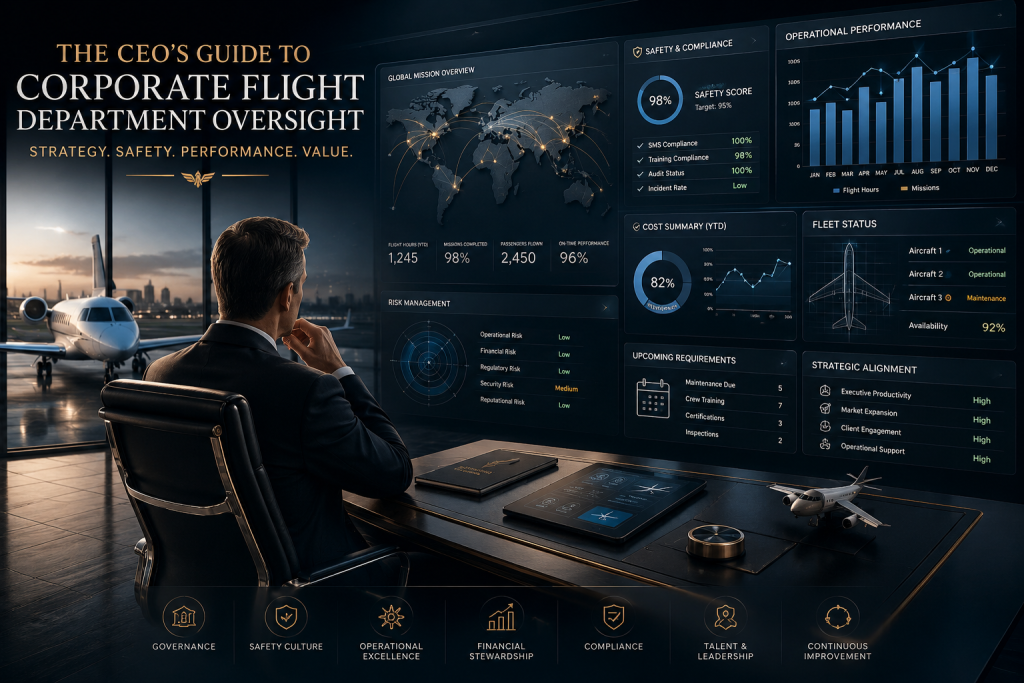
Corporate aviation is one of the most valuable yet frequently misunderstood strategic assets within a modern enterprise. While many CEOs rely on their flight departments to support executive mobility, client engagement, operational continuity, and global expansion, relatively few fully understand how to oversee these aviation assets effectively.
Corporate Flight Department Oversight is not about managing pilots or approving fuel invoices. It is about ensuring that a critical business asset operates safely, efficiently, compliantly, and in alignment with corporate objectives. The most successful organizations treat their flight departments as strategic business units rather than transportation departments.
For CEOs, board members, family office principals, and corporate aircraft owners, understanding the fundamentals of aviation governance can significantly improve asset performance while reducing operational, financial, regulatory, and reputational risks.
By: PrivateJetio Aviation Advisory Team
Why Corporate Flight Department Oversight Matters
A corporate aircraft can represent a substantial investment. Depending on aircraft type, annual operating expenses may range from hundreds of thousands to several million dollars.
Without executive oversight, organizations can encounter challenges including:
- Rising operational costs
- Regulatory compliance failures
- Safety culture deterioration
- Underutilized aviation assets
- Vendor management inefficiencies
- Reputation risks
- Inadequate succession planning
Strong oversight helps leadership maintain visibility into performance while empowering aviation professionals to execute their responsibilities effectively.
The objective is not micromanagement. The objective is strategic governance.
Understanding the Modern Corporate Flight Department
Today’s corporate aviation departments are sophisticated operational organizations.
Depending on fleet size, a flight department may include:
- Chief Pilot
- Director of Aviation
- Maintenance Manager
- Safety Manager
- Dispatch Personnel
- Scheduling Coordinators
- Compliance Specialists
- Aircraft Technicians
- Security Personnel
Many larger organizations operate under comprehensive management systems comparable to commercial aviation environments.
The CEO’s role is not to manage daily activities but to ensure organizational alignment and accountability.
The CEO’s Strategic Responsibilities
Executive leadership should focus on several core oversight functions.
Defining Mission Objectives
Every aviation department must support a clearly defined business mission.
Questions CEOs should ask include:
- Why does the organization own or operate aircraft?
- What business objectives are being supported?
- Which stakeholders benefit from aircraft access?
- How is success measured?
Without clear mission criteria, aviation programs often drift toward convenience rather than strategic value.
Establishing Governance Structures
Effective oversight begins with governance.
Many leading organizations create formal aviation governance frameworks that include:
- Reporting structures
- Operational policies
- Risk management procedures
- Financial controls
- Safety oversight mechanisms
- Board reporting standards
Governance creates accountability while preserving operational independence.
Aligning Aviation With Corporate Strategy
Corporate aircraft should support broader organizational goals.
Examples include:
- Accelerating acquisitions
- Supporting global expansion
- Improving executive productivity
- Accessing remote facilities
- Enhancing customer engagement
- Supporting crisis response
Aircraft that do not directly support strategic objectives often become difficult to justify financially.
Building a Safety-First Culture
Safety remains the most important responsibility of any aviation operation.
A strong safety culture begins at the executive level.
Why Leadership Influences Safety
Employees often model behavior based on executive priorities.
If leadership consistently emphasizes schedule pressure, crews may feel compelled to take unnecessary risks.
Conversely, when executives emphasize safety above convenience, crews gain confidence in making conservative decisions.
The message should always be clear:
“No business objective justifies compromising aviation safety.”
Implementing Aviation Safety Management
Modern aviation organizations increasingly adopt formal aviation safety management systems.
A Safety Management System (SMS) provides structured processes for:
- Hazard identification
- Risk assessment
- Incident reporting
- Safety audits
- Corrective actions
- Continuous improvement
The CEO does not manage the SMS directly but should receive regular reporting on its effectiveness.
Safety Metrics CEOs Should Monitor
Useful indicators include:
- Incident reports
- Safety audit results
- Training completion rates
- Crew qualification status
- Regulatory findings
- Maintenance discrepancies
- Operational risk trends
Monitoring these metrics helps identify problems before they become significant events.
Financial Oversight Without Micromanagement
One of the most common executive mistakes is focusing exclusively on operating costs.
While cost management is important, aviation should be evaluated based on value creation rather than expense reduction alone.
Understanding Total Cost of Ownership
Corporate aircraft expenses extend beyond fuel and maintenance.
Key cost categories include:
- Aircraft acquisition
- Financing
- Insurance
- Crew salaries
- Training
- Maintenance
- Hangar expenses
- Navigation fees
- Regulatory compliance
- Technology upgrades
Comprehensive visibility allows executives to make informed decisions.
Evaluating Aircraft Utilization
Aircraft utilization is one of the most important performance indicators.
Questions include:
- How many annual flight hours are generated?
- Are aircraft meeting utilization targets?
- Are travel patterns changing?
- Is the fleet correctly sized?
Many organizations discover that changing mission profiles require fleet adjustments.
Benchmarking Against Industry Standards
Executives should regularly compare their operations against peer organizations.
Benchmarking can reveal opportunities related to:
- Maintenance costs
- Staffing levels
- Fuel efficiency
- Training expenses
- Scheduling practices
External aviation consultants often provide valuable benchmarking insights.
Understanding Flight Operations Performance
Strong flight operations management drives both safety and efficiency.
CEOs should understand how flight departments execute missions and manage operational complexity.
Key Flight Operations Metrics
Important performance indicators include:
- Mission completion rate
- Dispatch reliability
- Schedule adherence
- Crew availability
- Aircraft downtime
- Maintenance delays
These indicators provide visibility into operational effectiveness.
Avoiding Executive Scheduling Pressure
One of the most overlooked risks involves executive influence on flight scheduling.
Leadership should avoid creating pressure that encourages:
- Marginal weather decisions
- Fatigue-related risks
- Regulatory compromises
- Maintenance deferrals
Professional aviation teams must retain authority to decline unsafe operations.
Aviation Compliance and Regulatory Oversight
Corporate aviation operates within a highly regulated environment.
Failure to maintain aviation compliance can expose organizations to legal, financial, and reputational consequences.
Areas Requiring Oversight
Compliance responsibilities often include:
- Flight crew certification
- Aircraft maintenance requirements
- Operational documentation
- International flight regulations
- Customs procedures
- Security requirements
- Environmental regulations
Executives should receive periodic compliance summaries rather than relying on assumptions.
International Operations Challenges
Global aviation introduces additional complexity.
Issues may include:
- Airspace restrictions
- Sanctions compliance
- Permit requirements
- Security concerns
- Foreign tax obligations
Oversight becomes increasingly important as international operations expand.
Aviation Risk Management for Executive Leaders
Every aviation operation faces risk.
The goal is not eliminating risk but managing it intelligently.
Categories of Aviation Risk
Common exposure areas include:
Operational Risk
Associated with flight activities, maintenance, and crew performance.
Financial Risk
Related to aircraft values, financing, operating costs, and market fluctuations.
Regulatory Risk
Associated with compliance failures and changing regulations.
Security Risk
Including physical threats, cyber risks, and executive protection concerns.
Reputational Risk
Aviation incidents often receive significant media attention.
Developing an Executive Risk Dashboard
Many organizations benefit from a quarterly aviation risk review.
The dashboard may include:
- Safety trends
- Insurance updates
- Fleet condition assessments
- Compliance status
- Security evaluations
- Financial exposure summaries
This approach provides visibility without excessive administrative burden.
Aircraft Utilization and Strategic Asset Performance
Corporate aircraft should be viewed as business tools rather than luxury assets.
The key question is whether the aircraft supports enterprise value creation.
Measuring Strategic Return
Direct ROI calculations often fail to capture aviation’s full value.
Benefits may include:
- Executive productivity
- Faster decision-making
- Access to underserved markets
- Improved customer relationships
- Enhanced operational responsiveness
These factors frequently justify aircraft ownership beyond traditional financial analysis.
Evaluating Fleet Composition
Organizations should periodically review whether their aircraft match operational needs.
Factors to assess include:
- Passenger capacity
- Range requirements
- Mission frequency
- Operating economics
- Airport accessibility
Fleet optimization often generates significant long-term savings.
Human Capital Oversight
People ultimately determine aviation performance.
The quality of leadership, pilots, technicians, and support staff directly impacts outcomes.
Recruiting Aviation Talent
Competition for experienced aviation professionals continues to intensify.
Flight departments should maintain strong strategies for:
- Pilot recruitment
- Technician recruitment
- Leadership development
- Succession planning
Executive attention to talent strategy can prevent future operational disruptions.
Training and Professional Development
Continuous training remains essential.
Areas include:
- Simulator training
- Safety programs
- Leadership development
- Regulatory updates
- Emergency response preparation
Organizations that invest in professional development often experience stronger operational performance.
Technology and Data-Driven Decision Making
Modern flight departments increasingly rely on sophisticated technology platforms.
Emerging Technologies
Examples include:
- Flight data monitoring systems
- Predictive maintenance software
- Artificial intelligence analytics
- Crew scheduling systems
- Safety reporting platforms
- Operational dashboards
These tools provide valuable visibility for both aviation managers and executive leadership.
Executive Reporting Frameworks
CEOs should receive concise, actionable reports rather than excessive operational detail.
An effective monthly aviation report may include:
- Safety performance
- Utilization statistics
- Financial summary
- Compliance status
- Strategic initiatives
- Emerging risks
The goal is informed oversight rather than information overload.
Working Effectively With the Director of Aviation
The Director of Aviation serves as the bridge between executive leadership and operational execution.
A productive relationship requires:
- Clear expectations
- Defined authority
- Consistent communication
- Mutual trust
- Strategic alignment
CEOs should evaluate aviation leaders based on outcomes rather than daily activity.
Strong aviation directors typically excel at balancing safety, service quality, operational efficiency, and fiscal responsibility.
When CEOs Should Engage External Aviation Advisors
Independent advisors provide valuable perspectives that internal teams may not always offer.
Common situations include:
- Aircraft acquisitions
- Aircraft sales
- Fleet modernization
- Flight department audits
- Safety assessments
- Cost optimization projects
- Succession planning
- Strategic aviation reviews
Independent expertise often reveals opportunities and risks that would otherwise remain hidden.
Common Oversight Mistakes CEOs Make
Several recurring errors appear across corporate aviation programs.
Treating Aviation as a Luxury
Corporate aircraft should be evaluated as strategic assets, not executive perks.
Focusing Only on Costs
Cost reduction without strategic analysis can weaken operational capability.
Ignoring Safety Indicators
Safety trends require continuous attention even when no incidents occur.
Allowing Informal Governance
Lack of structure often creates accountability gaps.
Delaying Fleet Decisions
Waiting too long to modernize aircraft can increase costs and operational risks.
Recognizing these pitfalls helps leadership improve long-term outcomes.
A CEO Oversight Framework
A practical oversight framework can be summarized into five areas:
- Safety and culture
- Financial performance
- Strategic alignment
- Regulatory compliance
- Risk management
When these areas receive consistent attention, flight departments typically deliver superior results.
Organizations with mature aviation governance frequently achieve better safety outcomes, stronger financial performance, and greater executive confidence.
Conclusion
Corporate Flight Department Oversight is not about becoming an aviation expert. It is about becoming an informed executive sponsor of a critical business asset.
The most successful CEOs understand that aviation creates value when it operates safely, strategically, and efficiently. They establish governance structures, demand accountability, monitor key performance indicators, and empower qualified aviation professionals to execute the mission.
Whether managing a single business aircraft or a global fleet, leadership involvement remains one of the strongest predictors of long-term aviation success.
For organizations evaluating fleet strategy, governance frameworks, aircraft acquisitions, or operational optimization, a professional aviation advisory review can provide the independent insight needed to align aviation assets with broader business objectives and maximize long-term value.
Frequently Asked Questions
What is Corporate Flight Department Oversight?
Corporate Flight Department Oversight refers to the executive governance, strategic direction, financial monitoring, safety supervision, and risk management of a company’s aviation operations. It focuses on accountability rather than daily operational management.
How often should a CEO review flight department performance?
Most organizations benefit from monthly operational reporting and quarterly strategic reviews. Larger aviation departments may require more frequent executive engagement depending on fleet size and operational complexity.
What metrics matter most in corporate aviation?
Safety performance, aircraft utilization, dispatch reliability, regulatory compliance, maintenance status, and total operating cost are among the most important indicators for executive oversight.
Should a company own or outsource its flight department?
The answer depends on mission requirements, utilization levels, budget considerations, and strategic objectives. Independent aviation advisory assessments can help determine the most efficient structure.
Why is an independent aviation consultant valuable?
Independent advisors provide objective evaluations of fleet strategy, operational efficiency, compliance, safety programs, acquisitions, and asset value. Their external perspective often identifies opportunities and risks that internal teams may overlook.
References:
- National Business Aviation Association (NBAA)
https://nbaa.org - International Business Aviation Council (IBAC)
https://ibac.org - Federal Aviation Administration – Safety Management Systems
https://www.faa.gov - International Civil Aviation Organization (ICAO) Safety Management Manual
https://www.icao.int - European Union Aviation Safety Agency (EASA)
https://www.easa.europa.eu


