
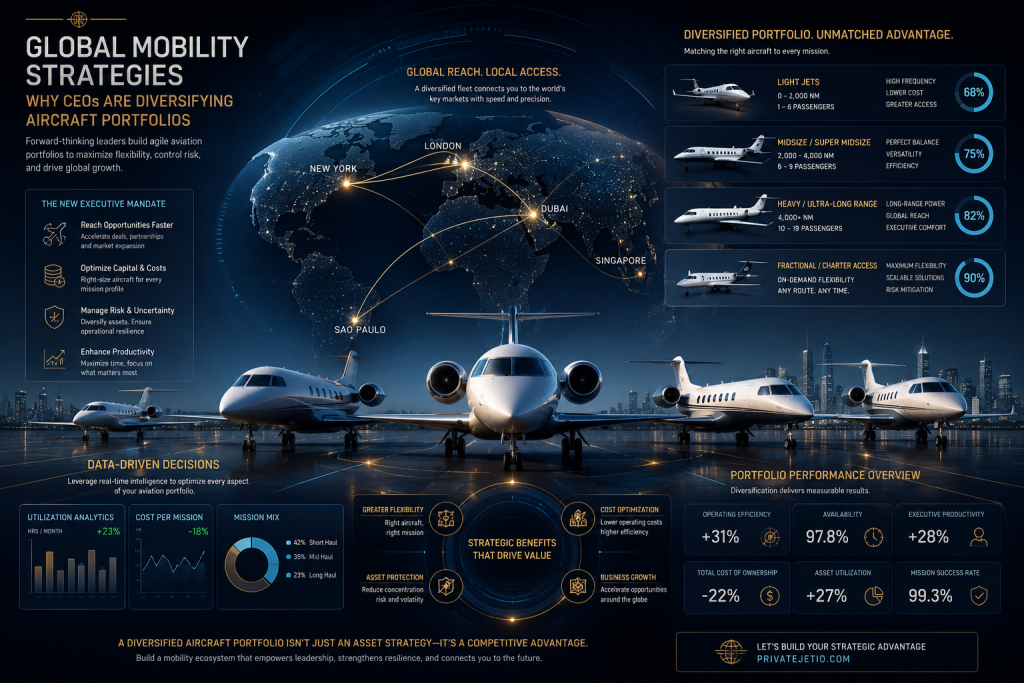
In today’s interconnected economy, executive mobility has become a strategic advantage rather than a transportation convenience. Corporate leaders, family offices, private investors, and multinational organizations increasingly recognize that relying on a single aircraft type can limit operational flexibility, increase costs, and create unnecessary exposure to market shifts.
As a result, a growing number of CEOs are embracing aircraft portfolio diversification. Instead of owning or accessing one aircraft for every mission profile, they are building sophisticated aviation ecosystems designed to maximize efficiency, flexibility, security, and long-term value.
This shift reflects a broader evolution in business aviation strategy. Modern aviation decision-makers are treating aircraft assets much like financial portfolios—balancing risk, performance, utilization, and future market conditions. The result is a smarter approach to global mobility solutions that aligns aviation resources with organizational objectives.
The question is no longer whether diversification makes sense. The question is how leading executives are implementing it and what lessons can be applied by prospective aircraft owners and aviation investors.
By: PrivateJetio Aviation Advisory Team
The Evolution of Executive Mobility
Twenty years ago, many organizations viewed private aircraft ownership primarily as a status symbol. Today, the perspective is fundamentally different.
For global enterprises, mobility directly impacts:
- Revenue generation
- Executive productivity
- Deal execution
- Market expansion
- Risk management
- Talent retention
- Competitive advantage
As international business environments become increasingly complex, aircraft ownership structures have evolved accordingly.
Modern executives frequently operate across multiple continents within a single week. Their travel requirements vary dramatically depending on mission objectives.
One day may require a short regional trip involving several stops. The next may demand nonstop intercontinental capability. A single aircraft often struggles to perform both missions efficiently.
This reality is driving the emergence of aircraft portfolio diversification as a cornerstone of modern corporate mobility planning.
Why a Single Aircraft Strategy Is Becoming Obsolete
The traditional model centered around purchasing one aircraft and using it for every mission profile.
While straightforward, this approach creates several challenges.
Mission Mismatch
Every aircraft is designed for specific operational parameters.
An ultra-long-range jet excels at crossing oceans but may be inefficient for short domestic flights.
A light jet may provide excellent operating economics for regional missions but lack the range necessary for international travel.
When one aircraft attempts to cover every requirement, compromises become unavoidable.
Underutilized Capital
Aircraft ownership requires significant capital deployment.
Purchasing a single high-capability aircraft to perform occasional long-range missions often means overpaying for everyday travel requirements.
Executives increasingly recognize that capital efficiency matters just as much in aviation as it does elsewhere in the balance sheet.
Operational Limitations
Unexpected maintenance events can ground an aircraft without warning.
When organizations rely exclusively on one asset, travel disruptions can create significant operational consequences.
Diversification introduces redundancy and resilience.
Market Exposure
Aircraft values fluctuate according to supply, demand, technology cycles, regulatory changes, and macroeconomic conditions.
Concentrating all aviation exposure into one aircraft model creates unnecessary risk.
Many sophisticated owners now approach aviation investment through a portfolio mindset that distributes exposure across multiple asset categories.
Understanding Aircraft Portfolio Diversification
Aircraft portfolio diversification involves combining multiple aviation solutions rather than relying on a single ownership model or aircraft category.
The structure varies according to organizational requirements.
Examples may include:
- Light jet ownership
- Super midsize aircraft ownership
- Ultra-long-range aircraft ownership
- Fractional ownership programs
- Strategic charter utilization
- Jet card programs
- Aircraft leasing arrangements
The objective is not necessarily owning more aircraft.
The objective is creating the optimal mobility ecosystem.
A CEO who flies regionally three times per week and internationally twice per month may benefit from entirely different assets for each mission type.
The resulting framework often delivers superior economics and operational flexibility.
The Rise of Multi-Aircraft Thinking Among Global CEOs
Several market trends are accelerating diversification.
International Expansion
Organizations increasingly operate across multiple jurisdictions.
Executive teams regularly travel between North America, Europe, the Middle East, and Asia-Pacific markets.
Different routes require different capabilities.
A diversified portfolio enables organizations to deploy the right aircraft for the right mission.
Time Sensitivity
Modern executives face unprecedented demands on their schedules.
Travel delays can impact acquisitions, investor meetings, board sessions, regulatory discussions, and client relationships.
The ability to optimize each trip improves productivity and organizational responsiveness.
Geopolitical Uncertainty
Political instability, sanctions environments, regional conflicts, and changing regulatory frameworks continue influencing global business operations.
Aircraft asset management strategies increasingly incorporate flexibility to adapt quickly to evolving circumstances.
Diversification provides optionality.
Optionality often becomes invaluable during periods of uncertainty.
Increased Aviation Sophistication
Corporate leaders today have access to far more data than previous generations of aircraft owners.
Advanced analytics enable decision-makers to evaluate:
- Utilization patterns
- Mission profiles
- Cost structures
- Residual value forecasts
- Market liquidity
- Fleet optimization opportunities
This data-driven approach naturally encourages portfolio diversification.
Fleet Optimization as a Competitive Advantage
One of the most compelling reasons executives diversify is fleet optimization.
Rather than forcing one aircraft into multiple roles, organizations assign assets based on mission requirements.
Consider a multinational company with three categories of travel:
Regional Executive Travel
Short flights under two hours.
Ideal aircraft:
- Light jets
- Very light jets
- Turboprops in specific markets
Benefits include lower operating costs and improved airport accessibility.
Continental Business Missions
Medium-distance travel involving management teams and client visits.
Ideal aircraft:
- Midsize jets
- Super midsize jets
These aircraft provide excellent balance between range and operating efficiency.
Intercontinental Strategic Travel
Long-range missions involving senior leadership and international expansion efforts.
Ideal aircraft:
- Ultra-long-range business jets
Examples include aircraft produced by major manufacturers such as Gulfstream Aerospace, Bombardier, and Dassault Aviation.
Using each category appropriately reduces costs while improving mission effectiveness.
The result is enhanced corporate travel efficiency and stronger returns on aviation investments.
The Financial Logic Behind Diversification
Many executives initially assume diversification increases costs.
In practice, the opposite frequently occurs.
Better Asset Utilization
Aircraft that closely match mission profiles tend to achieve better utilization rates.
Higher utilization improves overall return on capital invested.
Reduced Operating Costs
Using an ultra-long-range aircraft for short regional trips can be remarkably inefficient.
Deploying smaller aircraft where appropriate significantly reduces operating expenses.
Improved Residual Value Protection
Different aircraft categories respond differently to market cycles.
A diversified aviation portfolio may reduce concentration risk and improve long-term value preservation.
Greater Flexibility During Market Changes
Aviation markets experience cyclical fluctuations.
Diversification enables owners to adapt more effectively to changing conditions without being tied to a single asset strategy.
The Family Office Perspective
Family offices represent one of the fastest-growing segments embracing aircraft portfolio diversification.
Unlike public corporations, family offices often focus on multi-generational wealth preservation.
Their mobility requirements may include:
- Business travel
- Personal travel
- Asset inspections
- Investment due diligence
- Philanthropic activities
- International residency planning
These varied requirements make diversification particularly attractive.
Instead of concentrating resources into one aircraft, family offices increasingly combine ownership, charter access, and fractional solutions to create flexible mobility platforms.
This approach aligns aviation assets with broader wealth management objectives while enhancing global mobility solutions.
Aircraft Asset Management in the New Aviation Economy
The aviation landscape has changed dramatically over the last decade. Supply chain disruptions, fluctuating interest rates, geopolitical uncertainty, and evolving technology have altered how sophisticated buyers evaluate aircraft ownership.
Today, aircraft asset management is no longer simply about purchasing and operating an aircraft. It involves active portfolio oversight, strategic planning, lifecycle management, and risk mitigation.
Leading CEOs increasingly treat aviation assets similarly to investment portfolios.
They regularly assess:
- Asset performance
- Utilization efficiency
- Maintenance exposure
- Market liquidity
- Depreciation trends
- Replacement timelines
- Alternative ownership structures
This strategic mindset allows organizations to maximize value while maintaining mobility flexibility.
Aviation assets that once remained in service for decades are now evaluated against evolving business requirements and emerging technologies. As mobility needs change, portfolio structures change as well.
Diversification Through Ownership Models
Aircraft portfolio diversification does not necessarily require owning multiple aircraft outright.
Many organizations achieve diversification through a combination of ownership structures.
Full Ownership
Full ownership remains attractive for organizations with high utilization requirements and specific operational demands.
Advantages include:
- Complete control
- Scheduling flexibility
- Brand consistency
- Custom cabin configurations
However, full ownership also concentrates capital and operational risk.
Fractional Ownership
Fractional programs provide access to aircraft capacity without requiring full acquisition.
Benefits include:
- Lower capital commitment
- Predictable costs
- Professional management
- Access to multiple aircraft types
For many executives, fractional programs serve as an important component of broader diversification strategies.
Charter Solutions
Strategic charter utilization allows organizations to access aircraft precisely when needed.
Charter can be particularly effective for:
- Seasonal demand
- Special missions
- New market exploration
- Backup capacity
Many diversified portfolios incorporate charter as a flexible capacity layer.
Leasing Structures
Leasing provides another method of maintaining mobility while preserving capital flexibility.
In uncertain market environments, leasing can offer attractive risk-adjusted benefits.
Combining these ownership structures often creates a more resilient mobility framework than relying exclusively on one approach.
Why Global Expansion Is Driving Portfolio Complexity
Modern enterprises rarely operate within a single geographic region.
A CEO headquartered in New York may have operations in London, Dubai, Singapore, and São Paulo.
Each region presents unique aviation requirements.
Airport infrastructure, runway limitations, customs procedures, fuel availability, and regulatory frameworks all influence aircraft selection.
As global operations expand, executives increasingly discover that one aircraft cannot efficiently address every requirement.
This is especially true for organizations pursuing aggressive international growth strategies.
Aircraft portfolio diversification enables leadership teams to adapt mobility resources to diverse regional demands while maintaining operational efficiency.
The Role of Risk Management
Every major strategic decision involves risk.
Aviation is no exception.
Many executives underestimate the concentration risk associated with single-aircraft strategies.
Potential risks include:
- Maintenance downtime
- Regulatory changes
- Technological obsolescence
- Depreciation exposure
- Market liquidity challenges
- Operational limitations
Diversification reduces dependence on any one asset, manufacturer, or operational structure.
This principle mirrors successful investment portfolio design.
No experienced investor allocates all capital to a single stock.
Likewise, sophisticated aviation leaders increasingly avoid concentrating all mobility resources into one aircraft.
Private Jet Acquisition Has Become More Strategic
Historically, private jet acquisition often focused on prestige, cabin aesthetics, and headline performance metrics.
Today, acquisition decisions are becoming significantly more analytical.
Sophisticated buyers evaluate:
Mission Alignment
How closely does the aircraft match actual travel requirements?
Utilization Forecasts
Will the aircraft be used efficiently over time?
Lifecycle Economics
What will ownership costs look like over ten years?
Residual Value Potential
How likely is the aircraft to retain value?
Market Liquidity
How easily can the aircraft be sold or traded in the future?
These considerations have transformed acquisition from a standalone purchase decision into a component of a broader mobility strategy.
Technology Is Accelerating Diversification
Technology plays an increasingly important role in business aviation strategy.
Advanced analytics platforms now provide unprecedented visibility into operational performance.
Organizations can track:
- Flight patterns
- Passenger utilization
- Fuel consumption
- Route economics
- Maintenance trends
- Market valuations
This information enables more informed decisions regarding fleet optimization.
Executives can identify underperforming assets, improve utilization rates, and adjust portfolio structures based on objective data rather than assumptions.
Technology is also improving access to alternative mobility solutions.
Digital charter platforms, integrated scheduling systems, and predictive maintenance tools are making diversified strategies easier to manage than ever before.
Sustainability Considerations and Portfolio Design
Environmental responsibility is becoming an important consideration in executive aviation.
While private aviation remains a critical business tool, organizations increasingly seek ways to reduce environmental impact without sacrificing mobility.
Diversification can support sustainability goals.
Examples include:
- Deploying smaller aircraft for short missions
- Reducing unnecessary fuel consumption
- Optimizing route planning
- Incorporating newer aircraft technologies
- Leveraging sustainable aviation fuel opportunities
Organizations that align mobility strategies with environmental objectives often achieve both operational and reputational benefits.
As sustainability expectations continue evolving, diversified aviation portfolios may become even more valuable.
How Leading CEOs Evaluate Mobility Performance
Successful aviation leaders measure outcomes rather than focusing solely on aircraft ownership.
Key performance indicators frequently include:
Executive Time Saved
Time remains the most valuable executive resource.
Mobility solutions should maximize productive hours.
Deal Velocity
Can leadership teams reach opportunities faster than competitors?
Geographic Reach
How effectively can executives access emerging markets?
Cost Per Mission
Are resources being deployed efficiently?
Strategic Flexibility
Can the organization adapt quickly to changing circumstances?
These metrics shift the conversation away from aircraft ownership and toward business outcomes.
The aircraft becomes a strategic tool rather than an isolated asset.
The Emergence of the Aviation Portfolio Manager
A growing trend among large organizations and family offices is the appointment of dedicated aviation advisors or portfolio managers.
These specialists oversee:
- Acquisition decisions
- Asset sales
- Charter integration
- Utilization analysis
- Cost optimization
- Market intelligence
- Strategic planning
Their objective is not simply to manage aircraft.
Their objective is to maximize mobility value.
This approach reflects the increasing sophistication of private aviation consulting services across the global market.
Common Diversification Mistakes
Despite the benefits, diversification requires careful planning.
Several mistakes occur frequently.
Buying Too Much Aircraft
Many organizations acquire aircraft with capabilities they rarely use.
This creates unnecessary costs and inefficient capital deployment.
Ignoring Actual Mission Data
Assumptions often differ from reality.
Historical travel data should guide portfolio decisions.
Overlooking Secondary Market Dynamics
Aircraft values can vary significantly between categories and market cycles.
Understanding liquidity trends is essential.
Focusing Solely on Acquisition Cost
Operating expenses, maintenance reserves, crew costs, and future disposition value are equally important.
Lacking a Long-Term Strategy
Diversification works best when aligned with broader business objectives.
Without a clear strategy, portfolios can become unnecessarily complex.
What the Future Looks Like
Several trends suggest aircraft portfolio diversification will continue accelerating over the coming decade.
These include:
- Increased globalization.
- Greater executive travel demands.
- More sophisticated aviation analytics.
- Growing emphasis on flexibility.
- Continued development of alternative ownership models.
- Enhanced sustainability requirements.
- Rapid technological innovation.
- Increased market volatility.
Collectively, these forces favor adaptive, diversified mobility strategies over traditional single-aircraft approaches.
Organizations that embrace this evolution will likely gain advantages in efficiency, resilience, and long-term value creation.
For CEOs, mobility is increasingly viewed as a strategic infrastructure asset.
Just as companies diversify investments, supply chains, and market exposure, they are now diversifying aviation resources.
The result is greater operational agility in an increasingly complex world.
Building an Effective Aircraft Portfolio Diversification Strategy
Developing a successful aircraft portfolio diversification plan requires a structured approach rather than ad hoc acquisitions.
The most successful aviation programs typically begin with a comprehensive mobility assessment.
Organizations should first understand how executives travel today and how those requirements are likely to evolve over the next five to ten years.
Key questions include:
- Which routes are flown most frequently?
- What percentage of missions are domestic versus international?
- How many passengers typically travel?
- What airports are most commonly used?
- What level of scheduling flexibility is required?
- How important is redundancy during maintenance events?
The answers provide the foundation for a portfolio that supports long-term business objectives.
Many organizations discover that their actual travel patterns differ significantly from what they initially assumed.
Data-driven planning often reveals opportunities to improve efficiency while reducing costs.
The Competitive Advantage of Mobility
In highly competitive industries, mobility itself can become a strategic differentiator.
Companies capable of reaching clients, partners, facilities, and investment opportunities faster than competitors frequently gain advantages that extend far beyond transportation.
Executive mobility influences:
- Mergers and acquisitions activity
- Investor relations
- Market expansion
- Crisis response
- Client retention
- Strategic partnerships
A well-designed aviation portfolio allows leadership teams to operate at a higher level of responsiveness.
When opportunities emerge, speed matters.
The ability to place decision-makers anywhere in the world quickly and efficiently often creates measurable business value.
This is one reason why aircraft portfolio diversification has become increasingly common among multinational corporations, family offices, private equity firms, and ultra-high-net-worth individuals.
When Diversification Makes the Most Sense
Not every organization requires a complex aviation portfolio.
However, diversification becomes increasingly attractive under several circumstances.
Rapid International Growth
Organizations expanding into multiple regions often require a broader range of mobility solutions.
High Executive Travel Volume
Frequent travel creates opportunities to optimize costs and improve utilization.
Multiple Mission Profiles
Different types of travel frequently justify different aircraft capabilities.
Capital Preservation Priorities
Diversified structures can improve financial flexibility and reduce concentration risk.
Long-Term Aviation Planning
Organizations viewing aviation as a strategic asset rather than a transportation expense often benefit most from diversification.
The key is alignment.
Every aircraft, ownership structure, and mobility solution should support clearly defined organizational goals.
Conclusion
Executive aviation is entering a new era.
The traditional model of relying on a single aircraft for every mission is increasingly being replaced by more sophisticated, flexible, and financially efficient approaches.
Aircraft Portfolio Diversification reflects a broader shift in how modern leaders think about mobility. Rather than viewing aircraft as standalone purchases, CEOs now evaluate them as strategic assets within a larger ecosystem designed to support growth, resilience, and global reach.
By combining appropriate ownership structures, aligning assets with mission requirements, and leveraging data-driven decision-making, organizations can improve corporate travel efficiency while protecting long-term value.
The future of executive mobility belongs to those who embrace flexibility.
The most successful aviation programs will not necessarily own the most aircraft. They will own, access, and manage the right aviation resources at the right time for the right mission.
For executives, investors, family offices, and private jet owners seeking to optimize their mobility strategy, diversification is no longer simply an option.
It is rapidly becoming a competitive necessity.
Executive Consultation
Private Jetio provides independent private aviation consulting for buyers, owners, investors, family offices, and corporate decision-makers seeking objective guidance on aircraft acquisition, aviation investment strategy, fleet optimization, aircraft asset management, and long-term mobility planning.
Whether you are evaluating your first aircraft or restructuring an existing aviation portfolio, our advisory team can help you make informed decisions based on operational requirements, financial objectives, and market intelligence.
Request a confidential consultation to explore the optimal mobility strategy for your organization.
Frequently Asked Questions
Why are CEOs diversifying aircraft portfolios?
CEOs are diversifying aircraft portfolios to improve flexibility, reduce operational risk, optimize costs, and align aviation resources with different mission requirements. Diversification also improves resilience during maintenance events and market fluctuations.
Does aircraft portfolio diversification require owning multiple jets?
No. Diversification can include a mix of ownership, fractional programs, leasing arrangements, charter access, and jet card memberships. The objective is flexibility rather than simply increasing the number of aircraft owned.
What are the financial benefits of diversification?
Benefits may include better asset utilization, lower operating costs, improved capital efficiency, stronger residual value protection, and reduced exposure to market volatility.
How do family offices use diversified aviation strategies?
Family offices often combine ownership and access solutions to support business travel, personal travel, investment activities, and international operations while preserving long-term capital flexibility.
When should a company consider reviewing its aviation portfolio?
Organizations should review their aviation strategy whenever travel patterns change, international expansion occurs, executive travel increases, or major aircraft acquisition decisions are being considered.
References:
National Business Aviation Association (NBAA)
https://nbaa.org
General Aviation Manufacturers Association (GAMA)
https://gama.aero
International Business Aviation Council (IBAC)
https://ibac.org
Federal Aviation Administration – Business Aviation Resources
https://www.faa.gov
European Business Aviation Association (EBAA)
https://www.ebaa.org
Aircraft Owners and Pilots Association (AOPA)
https://www.aopa.org


