
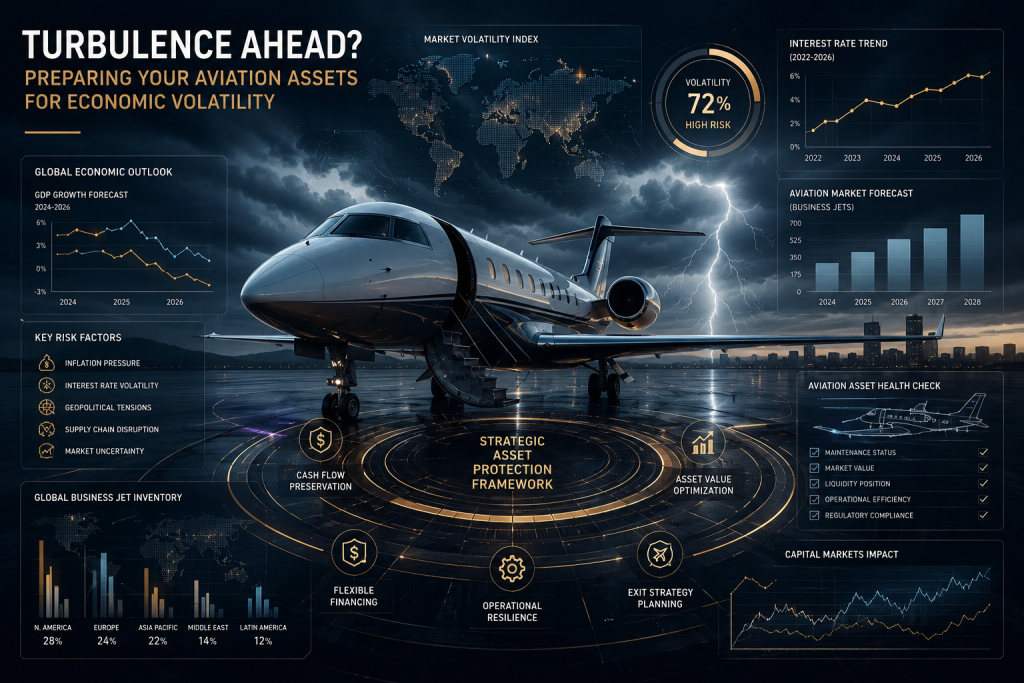
Economic cycles are inevitable. Expansion eventually gives way to contraction, capital becomes more expensive, liquidity tightens, and even the world’s most sophisticated investors begin reassessing their exposure to risk. For private aircraft owners, family offices, corporate flight departments, and aviation investment groups, these periods create both challenges and opportunities.
The difference between preserving millions in value and suffering significant losses often comes down to preparation. Aviation assets represent substantial capital commitments, and during periods of economic uncertainty, strategic planning becomes essential. The owners who emerge strongest from market volatility are rarely the ones who react the fastest they are the ones who prepared before turbulence arrived.
Whether you own a single private jet, manage a diversified fleet, or are considering an aircraft acquisition strategy in the coming years, understanding how economic volatility affects aviation assets can help you protect wealth, maintain flexibility, and capitalize on opportunities when others are forced into defensive positions.
By: PrivateJetio Aviation Advisory Team
Why Economic Volatility Matters in Aviation
Aviation has always been influenced by macroeconomic conditions. Interest rates, corporate profitability, global trade activity, geopolitical stability, and capital market performance all influence aircraft demand and valuation.
Unlike many traditional assets, aircraft occupy a unique position. They are operational tools, lifestyle assets, business productivity enhancers, and financial instruments simultaneously.
When economic conditions deteriorate, several factors typically emerge:
- Reduced corporate spending
- Higher financing costs
- Increased asset supply
- Longer transaction timelines
- Greater scrutiny from lenders
- Shifting charter demand
- Pressure on residual values
However, not all aircraft categories experience downturns equally.
Historically, premium long-range business jets often demonstrate stronger resilience than older, less efficient aircraft. Owners and operators seeking reliability, fuel efficiency, and global capability continue to prioritize top-tier assets even during periods of uncertainty.
Understanding these distinctions is the first step toward effective aviation asset management.
The Hidden Risks Facing Aircraft Owners
Many owners focus primarily on acquisition costs and operating expenses. During stable markets, this approach may seem sufficient.
During volatile periods, however, several hidden risks can rapidly emerge.
Liquidity Risk
Aircraft are valuable assets, but they are not highly liquid.
Selling a private jet quickly often requires price concessions. During economic downturns, buyers gain negotiating leverage, which can pressure sellers into accepting lower valuations than anticipated.
An owner who unexpectedly requires liquidity may discover that converting an aircraft into cash takes considerably longer than expected.
Financing Risk
Aircraft financing becomes more challenging when interest rates rise or lending standards tighten.
Even highly qualified borrowers may encounter:
- Higher borrowing costs
- Increased down payment requirements
- Stricter underwriting
- Reduced loan availability
Owners approaching refinancing deadlines may face materially different financing environments than those that existed when the aircraft was originally acquired.
Residual Value Risk
Aircraft depreciation is rarely linear.
Market sentiment, technological advancements, regulatory changes, and economic conditions can significantly affect future values.
A jet that appears attractive today may experience accelerated depreciation if newer models introduce substantial efficiency improvements.
Operational Cost Inflation
Periods of economic instability frequently coincide with inflationary pressures.
Aircraft owners may face rising costs related to:
- Fuel
- Maintenance
- Crew compensation
- Insurance
- Hangar space
- Parts availability
Without proper planning, operating budgets can expand significantly faster than expected.
Understanding Aircraft Value Retention During Market Downturns
One of the most important concepts for aircraft owners is aircraft value retention.
Not all aircraft preserve value equally.
Several characteristics consistently support stronger long-term performance.
Modern Technology Platforms
Newer aircraft equipped with advanced avionics, efficient engines, and improved cabin technology often maintain demand even when broader markets weaken.
Buyers increasingly prioritize operational efficiency and reduced lifecycle costs.
Strong Manufacturer Support
Aircraft backed by manufacturers with robust global service networks typically perform better in secondary markets.
Availability of parts, maintenance expertise, and technical support contributes significantly to long-term valuation stability.
Global Demand Profile
Aircraft appealing to international buyers tend to have broader resale markets.
A larger buyer pool can improve transaction flexibility and help support values during weaker economic conditions.
Mission Flexibility
Jets capable of serving multiple operational requirements often demonstrate greater resilience.
Aircraft with strong range, passenger capacity, airport accessibility, and operating economics appeal to a wider range of potential buyers.
How Interest Rates Influence Aviation Assets
Interest rates affect virtually every segment of business aviation.
When borrowing costs rise, aircraft purchasing decisions become more complex.
For example, a financing structure that appeared highly attractive during low-rate environments may become significantly more expensive after several rate increases.
This affects:
- Monthly payments
- Total ownership costs
- Buyer demand
- Aircraft liquidity
- Residual values
Higher rates can temporarily suppress demand among marginal buyers, creating downward pressure on some aircraft categories.
However, sophisticated owners often use these periods strategically.
When competitors delay acquisitions due to financing concerns, well-capitalized buyers may gain access to better pricing, stronger negotiating leverage, and superior inventory selection.
Strategic Portfolio Thinking for Aircraft Owners
Many ultra-high-net-worth individuals view aircraft ownership through an operational lens.
Elite investors increasingly view aviation assets as part of a broader capital allocation framework.
This shift in perspective is becoming increasingly important.
An aircraft should not be evaluated solely based on acquisition price.
Instead, owners should consider:
- Capital preservation
- Opportunity cost
- Liquidity requirements
- Financing flexibility
- Tax considerations
- Operational value
- Exit strategy planning
When these variables are assessed collectively, better decisions typically emerge.
For example, retaining an aircraft may appear less expensive than replacing it. However, if maintenance costs are escalating and future residual values are deteriorating, replacement could represent the superior financial decision.
Conversely, purchasing a newer aircraft during a temporary market slowdown may provide long-term value advantages unavailable during peak market conditions.
The Importance of Aviation Asset Management
Professional aviation asset management has evolved dramatically over the past decade.
The most successful owners increasingly rely on specialized advisors who analyze both operational and financial dimensions of ownership.
Effective asset management includes:
Market Monitoring
Aviation market trends can change rapidly.
Monitoring supply levels, transaction activity, manufacturer production rates, and buyer behavior helps owners identify emerging opportunities and risks.
Maintenance Planning
Maintenance events significantly affect aircraft value.
Proactive planning reduces unexpected expenses while improving marketability.
Well-documented maintenance histories often command premium pricing.
Capital Structure Optimization
Debt structures should align with ownership objectives.
Regular reviews can identify opportunities to improve financing efficiency and reduce risk exposure.
Exit Planning
Many owners spend considerable effort evaluating acquisitions but devote little attention to disposition planning.
A clearly defined exit strategy can materially improve long-term financial outcomes.
The best time to plan an aircraft sale is often years before the transaction occurs.
Why Market Timing Is More Difficult Than Most Owners Realize
Many investors attempt to predict economic cycles.
Few succeed consistently.
Aircraft owners frequently ask:
“Should I buy now or wait?”
The more productive question is often:
“Is this aircraft aligned with my long-term objectives?”
Short-term economic forecasting is notoriously difficult.
Instead of attempting to perfectly time markets, sophisticated buyers focus on:
- Asset quality
- Financial flexibility
- Operational necessity
- Long-term ownership economics
- Risk-adjusted value
This approach generally produces superior outcomes over extended ownership periods.
Business Aviation During Economic Uncertainty
Interestingly, business aviation often demonstrates remarkable resilience compared to many luxury asset categories.
Several structural factors support demand.
Corporate leaders increasingly recognize the value of:
- Time efficiency
- Schedule control
- Security
- Operational flexibility
- Global mobility
Following recent global disruptions, many organizations reassessed transportation strategies and increased their reliance on private aviation solutions.
This trend has helped strengthen segments of the private jet market even during periods of broader economic uncertainty.
For many enterprises, private aircraft are no longer viewed as discretionary luxuries.
They are considered productivity assets that support strategic objectives and executive effectiveness.
The Emerging Role of Data in Aviation Decision-Making
Today’s aircraft owners have access to unprecedented amounts of information.
Advanced analytics now influence decisions involving:
- Fleet optimization
- Aircraft acquisition strategy
- Residual value forecasting
- Maintenance planning
- Charter utilization
- Capital deployment
Data-driven ownership models are replacing intuition-based decision making.
The owners who leverage reliable market intelligence often identify opportunities earlier and avoid costly mistakes that become apparent only after market conditions change.
Building a Defensive Aviation Strategy Before Volatility Strikes
The most successful aviation investors rarely wait for economic headlines before taking action.
They build resilience into their ownership structure long before markets become unstable.
A defensive aviation strategy does not mean avoiding growth or delaying investment decisions. It means creating flexibility that allows you to respond effectively regardless of market conditions.
Several principles consistently distinguish resilient aircraft owners from vulnerable ones.
Maintain Liquidity Reserves
Aircraft ownership is capital intensive.
Unexpected maintenance events, regulatory changes, operational disruptions, or acquisition opportunities can emerge at any time.
Maintaining adequate liquidity reserves allows owners to avoid forced decisions.
Owners with strong liquidity positions often gain access to attractive acquisition opportunities when other market participants are constrained.
Evaluate Financing Structures Regularly
Financing should never be viewed as a “set it and forget it” decision.
Interest rate environments evolve.
Lending markets change.
Corporate priorities shift.
Regular reviews of financing arrangements help identify opportunities to reduce risk and improve flexibility.
In volatile markets, financing structure can become just as important as aircraft selection.
Prioritize Operational Efficiency
Efficient aircraft often outperform less efficient alternatives during uncertain economic periods.
Fuel consumption, maintenance requirements, dispatch reliability, and crew costs all influence long-term ownership economics.
Aircraft that minimize operational inefficiencies frequently attract stronger buyer interest and maintain healthier residual values.
How Fleet Owners Should Think Differently
Owners managing multiple aircraft face a unique set of challenges.
While fleet diversification can create operational advantages, it can also introduce complexity during economic downturns.
Fleet operators should regularly evaluate:
Aircraft Utilization
Low-utilization assets can become significant financial burdens during periods of reduced demand.
Each aircraft should have a clearly defined mission profile and measurable operational value.
Fleet Redundancy
Some organizations maintain overlapping capabilities across multiple aircraft.
Economic volatility often creates opportunities to streamline fleets without sacrificing operational effectiveness.
Replacement Timing
Waiting too long to replace aging aircraft can increase maintenance exposure and accelerate depreciation.
At the same time, replacing aircraft too early may result in unnecessary capital expenditures.
Strategic timing remains essential.
Charter Integration
Some owners offset costs through charter activity.
A well-structured charter strategy can improve asset utilization and generate revenue streams that support ownership economics.
However, charter markets also experience cyclical fluctuations and should not be viewed as guaranteed sources of income.
Aircraft Acquisition Strategy During Economic Uncertainty
Conventional wisdom often suggests delaying major purchases during uncertain times.
In aviation, that approach is not always optimal.
Some of the strongest aircraft acquisitions in history occurred during periods of market dislocation.
When uncertainty increases:
- Competition among buyers may decline.
- Sellers may become more flexible.
- Negotiating leverage often improves.
- Inventory selection may expand.
- Transaction structures become more creative.
Sophisticated buyers focus on value rather than headlines.
Questions Every Buyer Should Ask
Before acquiring an aircraft during a volatile economic environment, consider:
- Does this aircraft support long-term mission requirements?
- Is the financing structure sustainable under different economic scenarios?
- How resilient is demand for this aircraft category?
- What is the expected maintenance profile over the next decade?
- How broad is the global buyer pool?
- What factors could affect future liquidity?
- What is the realistic exit strategy?
These questions often reveal risks and opportunities that are not visible in simple acquisition comparisons.
The Importance of Exit Planning
One of the most overlooked aspects of aircraft ownership is disposition strategy.
Many buyers devote extensive resources to acquisitions yet spend little time planning eventual exits.
Every aircraft acquisition should include a future sale strategy.
Understanding the Future Buyer
The strongest ownership decisions consider who is likely to purchase the aircraft years later.
Questions to evaluate include:
- Will the aircraft remain technologically relevant?
- Will operating costs remain competitive?
- Will regulatory changes affect demand?
- Will maintenance status support resale value?
- Will new aircraft models create competitive pressure?
Thinking like a future buyer often improves present-day acquisition decisions.
Timing the Exit
Perfect market timing is unrealistic.
However, understanding market cycles can improve outcomes.
Owners should monitor:
- Inventory levels
- Manufacturer production rates
- Interest rate trends
- Economic growth forecasts
- Secondary market activity
- Buyer sentiment
These indicators help identify favorable disposition windows.
Geopolitical Risks and Aviation Assets
Economic volatility rarely occurs in isolation.
Geopolitical developments increasingly influence aviation markets.
Sanctions, trade restrictions, regional conflicts, and regulatory changes can alter demand patterns almost overnight.
Aircraft owners operating internationally should evaluate:
Jurisdictional Exposure
Certain regions may become less attractive due to regulatory uncertainty or geopolitical tension.
Understanding jurisdictional risks helps protect asset value.
Cross-Border Operations
International operations introduce additional complexity.
Tax structures, registration considerations, compliance requirements, and operational restrictions all deserve careful review.
Supply Chain Vulnerability
Aircraft maintenance increasingly depends on global supply chains.
Disruptions affecting parts availability can influence both operational reliability and asset valuation.
Forward-thinking owners monitor these risks continuously.
Why Family Offices Are Taking Aviation More Seriously
Family offices have become increasingly sophisticated participants in business aviation.
Rather than viewing aircraft solely as transportation tools, many now evaluate them as strategic capital assets.
This shift reflects a broader trend toward integrated wealth management.
Modern family offices often analyze:
- Opportunity cost of capital
- Asset liquidity
- Risk-adjusted returns
- Operational value creation
- Tax efficiency
- Succession planning
This framework produces more disciplined ownership decisions.
It also reinforces the importance of professional advisory support.
The New Era of Private Jet Ownership
The private aviation sector continues to evolve.
Several trends are reshaping ownership decisions.
Technology-Driven Transparency
Market intelligence is becoming more accessible.
Buyers now have greater visibility into pricing, inventory, transaction trends, and operating costs.
This transparency rewards informed decision-making.
Sustainability Considerations
Environmental considerations increasingly influence corporate aviation strategies.
While business aviation remains essential for many organizations, sustainability initiatives are becoming part of long-term planning.
Global Mobility Demands
Executives, entrepreneurs, investors, and multinational organizations continue to prioritize mobility.
Access to global markets remains a strategic advantage.
As a result, high-quality aviation assets continue to play a critical role in wealth preservation and business productivity.
Common Mistakes Aircraft Owners Make During Economic Downturns
Economic uncertainty often exposes weaknesses in ownership strategies.
The most common mistakes include:
- Delaying necessary maintenance.
- Ignoring market intelligence.
- Overleveraging acquisitions.
- Failing to monitor aircraft value trends.
- Making emotionally driven selling decisions.
- Neglecting exit planning.
- Underestimating liquidity requirements.
Avoiding these mistakes can significantly improve long-term ownership outcomes.
A Practical Framework for Protecting Aviation Assets
Owners seeking to strengthen resilience should consider the following framework:
Step 1: Assess Current Exposure
Evaluate:
- Aircraft value
- Debt obligations
- Liquidity position
- Maintenance outlook
- Operational requirements
Step 2: Stress-Test Assumptions
Model potential scenarios involving:
- Higher interest rates
- Reduced aircraft demand
- Increased operating costs
- Longer sales timelines
Step 3: Optimize Capital Structure
Review financing, reserves, and ownership structures.
Identify opportunities to improve flexibility.
Step 4: Monitor Market Signals
Track:
- Inventory trends
- Transaction activity
- Manufacturer production rates
- Charter demand
- Economic indicators
Step 5: Develop an Exit Strategy
Document a realistic disposition plan before market conditions force action.
Owners who complete these steps typically enjoy greater confidence and stronger outcomes during periods of uncertainty.
Conclusion: Economic Volatility Creates Opportunity for the Prepared
Economic volatility is not a temporary anomaly. It is a permanent feature of global markets.
For owners of aviation assets, the objective should not be avoiding uncertainty. The objective should be preparing for it.
History consistently demonstrates that high-quality aircraft, disciplined ownership structures, sound financing strategies, and informed decision-making outperform reactive approaches.
Periods of market turbulence often separate strategic owners from speculative participants.
Those who understand aviation market trends, prioritize aircraft value retention, maintain financial flexibility, and follow a disciplined aircraft acquisition strategy position themselves to protect wealth while capitalizing on opportunities that emerge during uncertainty.
In aviation, as in investing, preparation is often the ultimate competitive advantage.
For aircraft owners, family offices, corporations, and aviation investors seeking clarity in uncertain markets, professional advisory guidance can provide the market intelligence, transaction expertise, and strategic perspective necessary to make confident decisions. The right strategy today may determine whether volatility becomes a threat or an opportunity.
FAQ
How do economic downturns affect private jet values?
Economic downturns can reduce buyer demand, increase inventory levels, and lengthen transaction timelines. However, premium aircraft with strong market demand often retain value better than older or less efficient models.
Should I delay purchasing a private jet during uncertain economic conditions?
Not necessarily. Economic uncertainty can create favorable buying opportunities, improved negotiating leverage, and access to premium inventory that may not be available during stronger market cycles.
What aircraft categories typically perform best during market volatility?
Modern, fuel-efficient, long-range business jets with strong manufacturer support networks often demonstrate greater resilience and stronger residual value performance.
How important is financing strategy during economic volatility?
Financing strategy becomes increasingly important when interest rates rise or lending conditions tighten. A well-structured financing arrangement can significantly reduce ownership risk.
Why is exit planning important for aircraft owners?
Exit planning helps maximize asset value, improve liquidity outcomes, and reduce exposure to adverse market conditions. The most successful aircraft transactions are often planned years in advance.
References:
National Business Aviation Association – Industry Resources
https://nbaa.org
General Aviation Manufacturers Association – Market Data and Industry Reports
https://gama.aero
International Civil Aviation Organization – Global Aviation Statistics and Policy
https://www.icao.int
Federal Aviation Administration – Aviation Forecasts and Economic Data
https://www.faa.gov/data_research/aviation
International Air Transport Association – Economic Reports and Industry Outlook
https://www.iata.org/en/publications/economics/


