
Introduction
Many aircraft owners focus heavily on acquisition price while overlooking the far larger financial commitment that follows delivery. In private aviation, the purchase transaction often represents only a fraction of the aircraft’s lifetime expense profile. The true financial challenge lies in managing the Private Jet Total Cost of Ownership over years of operation.
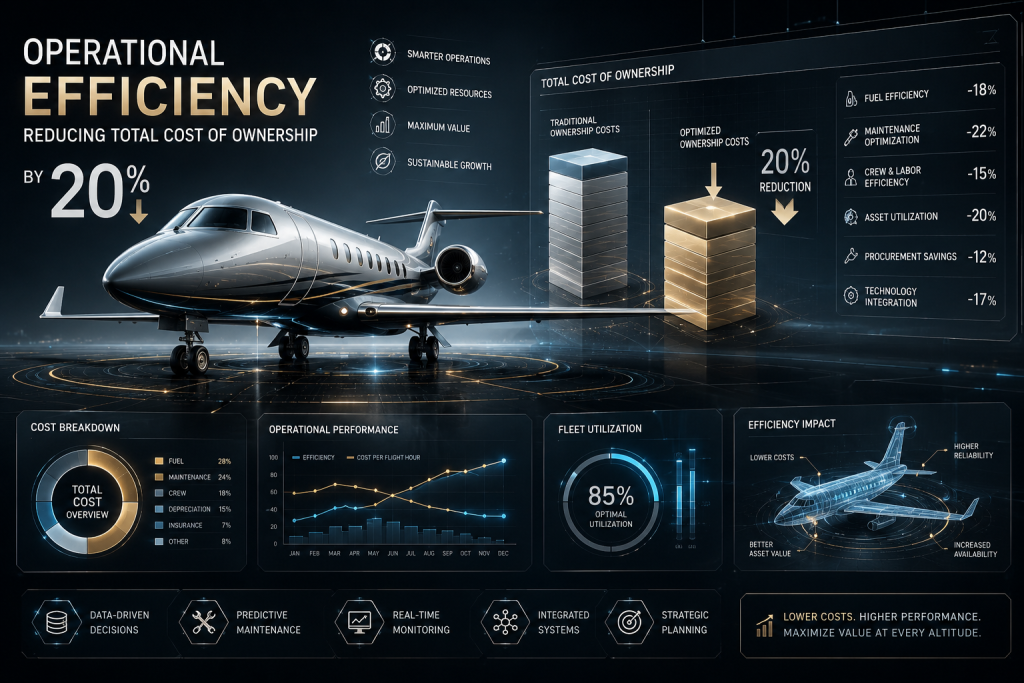
For owners, family offices, corporations, and aviation operators, improving operational efficiency can produce substantial savings without sacrificing safety, comfort, or mission capability. In fact, a carefully designed efficiency strategy can reduce ownership expenses by 20% or more over the lifecycle of an aircraft.
The difference between a well-managed aviation asset and an inefficient one can amount to millions of dollars. The most successful owners understand that reducing expenses is not about cutting corners. It is about making intelligent decisions across maintenance, utilization, crew management, fuel purchasing, asset planning, and operational oversight.
This article explores how sophisticated aircraft owners and aviation decision-makers can systematically reduce costs while maximizing performance, reliability, and long-term asset value.
By: PrivateJetio Aviation Advisory Team
Understanding the True Cost of Aircraft Ownership
Before reducing expenses, it is important to understand where costs originate.
Many first-time buyers assume ownership costs consist primarily of fuel, crew salaries, and hangar fees. While these expenses are significant, the actual cost structure is much broader.
Major ownership expenses include:
- Aircraft acquisition
- Financing costs
- Depreciation
- Insurance
- Crew compensation
- Maintenance programs
- Engine reserves
- Parts replacement
- Fuel expenses
- Hangar rental
- Navigation fees
- Regulatory compliance
- Software subscriptions
- Aircraft management services
- Training requirements
- Interior refurbishment
- Avionics upgrades
When viewed collectively, these categories create the complete Aircraft Lifecycle Costs profile.
Elite aircraft owners increasingly recognize that every operational decision influences long-term ownership economics.
Why Operational Efficiency Matters More Than Ever
The aviation industry has become significantly more sophisticated during the past decade.
Fuel volatility, supply chain disruptions, maintenance delays, labor shortages, and regulatory changes have increased operational complexity.
Owners who continue using traditional management models often experience:
- Escalating operating costs
- Reduced aircraft availability
- Higher maintenance surprises
- Increased downtime
- Lower residual value
By contrast, organizations focused on operational efficiency create measurable advantages.
These advantages include:
- Reduced direct operating expenses
- Improved aircraft utilization
- Better maintenance predictability
- Enhanced resale value
- Stronger safety performance
- Improved mission reliability
In practical terms, efficiency becomes a competitive financial strategy.
The 20% Cost Reduction Framework
Achieving a 20% reduction in ownership costs rarely comes from a single action.
Instead, it results from cumulative improvements across multiple categories.
The most effective framework includes:
- Maintenance optimization
- Fuel cost management
- Fleet optimization
- Crew efficiency improvements
- Utilization management
- Technology integration
- Strategic procurement
- Lifecycle planning
When implemented together, these measures often generate savings well beyond initial expectations.
Maintenance Optimization: The Largest Opportunity
For many aircraft owners, maintenance represents the most controllable cost category.
Unexpected maintenance events can dramatically increase annual expenses.
Sophisticated Maintenance Planning focuses on prevention rather than reaction.
Instead of waiting for failures to occur, leading operators use predictive strategies to identify issues before they become costly events.
Benefits include:
- Reduced unscheduled downtime
- Lower repair expenses
- Improved dispatch reliability
- Extended component life
- Enhanced resale value
A proactive maintenance strategy typically includes:
Predictive Maintenance Analytics
Modern aircraft generate enormous volumes of operational data.
This information can identify developing issues before they evolve into major failures.
Predictive analytics allows operators to:
- Monitor engine health
- Track component wear
- Forecast replacement cycles
- Schedule repairs efficiently
This reduces expensive aircraft-on-ground situations and minimizes operational disruption.
Long-Term Maintenance Programs
Many manufacturers offer comprehensive maintenance plans that convert unpredictable expenses into predictable budgets.
Examples include:
- Engine maintenance programs
- Airframe support plans
- Avionics protection programs
While these programs involve ongoing fees, they often reduce overall ownership risk and stabilize annual expenditures.
Strategic Downtime Scheduling
Aircraft that undergo maintenance during planned operational gaps avoid costly disruptions.
Elite operators align maintenance windows with travel schedules, reducing lost utilization and minimizing charter replacement requirements.
Fuel Management: One of the Fastest Ways to Save Money
Fuel remains one of the largest operating expenses in private aviation.
Even modest improvements can produce substantial savings over time.
Fuel Efficiency Programs have become essential tools for modern operators seeking cost control.
Smart Fuel Purchasing
Not all fuel providers offer identical pricing.
Strategic fuel procurement involves:
- Contract negotiations
- Fuel card programs
- Volume purchasing agreements
- Preferred supplier networks
Professional flight departments frequently save hundreds of thousands of dollars annually through optimized fuel purchasing alone.
Route Optimization
Advanced flight planning software can identify:
- More efficient routing
- Better altitude profiles
- Favorable wind conditions
- Reduced holding patterns
These improvements lower fuel consumption while reducing engine wear.
Weight Management
Every unnecessary pound carried onboard increases fuel burn.
Efficient operators regularly evaluate:
- Cabin inventory
- Equipment loads
- Catering requirements
- Excess baggage
Small reductions create meaningful annual savings.
Fleet Optimization and Asset Alignment
One of the most common ownership mistakes is operating the wrong aircraft for the mission.
Many owners purchase aircraft larger than their actual requirements.
While larger cabins may provide prestige, they also create:
- Higher fuel consumption
- Increased maintenance costs
- Larger crew requirements
- Greater insurance expenses
Fleet Optimization focuses on matching aircraft capability to mission demand.
Mission Profile Analysis
A detailed mission profile should evaluate:
- Passenger counts
- Typical trip lengths
- International requirements
- Airport accessibility
- Annual utilization
This analysis often reveals opportunities to right-size the fleet.
Mixed Fleet Strategies
Many organizations benefit from maintaining access to multiple aircraft categories.
For example:
- Light jets for regional missions
- Super midsize aircraft for business travel
- Long-range jets for intercontinental operations
This approach frequently delivers superior economics compared to operating a single large aircraft for every mission.
Charter Supplementation
In some cases, supplementing ownership with charter access creates greater efficiency.
Rather than acquiring additional aircraft, owners can leverage charter capacity during peak demand periods.
This reduces capital commitment while preserving flexibility.
Aviation Asset Management as a Strategic Discipline
Elite aviation organizations increasingly treat aircraft as financial assets rather than transportation tools.
This shift changes decision-making dramatically.
Effective Aviation Asset Management focuses on:
- Value preservation
- Lifecycle planning
- Capital allocation
- Market timing
- Residual value optimization
The objective is not simply operating the aircraft efficiently.
The objective is maximizing return on capital throughout the ownership cycle.
Monitoring Residual Value Drivers
Aircraft values are influenced by factors including:
- Maintenance status
- Engine program enrollment
- Cabin condition
- Avionics modernization
- Market demand
Owners who actively manage these variables frequently outperform the broader market when selling or upgrading aircraft.
Timing Major Upgrades
Not every upgrade creates value.
The best operators carefully evaluate whether modifications improve:
- Mission capability
- Marketability
- Operating economics
- Resale positioning
Strategic upgrades enhance asset value while avoiding unnecessary expenditures.
Building a High-Performance Flight Department
A highly efficient aircraft operation requires more than technology.
It requires disciplined management.
The most successful flight departments continuously monitor performance indicators, identify inefficiencies, and implement measurable improvements.
Key performance metrics often include:
- Cost per flight hour
- Dispatch reliability
- Maintenance events
- Fuel consumption
- Aircraft utilization
- Crew productivity
- Downtime percentage
This data-driven approach transforms operational decision-making from reactive to proactive.
The result is a more efficient organization, lower ownership costs, and a stronger long-term investment outcome.
Flight Department Efficiency: The Hidden Competitive Advantage
Many owners underestimate the financial impact of a well-managed flight department.
Aircraft, technology, and maintenance programs receive significant attention, yet human performance often determines whether an operation achieves efficiency targets.
Flight Department Efficiency is not about reducing personnel. It is about maximizing operational effectiveness while maintaining the highest safety standards.
The world’s most successful aviation organizations establish clear performance objectives, standardized procedures, and continuous improvement programs.
Standardized Operating Procedures
Consistency reduces risk and improves efficiency.
Standardized procedures help flight departments:
- Reduce operational errors
- Improve crew coordination
- Enhance scheduling efficiency
- Lower training costs
- Improve safety outcomes
When crews operate under clearly defined standards, organizations experience fewer costly disruptions and greater mission reliability.
Crew Scheduling Optimization
Crew management significantly affects ownership costs.
Advanced scheduling systems help operators:
- Minimize repositioning flights
- Reduce overtime expenses
- Improve crew utilization
- Ensure regulatory compliance
- Maintain crew satisfaction
Efficient scheduling often produces measurable cost reductions without impacting service quality.
Continuous Training and Development
Training should be viewed as an investment rather than an expense.
Highly trained crews typically:
- Consume less fuel through optimized operations
- Reduce maintenance-related incidents
- Improve passenger experience
- Increase dispatch reliability
Over time, these benefits contribute directly to lower operating expenses.
Leveraging Technology for Operational Excellence
Technology has transformed modern private aviation.
Owners who embrace digital tools gain visibility into operational performance and identify opportunities that were previously impossible to detect.
Data Analytics and Operational Intelligence
Today’s aircraft generate thousands of data points during every flight.
Advanced analytics platforms can evaluate:
- Fuel consumption patterns
- Maintenance trends
- Component performance
- Utilization metrics
- Operational costs
This information enables more informed decision-making and supports continuous improvement initiatives.
Integrated Management Platforms
Modern aviation software allows owners and operators to monitor:
- Flight schedules
- Maintenance status
- Financial performance
- Crew management
- Compliance requirements
Centralized visibility reduces administrative burden and improves operational control.
Artificial Intelligence and Predictive Planning
Emerging technologies are beginning to reshape private aviation management.
AI-powered systems can assist with:
- Predictive maintenance
- Fuel optimization
- Route planning
- Demand forecasting
- Risk assessment
While adoption remains in its early stages, the long-term efficiency potential is substantial.
Procurement Strategies That Reduce Ownership Costs
Aircraft owners frequently focus on major expenditures while overlooking procurement inefficiencies.
Strategic purchasing can significantly reduce annual operating expenses.
Vendor Consolidation
Working with a limited number of trusted vendors often produces:
- Better pricing
- Improved service levels
- Simplified administration
- Stronger negotiation leverage
Vendor relationships should be managed strategically rather than transactionally.
Long-Term Supplier Agreements
Multi-year agreements may generate savings across:
- Fuel purchasing
- Maintenance support
- Crew training
- Hangar services
- Aircraft management
Organizations with predictable requirements often secure favorable pricing through long-term commitments.
Competitive Benchmarking
Owners should regularly evaluate whether existing suppliers remain competitive.
Periodic benchmarking helps identify:
- Pricing disparities
- Service gaps
- Alternative providers
- Emerging market opportunities
Even modest procurement improvements can contribute significantly toward a 20% cost reduction objective.
The Role of Aircraft Utilization in Cost Efficiency
Aircraft utilization directly influences ownership economics.
An underutilized aircraft often carries the same fixed expenses as a heavily utilized one.
Consequently, understanding utilization patterns is essential.
Calculating Cost per Flight Hour
Many owners focus exclusively on annual expenses.
However, cost per flight hour provides a more meaningful performance metric.
Factors influencing cost per hour include:
- Fixed ownership costs
- Variable operating expenses
- Maintenance reserves
- Depreciation
- Financing costs
Increasing productive utilization often improves overall economic efficiency.
Balancing Utilization and Asset Preservation
More utilization is not always better.
Excessive usage may accelerate:
- Maintenance requirements
- Component wear
- Interior deterioration
- Residual value decline
The goal is optimized utilization rather than maximum utilization.
Strategic Charter Revenue
Certain owners offset ownership costs through carefully managed charter programs.
When structured correctly, charter activity may:
- Increase asset productivity
- Offset fixed expenses
- Improve overall economics
However, owners should carefully evaluate operational complexity, regulatory requirements, and long-term asset impact before pursuing this strategy.
Managing Depreciation as an Operational Strategy
Depreciation is often the largest single ownership expense.
Yet many owners treat it as an unavoidable outcome rather than a manageable variable.
The reality is that operational decisions directly affect depreciation rates.
Factors That Influence Aircraft Value
Residual value depends on numerous variables:
- Maintenance history
- Engine condition
- Aircraft age
- Cabin modernization
- Avionics relevance
- Market demand
- Documentation quality
Well-managed aircraft consistently command premium valuations.
Protecting Future Resale Performance
Owners should make decisions with future buyers in mind.
Questions worth asking include:
- Will this modification increase market appeal?
- Will maintenance records support a premium valuation?
- Does the aircraft remain competitive within its segment?
Small decisions made throughout ownership often produce significant differences at resale.
Risk Management and Cost Control
Unexpected events can quickly eliminate years of cost savings.
Effective risk management protects operational efficiency initiatives.
Insurance Optimization
Insurance represents a substantial ownership expense.
Periodic reviews can identify opportunities to:
- Improve coverage structure
- Adjust deductibles
- Eliminate unnecessary exposure
- Secure more competitive pricing
Insurance should align with operational realities rather than historical assumptions.
Regulatory Compliance
Compliance failures create direct and indirect costs.
Strong compliance programs reduce the risk of:
- Operational disruptions
- Financial penalties
- Reputational damage
- Increased insurance costs
Proactive compliance management supports long-term efficiency.
Business Continuity Planning
Operational interruptions can be extremely expensive.
Prepared organizations maintain contingency plans covering:
- Crew availability
- Maintenance disruptions
- Supply chain shortages
- Airport access limitations
Preparedness often determines how effectively operators navigate unexpected challenges.
Why Advisory-Led Ownership Outperforms Traditional Ownership
The most sophisticated aircraft owners increasingly rely on independent advisory services.
The reason is simple.
Aircraft acquisition and operation involve highly specialized decisions with long-term financial consequences.
Professional advisory support helps owners:
- Avoid acquisition mistakes
- Optimize fleet structure
- Improve maintenance strategy
- Reduce operating expenses
- Preserve asset value
- Strengthen negotiation outcomes
The advisory approach focuses on maximizing lifetime ownership performance rather than merely completing transactions.
For many owners, a single strategic decision can generate savings that exceed advisory fees many times over.
The Future of Operational Efficiency in Private Aviation
The next decade will reward owners who embrace data-driven decision-making.
Several trends are already reshaping the industry:
- Predictive maintenance systems
- Artificial intelligence applications
- Advanced operational analytics
- Sustainable aviation initiatives
- Digital asset management platforms
- Integrated fleet intelligence systems
Organizations that adopt these innovations early will likely enjoy lower operating costs, stronger asset performance, and greater market competitiveness.
The gap between sophisticated operators and traditional operators will continue to widen.
Conclusion
Reducing the Private Jet Total Cost of Ownership by 20% is not an unrealistic aspiration. It is an achievable objective for owners who approach aviation as a strategic business asset rather than a transportation expense.
Meaningful savings rarely come from a single initiative. They emerge through coordinated improvements across maintenance planning, fuel efficiency programs, aviation asset management, fleet optimization, procurement strategy, flight department efficiency, technology integration, and lifecycle planning.
The most successful owners understand that operational efficiency is not about spending less. It is about spending intelligently.
Every decision—from acquisition and maintenance to utilization and eventual disposition—contributes to the overall financial performance of the aircraft.
Whether you own a single aircraft, manage a family office aviation portfolio, or oversee a corporate flight department, a comprehensive efficiency review can uncover opportunities worth millions of dollars over the lifecycle of an asset.
Request an Executive Consultation
At PrivateJetio, we help aircraft owners, investors, family offices, and corporate aviation leaders make informed strategic decisions regarding acquisition, operations, ownership structure, asset optimization, and exit planning.
If you are evaluating ways to improve operational efficiency, reduce ownership costs, or maximize aircraft value, request a confidential executive consultation with our advisory team.
FAQ
How much does operational efficiency impact private jet ownership costs?
For many operators, comprehensive efficiency initiatives can reduce total ownership expenses by 10% to 25%. Savings typically come from maintenance optimization, fuel management, procurement improvements, and better utilization planning.
What is the largest cost component of aircraft ownership?
Depreciation is often the largest long-term ownership expense. Maintenance, fuel, crew salaries, and financing costs also represent significant portions of total ownership costs.
Can predictive maintenance reduce operating expenses?
Yes. Predictive maintenance identifies developing issues before failures occur, reducing unscheduled downtime, emergency repairs, and operational disruption while improving reliability.
Is owning a larger aircraft always more expensive?
Generally, yes. Larger aircraft usually require more fuel, higher maintenance spending, increased crew support, and greater insurance coverage. Matching aircraft size to mission requirements often improves economics.
Should owners use charter services instead of purchasing an aircraft?
The answer depends on annual flight activity, mission requirements, flexibility needs, and financial objectives. An independent advisory assessment can determine whether ownership, charter, fractional ownership, or a hybrid strategy provides the best value.
References:
National Business Aviation Association (NBAA) – Business Aviation Resources
https://nbaa.org
Federal Aviation Administration (FAA) – Aircraft Operations and Maintenance
https://www.faa.gov
International Business Aviation Council (IBAC)
https://ibac.org
General Aviation Manufacturers Association (GAMA)
https://gama.aero
Aircraft Owners and Pilots Association (AOPA)
https://www.aopa.org
International Civil Aviation Organization (ICAO)
https://www.icao.int
McKinsey & Company – Aviation Industry Insights
https://www.mckinsey.com/industries/travel-logistics-and-infrastructure/our-insights
Deloitte Aviation Industry Outlook
https://www.deloitte.com
PwC Aerospace and Aviation Industry Publications
https://www.pwc.com
Oliver Wyman Aviation Insights
https://www.oliverwyman.com/our-expertise/industries/transportation/aviation.html


