
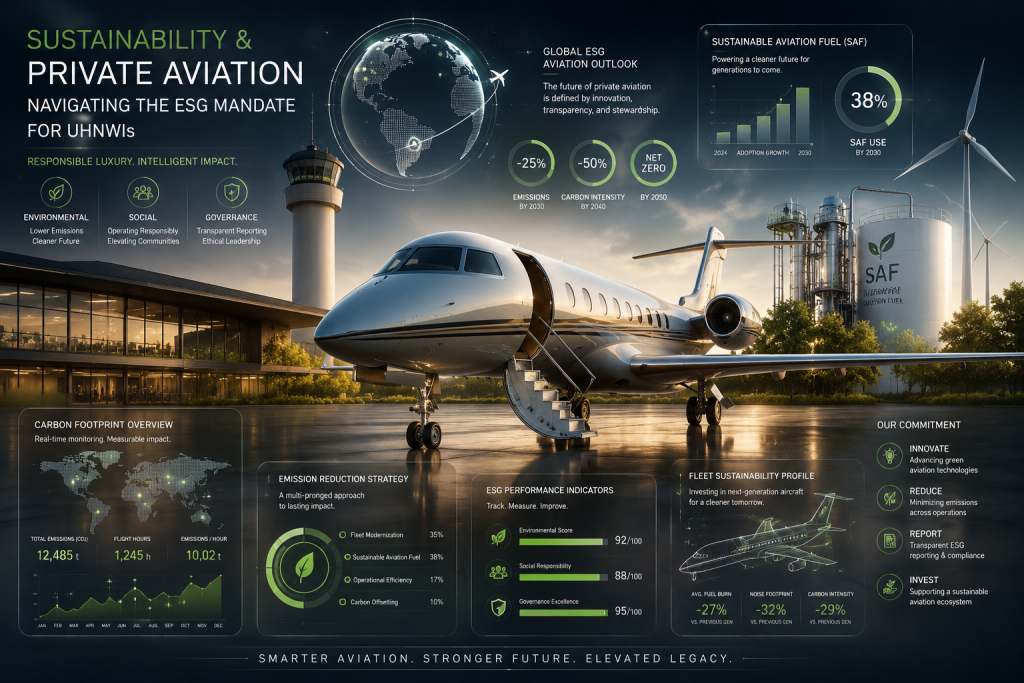
Sustainability and Private Aviation: A Strategic Imperative for Modern Aircraft Owners
Private aviation has always represented freedom, efficiency, privacy, and global mobility. Today, however, a new consideration sits alongside performance, range, and operating economics: sustainability. For ultra-high-net-worth individuals (UHNWIs), family offices, corporate flight departments, and aviation investors, the relationship between sustainability and private aviation is no longer a public relations discussion. It has become a strategic business matter.
Investors increasingly evaluate environmental performance. Boards face growing scrutiny regarding environmental commitments. Customers, stakeholders, and regulators are demanding greater transparency. As a result, aircraft ownership decisions now extend beyond acquisition costs and operational capabilities into Environmental, Social, and Governance (ESG) considerations.
The challenge is not whether private aviation can become more sustainable. The real question is how owners can navigate ESG expectations while preserving the operational advantages that make private aviation indispensable.
The answer lies in intelligent planning, advanced technology adoption, strategic fleet management, and a realistic understanding of the evolving aviation ecosystem.
By: PrivateJetio Aviation Advisory Team
Why ESG Has Become a Boardroom Priority
Ten years ago, ESG was often viewed as a niche topic reserved for sustainability teams and corporate responsibility reports. Today, it directly influences investment decisions, corporate valuations, lending practices, and reputational risk management.
For UHNWIs and corporate aircraft owners, ESG considerations increasingly affect:
- Access to investment capital
- Corporate reputation
- Shareholder relations
- Family office governance
- Enterprise risk management
- Long-term asset value
- Regulatory preparedness
Private aviation occupies a particularly visible position in ESG discussions because aircraft represent both substantial mobility advantages and significant environmental impact.
The conversation is becoming more sophisticated. Stakeholders no longer ask whether aviation produces emissions. Instead, they ask what owners are doing to reduce, mitigate, and manage those emissions responsibly.
This shift creates both challenges and opportunities.
Owners who proactively embrace aviation sustainability initiatives often strengthen their public image while positioning themselves ahead of future regulatory developments.
Understanding the ESG Landscape in Private Aviation
Environmental considerations dominate most discussions, but ESG encompasses much more than carbon emissions.
Environmental Factors
Environmental performance includes:
- Aircraft fuel efficiency
- Emissions reduction initiatives
- Sustainable aviation fuel adoption
- Fleet modernization
- Carbon offset programs
- Resource consumption
- Environmental reporting
Social Factors
Social considerations focus on:
- Employee safety
- Community impact
- Workforce development
- Ethical supply chains
- Diversity and inclusion
- Stakeholder engagement
Governance Factors
Governance considerations include:
- Transparency
- Risk oversight
- Regulatory compliance
- Ethical decision-making
- Sustainability disclosures
- Long-term strategic planning
For aviation owners, environmental factors typically receive the greatest attention, but leading organizations increasingly integrate all three pillars into a unified strategy.
The Reality of Private Jet Emissions
Any serious discussion about sustainability and private aviation must begin with a realistic assessment of emissions.
Private aircraft generally produce higher emissions per passenger than commercial airlines because they carry fewer passengers while delivering exceptional convenience and flexibility.
Critics often focus on this reality. However, the discussion frequently overlooks important nuances.
Business aviation frequently enables:
- Time-sensitive corporate operations
- Emergency transportation
- Medical missions
- Humanitarian support
- Access to underserved destinations
- Efficient multi-city travel
The goal should not be to eliminate private aviation but to improve how it operates.
The industry’s sustainability future depends on reducing environmental impact without sacrificing the economic and operational benefits that private aviation provides.
Sustainable Aviation Fuel: The Most Immediate Solution
Among all sustainability initiatives, sustainable aviation fuel represents the most significant near-term opportunity.
Unlike many emerging technologies that require entirely new aircraft platforms, sustainable aviation fuel can often be integrated into existing operations with minimal modifications.
What Is Sustainable Aviation Fuel?
Sustainable aviation fuel (SAF) is produced from renewable and sustainable feedstocks rather than traditional fossil fuels.
Sources may include:
- Agricultural waste
- Municipal waste
- Used cooking oils
- Forestry residues
- Renewable biomass
The resulting fuel can significantly reduce lifecycle carbon emissions compared to conventional jet fuel.
Why SAF Matters
SAF offers several critical advantages:
- Immediate emissions reduction potential
- Compatibility with existing aircraft
- Compatibility with existing airport infrastructure
- Scalability over time
- Strong support from regulators and manufacturers
Many industry experts view SAF as the cornerstone of net zero aviation strategies through 2050.
Challenges to Widespread Adoption
Despite its advantages, SAF adoption remains constrained by:
- Limited production capacity
- Higher costs
- Distribution challenges
- Supply chain limitations
For sophisticated aircraft owners, however, SAF procurement programs increasingly represent a practical way to demonstrate environmental commitment while maintaining operational flexibility.
Fleet Modernization as an ESG Strategy
One of the most effective sustainability decisions an owner can make occurs long before the first flight.
It begins during aircraft acquisition.
Modern aircraft designs deliver substantial efficiency improvements compared to older generations.
New Technology Advantages
Recent aircraft platforms incorporate:
- Advanced aerodynamics
- Lightweight composite materials
- More efficient engines
- Improved flight management systems
- Reduced maintenance requirements
These advancements translate directly into lower fuel consumption and reduced emissions.
ESG Benefits of Modern Fleets
Fleet modernization contributes to:
- Reduced operating costs
- Lower carbon intensity
- Enhanced asset value retention
- Better regulatory readiness
- Improved stakeholder perception
For many family offices and corporations, replacing aging aircraft may generate a larger sustainability impact than almost any other operational initiative.
Green Aviation Technology Is Reshaping the Industry
The next decade promises unprecedented innovation across aviation.
Manufacturers, suppliers, and research organizations are investing billions into green aviation technology designed to transform air travel.
Electric Aviation
Electric aircraft remain limited by battery technology.
While full-size intercontinental business jets powered entirely by batteries remain distant, smaller regional applications continue advancing rapidly.
Several manufacturers have already conducted successful demonstration flights.
Hybrid-Electric Systems
Hybrid technologies may bridge the gap between conventional fuel systems and fully electric aviation.
Potential advantages include:
- Lower fuel consumption
- Reduced emissions
- Extended operational flexibility
- Improved efficiency during key flight phases
Hydrogen-Powered Aviation
Hydrogen represents another promising long-term pathway.
Although infrastructure and certification challenges remain significant, hydrogen-powered aircraft could eventually deliver dramatic reductions in carbon emissions.
Industry leaders continue exploring hydrogen as part of broader net zero aviation objectives.
The Growing Importance of ESG Reporting
Transparency has become a defining characteristic of modern ESG programs.
Investors and stakeholders increasingly expect measurable evidence rather than broad sustainability claims.
As a result, ESG reporting is becoming an essential component of aviation ownership strategies.
What Stakeholders Want to See
Sophisticated stakeholders often seek data related to:
- Total flight activity
- Fuel consumption
- Emissions metrics
- SAF utilization
- Offset purchases
- Sustainability targets
- Progress against commitments
Organizations that provide clear and credible reporting often enjoy stronger stakeholder trust and enhanced reputational resilience.
Moving Beyond Symbolic Commitments
The market increasingly distinguishes between genuine sustainability efforts and superficial messaging.
Effective ESG reporting focuses on measurable outcomes rather than aspirational statements alone.
This approach creates accountability while supporting long-term strategic planning.
Carbon Offset Programs: Useful but Not Sufficient
Carbon offset programs remain an important component of aviation sustainability strategies.
However, they should not be viewed as a complete solution.
High-quality offset initiatives can support projects such as:
- Reforestation
- Renewable energy development
- Carbon capture
- Conservation efforts
When combined with fleet modernization and SAF adoption, offsets can play a meaningful role in reducing net environmental impact.
The most credible ESG programs follow a hierarchy:
- Reduce emissions where possible.
- Improve operational efficiency.
- Adopt cleaner technologies.
- Offset remaining emissions.
This framework aligns with evolving investor expectations and emerging global sustainability standards.
Private Aviation and Corporate Sustainability Strategy
For corporations operating business aircraft, aviation sustainability cannot exist in isolation.
Aircraft operations should integrate directly into the broader corporate sustainability strategy.
Leading organizations increasingly evaluate aviation decisions through the same ESG framework applied to other business functions.
This alignment ensures consistency between corporate commitments and operational realities.
In many cases, aviation departments are becoming active contributors to enterprise-wide sustainability goals rather than exceptions to them.


