
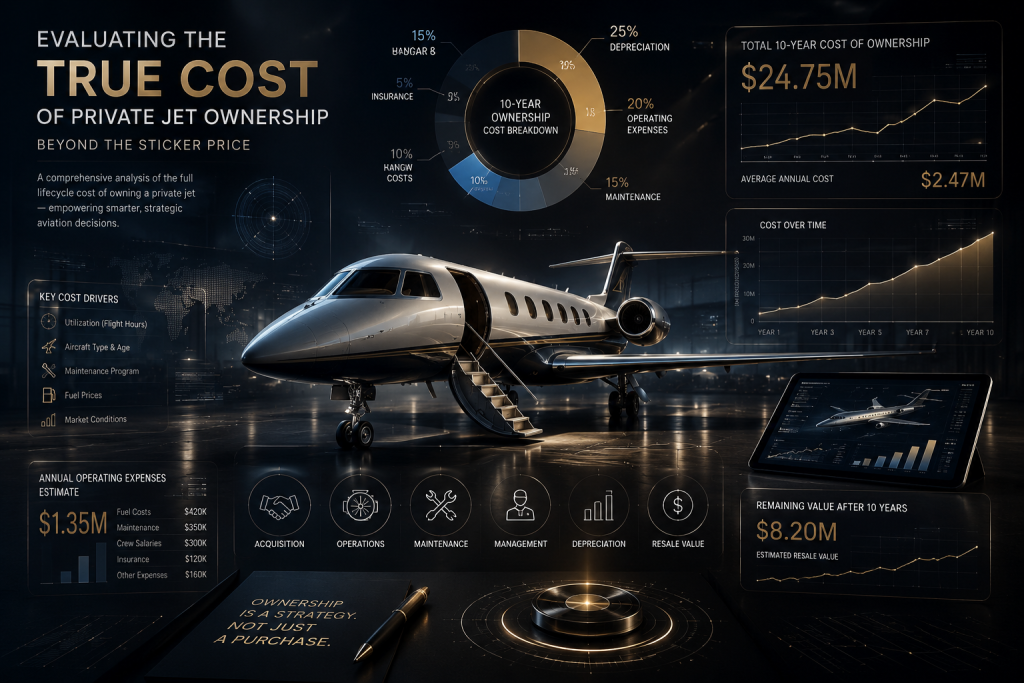
For many successful entrepreneurs, corporate leaders, investors, and ultra-high-net-worth individuals, purchasing a private jet represents more than transportation. It reflects freedom, efficiency, control, and access. Yet one of the most common mistakes buyers make is focusing almost exclusively on the acquisition price.
The purchase price of an aircraft is only the beginning of a much larger financial commitment. A jet that costs $20 million today may require tens of millions more throughout its operational life. Understanding the complete lifecycle cost of private jet ownership is essential for making an informed decision and protecting long-term capital.
Experienced aircraft owners rarely evaluate a jet based solely on what it costs to buy. Instead, they analyze the total economic picture—including maintenance, crew salaries, insurance, fuel, management, upgrades, hangar fees, financing, depreciation, and eventual resale value.
Whether you are considering your first aircraft or evaluating a fleet expansion strategy, understanding lifecycle costs can help you avoid expensive surprises and make smarter aviation investments.
By: PrivateJetio Aviation Advisory Team
Why Lifecycle Cost Matters More Than Purchase Price
Imagine two aircraft.
The first costs $12 million and appears to be a bargain. The second costs $18 million and initially seems expensive.
However, after ten years of ownership, the less expensive aircraft requires significantly more maintenance, burns more fuel, suffers faster depreciation, and commands a weaker resale price.
The result?
The supposedly cheaper aircraft may ultimately cost millions more.
This reality explains why sophisticated buyers evaluate ownership through a lifecycle perspective rather than a transaction perspective.
The true financial question is not:
“What does this jet cost today?”
The better question is:
“What will this jet cost over the next decade?”
Understanding the Major Components of Ownership Cost
Private aviation ownership costs can be divided into several major categories.
These include:
- Aircraft acquisition
- Financing costs
- Crew expenses
- Fuel consumption
- Maintenance programs
- Insurance
- Hangar fees
- Aircraft management
- Regulatory compliance
- Cabin upgrades
- Technology modernization
- Depreciation
- Disposal and resale
Each category influences the total cost of ownership.
Aircraft Acquisition: The Visible Cost
The acquisition price is the most obvious expense.
Private jets vary enormously in cost depending on age, range, manufacturer, cabin size, and market conditions.
Examples include:
Very Light Jets
Aircraft in this category may cost between $3 million and $8 million.
They are designed for shorter routes and smaller passenger groups.
Midsize Jets
Midsize aircraft generally range from $10 million to $25 million depending on age and specifications.
These aircraft often balance comfort, range, and operating efficiency.
Large Cabin Jets
Long-range aircraft can exceed $75 million.
Flagship models may surpass $80 million to $90 million before customization.
While acquisition is significant, it frequently represents only a portion of total lifetime ownership cost.
Jet Depreciation: The Largest Hidden Expense
Many owners underestimate the impact of jet depreciation.
Unlike residential real estate, aircraft are depreciating assets.
As aircraft age, market values generally decline.
Factors influencing depreciation include:
Aircraft Age
Newer aircraft command premium pricing.
Older aircraft experience greater value erosion.
Market Demand
Popular models from respected manufacturers often retain value better.
Technology Relevance
Aircraft equipped with modern avionics and cabin technology typically achieve stronger valuations.
Maintenance Status
Well-maintained aircraft retain value significantly better than neglected aircraft.
A business jet purchased for $25 million may sell ten years later for substantially less, even if maintained perfectly.
This reduction in value must be included when calculating total ownership economics.
Fuel Costs for Private Jets
Fuel is among the largest recurring expenses.
The amount varies based on:
- Aircraft size
- Engine efficiency
- Flight distance
- Fuel market conditions
- Operational profile
Modern aircraft have become more efficient, but fuel remains a major operational consideration.
For frequent operators, annual fuel expenditures can easily reach hundreds of thousands or even millions of dollars.
Long-range aircraft naturally consume more fuel than light jets, although efficiency improvements have narrowed the gap in recent years.
Owners evaluating different aircraft should always compare fuel burn rates over projected annual flight hours.
Aircraft Maintenance Expenses
Maintenance is one of the most important variables in aircraft economics.
Ignoring maintenance projections can create serious budget surprises.
Aircraft maintenance expenses generally fall into three categories:
Scheduled Maintenance
Manufacturers establish mandatory inspection intervals.
These inspections ensure airworthiness and regulatory compliance.
Unscheduled Maintenance
Unexpected mechanical issues occur regardless of aircraft age.
Engine events, component failures, and avionics issues can create significant costs.
Major Overhauls
Engines require periodic overhauls and inspections.
These events often represent some of the largest maintenance expenses during ownership.
Sophisticated owners often enroll in manufacturer maintenance programs to stabilize expenses and reduce uncertainty.
The Real Cost of Crew Operations
Private aviation requires highly trained professionals.
Crew-related expenses include:
Pilot Salaries
Experienced pilots command substantial compensation.
Long-range aircraft typically require multiple crew members.
Recurrent Training
Regulatory authorities require ongoing training and certification.
Annual simulator training is standard.
Travel and Accommodation
When crews remain with the aircraft away from home base, additional expenses arise.
Benefits and Insurance
Employers must also consider benefits packages and employment obligations.
Crew costs can represent a meaningful portion of annual operating expenses, especially for larger aircraft.
Private Aircraft Management Services
Many owners choose professional private aircraft management companies to oversee operations.
Management firms handle:
- Crew recruitment
- Scheduling
- Maintenance coordination
- Regulatory compliance
- Accounting
- Fuel procurement
- Charter management
For busy executives, management services provide efficiency and peace of mind.
However, these services create additional annual expenses that should be included in lifecycle calculations.
The value often outweighs the cost, particularly for owners seeking a fully managed aviation experience.
Insurance Costs and Risk Management
Aircraft insurance is another critical component.
Premiums depend on:
- Aircraft value
- Operational geography
- Pilot experience
- Usage profile
- Liability requirements
Comprehensive coverage is essential because aviation incidents can involve significant financial exposure.
Insurance expenses generally rise alongside aircraft value and operational complexity.
Hangar and Storage Fees
Many first-time buyers overlook hangar and storage fees.
Aircraft require protection from weather, environmental damage, and security threats.
Storage costs vary based on:
- Airport location
- Facility quality
- Aircraft size
- Climate considerations
Premium airports in major metropolitan markets often command significantly higher fees than regional facilities.
Over a decade of ownership, hangar expenses can represent a substantial financial commitment.
Understanding Fixed Costs vs Variable Costs
A useful framework for evaluating ownership involves separating costs into fixed and variable categories.
Fixed Costs
Fixed expenses occur regardless of flight activity.
Examples include:
- Insurance
- Crew salaries
- Hangar fees
- Management fees
- Regulatory compliance
Variable Costs
Variable expenses increase with usage.
Examples include:
- Fuel
- Maintenance events
- Landing fees
- Catering
- Ground handling
Understanding this distinction helps owners evaluate utilization strategies and determine optimal aircraft deployment.
Why Flight Hours Matter
Annual utilization dramatically influences ownership economics.
An aircraft flown 50 hours annually produces a different cost structure than one flown 500 hours.
Higher utilization generally spreads fixed costs across more flight hours.
This often reduces effective cost per hour.
For this reason, some owners eventually conclude that chartering or fractional ownership better suits their travel requirements.
Ownership becomes increasingly attractive as annual utilization rises.
Business Jet Ownership and Opportunity Cost
An often-overlooked factor is opportunity cost.
Capital invested in aviation assets cannot simultaneously be invested elsewhere.
For example, allocating $40 million toward an aircraft acquisition may reduce available capital for:
- Real estate investments
- Corporate expansion
- Private equity opportunities
- Public markets
- Strategic acquisitions
Sophisticated buyers evaluate aircraft ownership within a broader wealth-management framework.
The objective is not simply purchasing a jet.
The objective is optimizing capital allocation.
How Technology Impacts Lifecycle Economics
Modern aircraft benefit from technological advancements that influence ownership cost.
These include:
More Efficient Engines
Reduced fuel burn lowers operating expenses.
Advanced Avionics
Modern systems improve operational efficiency and reliability.
Predictive Maintenance
Data-driven maintenance reduces unexpected downtime.
Enhanced Connectivity
High-speed internet and communication systems improve passenger productivity.
Although newer aircraft may cost more initially, they often generate meaningful long-term savings.
Cabin Refurbishments and Modernization Costs
Over time, aircraft interiors require updates.
Owners frequently invest in:
- New seating
- Cabin redesigns
- Connectivity upgrades
- Entertainment systems
- Interior finishes
Luxury expectations evolve rapidly.
A cabin considered cutting-edge today may feel dated within a decade.
These modernization expenses should be included in long-term ownership planning.
Aircraft Resale Value and Exit Strategy
One of the most important aspects of ownership is aircraft resale value.
Smart buyers begin planning for resale before completing acquisition.
Factors influencing resale include:
Maintenance Records
Detailed records support stronger valuations.
Aircraft Condition
Interior and exterior condition significantly affect marketability.
Market Timing
Economic conditions influence buyer demand.
Fleet Trends
New model introductions can impact older aircraft values.
A carefully planned exit strategy can preserve millions in capital.
Comparing New Aircraft vs Pre-Owned Aircraft
Many buyers face a critical decision.
Should they purchase new or pre-owned?
Advantages of New Aircraft
- Latest technology
- Manufacturer warranty
- Custom configuration options
- Enhanced reliability
Advantages of Pre-Owned Aircraft
- Lower acquisition price
- Reduced initial depreciation
- Faster availability
- Potentially stronger value proposition
The correct choice depends on mission requirements, budget, and long-term ownership objectives.
The Hidden Cost of Downtime
Aircraft availability has financial value.
Unexpected maintenance can disrupt:
- Executive travel
- Client meetings
- Investment opportunities
- Corporate operations
Downtime may create indirect costs that exceed direct repair expenses.
This is why reliability often ranks among the most important acquisition criteria.
A Strategic Framework for Evaluating Ownership
When assessing a potential acquisition, experienced aviation advisors recommend examining:
- Acquisition cost
- Financing structure
- Annual utilization
- Fuel projections
- Maintenance reserves
- Crew requirements
- Insurance costs
- Management fees
- Hangar expenses
- Projected resale value
This framework provides a realistic understanding of long-term ownership economics.
Rather than focusing on the purchase price alone, it reveals the true financial profile of an aircraft.
Why Professional Advisory Matters
Private aviation is a sophisticated asset class.
Aircraft transactions often involve millions or tens of millions of dollars.
The wrong decision can create substantial long-term costs.
Professional aviation advisors help buyers evaluate:
- Mission requirements
- Fleet alternatives
- Ownership structures
- Cost projections
- Market timing
- Exit strategies
A comprehensive lifecycle analysis often identifies opportunities to save significant capital over the life of the aircraft.
Conclusion
The acquisition price of a private jet is only the beginning of the ownership journey. The true lifecycle cost of private jet ownership includes operating expenses, maintenance, fuel, crew, management, insurance, depreciation, modernization, and eventual resale.
Sophisticated buyers understand that a successful aircraft acquisition is not defined by obtaining the lowest purchase price. It is defined by achieving the best long-term value.
A jet that appears expensive on day one may prove remarkably efficient over fifteen years. Conversely, a seemingly attractive bargain can become a costly liability.
Before making a strategic aviation investment, conduct a comprehensive lifecycle analysis and evaluate every stage of ownership. The most successful aircraft owners focus not on what a jet costs today—but on what it will cost tomorrow, next year, and throughout its entire operational life.
For investors, corporations, family offices, and ultra-high-net-worth individuals considering a private aircraft acquisition, a professional lifecycle cost assessment can provide the clarity needed to make a confident decision.
FAQ
What is the lifecycle cost of private jet ownership?
Lifecycle cost includes all expenses associated with owning a jet, including acquisition, fuel, maintenance, crew, insurance, hangar fees, management costs, depreciation, and resale considerations.
What is usually the biggest expense after purchasing a private jet?
For many owners, depreciation and long-term maintenance represent the largest costs beyond the initial acquisition price.
Are newer jets cheaper to operate?
Not always. However, modern aircraft often offer better fuel efficiency, improved reliability, and lower maintenance requirements, which can reduce total ownership costs.
How important is aircraft resale value?
Extremely important. Resale value significantly affects overall ownership economics and should be evaluated before acquisition.
Should I buy a jet or use charter services?
The answer depends on annual flight activity, travel requirements, flexibility needs, and financial objectives. A professional aviation assessment can help determine the most suitable option.
References:
Federal Aviation Administration – Aircraft Ownership Resources
https://www.faa.gov
National Business Aviation Association – Business Aviation Insights
https://nbaa.org
General Aviation Manufacturers Association – Industry Data & Reports
https://gama.aero
International Civil Aviation Organization (ICAO)
https://www.icao.int
European Union Aviation Safety Agency (EASA)
https://www.easa.europa.eu


