
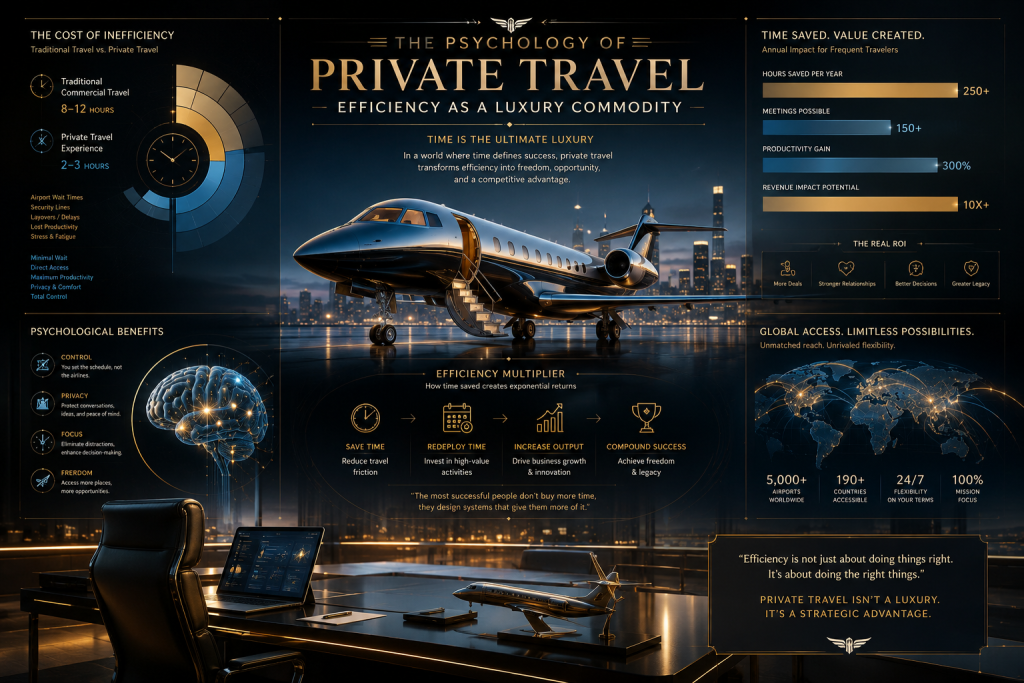
In the world of ultra-high-net-worth individuals, corporate leaders, and global entrepreneurs, luxury is no longer defined solely by physical assets. The modern elite increasingly value something far rarer than property, artwork, or exotic vehicles: time. This shift has transformed the psychology of private travel and elevated efficiency into one of the most coveted luxury commodities in existence. What was once considered a transportation choice is now viewed as a strategic lifestyle decision, where every saved hour translates into opportunity, productivity, privacy, and control.
The psychology behind private aviation extends far beyond comfort. It reflects a deeper understanding of value creation, cognitive performance, decision-making quality, and personal freedom. As global business becomes more complex and interconnected, the ability to move efficiently has become a competitive advantage.
For private jet owners, prospective buyers, family offices, and corporations, understanding the psychological drivers behind private aviation provides valuable insight into why demand continues to grow despite economic cycles and technological changes.
By: PrivateJetio Aviation Advisory Team
Understanding Luxury Beyond Material Possessions
Luxury has evolved dramatically over the past two decades.
Historically, luxury was measured through visible symbols of wealth. Large estates, yachts, jewelry, and exclusive memberships served as indicators of success. While these assets remain desirable, modern affluent individuals increasingly prioritize experiences and outcomes over possessions.
The psychology behind this evolution is straightforward. Once fundamental needs and financial security are achieved, people begin optimizing for higher-order benefits such as freedom, autonomy, efficiency, and emotional well-being.
Private aviation sits at the center of this transformation.
Unlike traditional luxury purchases, private aviation creates tangible returns in both lifestyle and business performance. It enables individuals to reclaim hours, reduce stress, improve flexibility, and enhance productivity.
For many executives, the aircraft itself is not the primary luxury.
The luxury is time.
Why Time Has Become the Ultimate Luxury Commodity
Every individual receives the same 24 hours per day.
The difference lies in how effectively those hours are utilized.
For successful entrepreneurs and executives, time often becomes more valuable than money because money can be replenished while time cannot.
This principle explains much of the psychology behind private jet travel.
Commercial aviation introduces numerous inefficiencies:
- Early airport arrivals
- Security queues
- Flight delays
- Layovers
- Congested terminals
- Limited scheduling flexibility
- Lost productivity
Private aviation eliminates many of these constraints.
A traveler can arrive minutes before departure, access smaller airports, adjust schedules quickly, and conduct business throughout the journey.
The resulting time optimization creates measurable value.
Consider an executive responsible for a billion-dollar enterprise. Saving five or six hours per trip may create opportunities that far exceed the operating cost of the aircraft itself.
From a psychological perspective, private aviation restores a sense of control over one of life’s most limited resources.
The Psychology of Control and Autonomy
One of the strongest drivers behind luxury consumption is control.
Research in behavioral psychology consistently demonstrates that humans experience lower stress levels when they maintain control over their environment.
Commercial travel often removes that control.
Passengers are subjected to predetermined schedules, gate changes, delays, cancellations, and crowded environments.
Private aviation reverses this dynamic.
Travelers regain authority over:
- Departure schedules
- Arrival locations
- Passenger selection
- Onboard environment
- Security procedures
- Travel flexibility
This level of autonomy creates a profound psychological benefit.
Rather than adapting to transportation systems, transportation adapts to the traveler.
For high-performing individuals accustomed to making critical decisions daily, this alignment with personal control can significantly improve satisfaction and reduce cognitive fatigue.
Cognitive Performance and Decision-Making Efficiency
Elite business leaders make hundreds of important decisions each week.
Decision quality often determines organizational outcomes worth millions or even billions of dollars.
Unfortunately, travel-related stress negatively impacts cognitive performance.
Crowded airports, long queues, flight disruptions, and lack of privacy consume mental energy that could otherwise be directed toward strategic thinking.
Private aviation helps preserve cognitive resources.
Instead of spending hours navigating logistical challenges, executives can focus on:
- Strategic planning
- Investor discussions
- Team leadership
- Client negotiations
- Market analysis
The aircraft effectively becomes a mobile executive office.
This benefit is particularly significant in business aviation, where travel frequently occurs between critical meetings and decision-making events.
The psychological advantage extends beyond convenience.
It directly supports higher-quality thinking.
The Relationship Between Executive Mobility and Success
Mobility has always been linked to economic opportunity.
Historically, individuals who could move faster than competitors often gained significant advantages.
Today’s global economy operates on the same principle.
Executive mobility allows leaders to:
Reach More Opportunities
Private aviation enables access to destinations underserved by commercial airlines.
Many business-critical locations lack direct airline connections.
Private aircraft provide direct access to thousands of additional airports worldwide.
Increase Meeting Density
An executive can visit multiple cities in a single day without relying on commercial schedules.
This increases relationship-building opportunities and accelerates business development efforts.
Respond Rapidly to Market Changes
Opportunities often emerge unexpectedly.
Private aviation provides the flexibility to respond immediately.
In competitive industries, speed frequently determines success.
Privacy as a Strategic Asset
Privacy has become increasingly valuable in the digital age.
Corporate executives, investors, celebrities, and public figures face growing concerns regarding information security and personal exposure.
Commercial terminals create numerous vulnerabilities.
Sensitive conversations may be overheard.
Travel patterns can become public knowledge.
Confidential documents may be exposed.
Private aviation significantly reduces these risks.
The resulting privacy enhances both security and peace of mind.
From a psychological standpoint, individuals perform better when they feel protected from unwanted observation.
This benefit contributes substantially to the luxury travel experience associated with private aviation.
Emotional Value Versus Financial Cost
Traditional financial analysis often focuses exclusively on direct costs.
However, affluent consumers frequently evaluate purchases through a broader framework that includes emotional return on investment.
Private aviation generates emotional benefits such as:
- Reduced stress
- Increased confidence
- Greater flexibility
- Enhanced security
- Improved family time
- Better work-life integration
These outcomes influence purchasing decisions even when they cannot be easily quantified.
The psychology of luxury consumption demonstrates that perceived value often exceeds purely financial calculations.
In many cases, aircraft ownership becomes a lifestyle optimization tool rather than a transportation expense.
The Scarcity Principle and Luxury Demand
Behavioral economists frequently reference the scarcity principle.
People assign greater value to resources that are limited or difficult to obtain.
Time represents the ultimate scarce resource.
No technology can manufacture additional hours.
Private aviation helps maximize the effectiveness of existing time.
This capability creates extraordinary perceived value among affluent travelers.
The aircraft becomes a mechanism for reducing wasted time rather than simply providing transportation.
This distinction is critical when understanding purchasing motivations.
Many buyers are not investing in a jet.
They are investing in efficiency.
The Evolution of Status Signaling
Luxury consumption has always involved status signaling.
However, the signals themselves have evolved.
Traditional status symbols focused on visibility.
Modern status symbols increasingly emphasize exclusivity, access, and efficiency.
Today, successful individuals often seek:
- Exclusive experiences
- Priority access
- Personal freedom
- Flexibility
- Time ownership
Private aviation aligns perfectly with these values.
The aircraft communicates a subtle but powerful message: time matters.
Rather than displaying wealth for its own sake, it demonstrates a commitment to operational efficiency and strategic living.
How Private Aviation Enhances Family Life
The psychological advantages of private travel extend beyond business applications.
Family offices and private owners increasingly view aviation as a quality-of-life investment.
Private aviation enables:
More Meaningful Family Time
Less time spent in airports means more time spent together.
Flexible Vacation Planning
Families can travel according to personal schedules rather than airline availability.
Access to Remote Destinations
Private aircraft unlock destinations that may be difficult to reach commercially.
Reduced Travel Stress
Children, elderly relatives, and family members with special requirements often benefit significantly from private travel arrangements.
For many families, these advantages become central to the ownership decision.
The Hidden Cost of Travel Friction
Most travelers underestimate the cumulative impact of travel friction.
Travel friction includes every unnecessary obstacle encountered during a journey.
Examples include:
- Waiting
- Uncertainty
- Delays
- Rebooking
- Security bottlenecks
- Ground transportation complications
Individually, these issues may appear minor.
Collectively, they create substantial psychological burden.
Private aviation minimizes travel friction at nearly every stage.
This reduction contributes significantly to overall satisfaction and productivity.
Business Aviation as a Competitive Advantage
Organizations increasingly recognize aviation as a strategic asset.
Leading companies utilize business aviation to support:
Market Expansion
Faster access to customers and partners accelerates growth initiatives.
Talent Retention
Executives value efficient travel arrangements that reduce stress and burnout.
Crisis Response
Private aviation enables immediate deployment during emergencies.
Relationship Building
Face-to-face meetings remain essential in many industries.
Private travel increases the frequency and quality of these interactions.
The result is a measurable competitive advantage that extends beyond transportation logistics.
The Role of Aviation Consulting in Strategic Decisions
Choosing the right aviation strategy requires careful analysis.
Options may include:
- Full ownership
- Fractional ownership
- Jet cards
- Charter solutions
- Corporate flight departments
Each model offers distinct advantages and trade-offs.
Professional aviation consulting helps clients align travel requirements with financial objectives.
This process often reveals opportunities to improve efficiency while reducing long-term costs.
Strategic advisory services also help buyers avoid costly mistakes during aircraft acquisition and management.
Aircraft Ownership as a Long-Term Strategic Asset
For many organizations and family offices, aircraft ownership represents a long-term strategic investment.
The decision should be evaluated through multiple lenses:
Financial Performance
Acquisition costs, operating expenses, maintenance, and residual value must be carefully analyzed.
Operational Efficiency
The aircraft must support actual travel patterns.
Mission Capability
Range, passenger capacity, and airport accessibility should align with requirements.
Lifestyle Benefits
Personal priorities often play a significant role in ownership decisions.
A comprehensive assessment ensures that ownership supports broader personal and business objectives.
Private Aviation Solutions for Modern Leaders
The future of luxury travel is increasingly centered on efficiency.
Modern leaders operate in a world characterized by:
- Global markets
- Instant communication
- Rapid change
- Increasing competition
Private aviation solutions address these realities by enabling faster, more effective movement.
As business complexity grows, the value of efficient mobility continues to increase.
This trend is likely to remain a defining characteristic of the private aviation industry for decades.
Measuring the Return on Time
One of the most insightful frameworks for evaluating private aviation involves measuring return on time rather than return on money alone.
Questions to consider include:
- How many productive hours are gained annually?
- How much stress is eliminated?
- How many additional opportunities become accessible?
- How much flexibility is created?
- How much personal freedom is restored?
For many owners, the answers justify the investment.
The calculation extends far beyond transportation economics.
It encompasses quality of life, business performance, and strategic advantage.
Conclusion: Why Efficiency Has Become the New Luxury
The psychology of private travel reveals a fundamental truth about modern wealth.
The world’s most successful individuals increasingly prioritize efficiency over excess.
Private aviation succeeds because it delivers something extraordinarily rare: control over time.
The aircraft itself is important, but it is not the ultimate product.
The true product is freedom.
Freedom from delays.
Freedom from inefficiency.
Freedom from unnecessary friction.
As global business and personal schedules become increasingly demanding, efficiency will continue to evolve from a convenience into one of the most valuable luxury commodities available.
For private jet owners, prospective buyers, family offices, and corporations, the question is no longer whether private aviation is a luxury.
The question is whether the strategic value of time justifies treating efficiency as an asset worth investing in.
For many of the world’s most successful decision-makers, the answer is already clear.
FAQ
Why is time considered the ultimate luxury today?
Time is the only resource that cannot be replenished. Affluent individuals increasingly prioritize experiences and solutions that help them maximize productivity, flexibility, and personal freedom.
How does private aviation improve productivity?
Private aviation reduces travel-related delays, provides a private workspace, and enables direct access to destinations, allowing executives to use their time more effectively.
Is private jet ownership primarily about status?
While status may play a role, most owners cite efficiency, privacy, flexibility, and convenience as the primary reasons for ownership.
What psychological benefits does private aviation provide?
Benefits include reduced stress, greater control, improved focus, enhanced privacy, and increased confidence during travel.
Should every frequent traveler consider aircraft ownership?
Not necessarily. The optimal solution depends on travel frequency, mission requirements, financial objectives, and long-term strategic goals. Professional aviation consulting can help determine the most effective approach.
References:
- National Business Aviation Association (NBAA)
https://nbaa.org - Federal Aviation Administration (FAA) Business Aviation Resources
https://www.faa.gov - General Aviation Manufacturers Association (GAMA)
https://gama.aero - International Civil Aviation Organization (ICAO)
https://www.icao.int - Harvard Business Review – Decision Making and Executive Performance
https://hbr.org - McKinsey & Company – Time Management and Executive Productivity
https://www.mckinsey.com - World Economic Forum – Future of Mobility and Business Travel
https://www.weforum.org - Deloitte Insights – The Future of Business Aviation
https://www2.deloitte.com/insights/


