
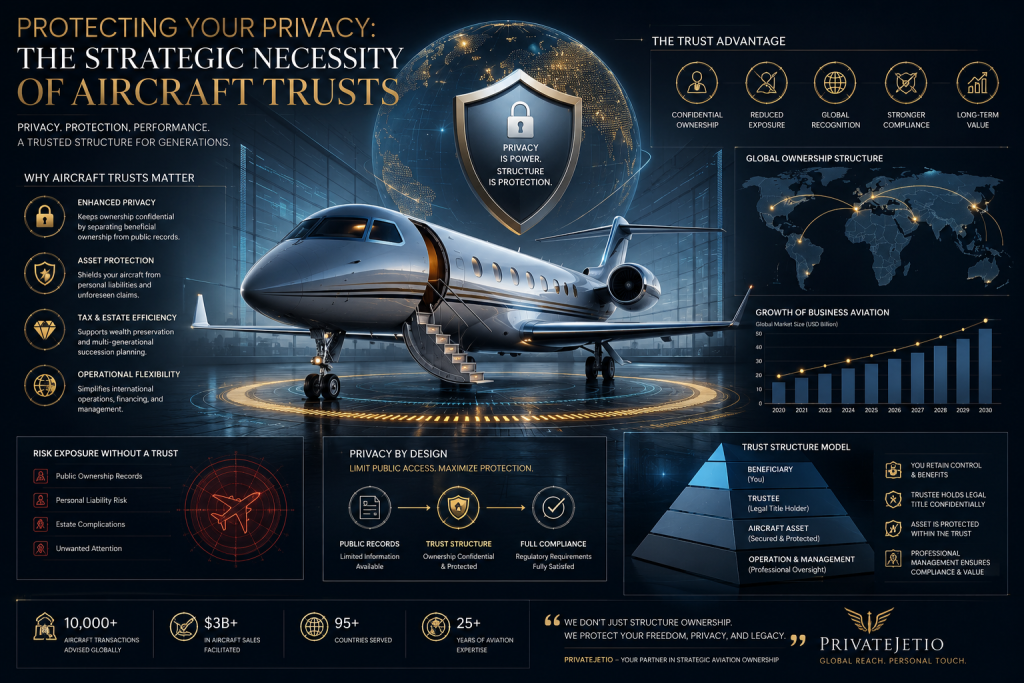
Privacy has become one of the most valuable assets in modern aviation. For ultra-high-net-worth individuals, family offices, multinational corporations, and aircraft operators, ownership transparency can expose sensitive information regarding wealth, travel patterns, business activities, and strategic interests. As global data accessibility continues to expand, protecting ownership confidentiality has evolved from a luxury consideration into a critical component of aviation strategy.
Aircraft trusts have emerged as one of the most effective legal structures available to private jet owners seeking enhanced privacy, asset protection, regulatory flexibility, and long-term ownership efficiency. Far beyond a simple registration mechanism, a properly structured aircraft trust can help shield ownership information, facilitate international operations, streamline compliance obligations, and support broader wealth preservation objectives.
Understanding how aircraft trusts function and when they should be utilized can significantly influence both operational success and financial outcomes throughout the lifecycle of an aviation asset.
By: PrivateJetio Aviation Advisory Team
Why Privacy Has Become a Strategic Concern in Aviation
Private aviation operates within a highly visible regulatory environment. Aircraft ownership records are generally maintained through national aviation authorities and often become publicly accessible.
For many owners, this creates several concerns.
An aircraft can reveal far more than transportation preferences. It may indicate wealth levels, business expansion strategies, acquisition activity, political exposure, investment interests, and personal travel habits.
Executives involved in mergers and acquisitions, private equity transactions, government contracts, or sensitive negotiations frequently seek methods to reduce unnecessary visibility regarding aviation assets.
The challenge becomes even greater when ownership structures involve multiple jurisdictions, corporate entities, or family wealth vehicles.
A sophisticated aircraft ownership structure can provide an important layer of confidentiality while maintaining full legal compliance.
Understanding Aircraft Trusts
An aircraft trust is a legal arrangement in which a trustee holds legal title to an aircraft on behalf of a beneficiary.
The beneficiary remains the economic owner and retains the practical benefits of ownership, while the trustee serves as the registered owner according to the governing trust agreement.
This distinction creates strategic advantages that extend beyond privacy.
Aircraft trusts are commonly used for:
- Privacy enhancement
- Aircraft registration purposes
- International ownership arrangements
- Regulatory compliance
- Asset protection strategy implementation
- Estate planning
- Wealth preservation
- Cross-border aviation operations
The exact structure depends on the jurisdiction, ownership goals, operational requirements, and regulatory environment.
While many trust arrangements are established in the United States, several other aviation-friendly jurisdictions offer trust-based ownership solutions as well.
The Growing Importance of Ownership Confidentiality
Public ownership databases have dramatically increased transparency across multiple industries.
While transparency serves important regulatory purposes, it can also create unintended risks.
Private jet owners frequently encounter concerns such as:
Personal Security Exposure
Aircraft ownership can identify high-net-worth individuals and their families.
This information may increase security risks ranging from targeted theft to cybercrime and unwanted public attention.
For prominent individuals, maintaining discretion is often a practical security measure rather than a preference.
Corporate Intelligence Risks
Competitors often monitor aircraft activity.
Flight patterns may reveal:
- New market expansion efforts
- Acquisition targets
- Executive travel activity
- Strategic partnerships
- Emerging business initiatives
Even partial ownership information can provide valuable intelligence to competitors.
Media and Public Scrutiny
High-profile individuals increasingly face scrutiny regarding private aviation usage.
Environmental debates, political considerations, shareholder concerns, and public relations issues can amplify attention on aircraft ownership.
An effective ownership structure helps separate personal identity from publicly available registration information.
How Aircraft Trusts Enhance Privacy
One of the primary advantages of aircraft trusts is the separation between beneficial ownership and registered ownership.
Rather than publicly displaying the beneficiary’s name, official records often identify the trustee as the registered owner.
This arrangement creates a valuable confidentiality layer.
Importantly, this is not designed to conceal ownership unlawfully.
Instead, it provides legitimate privacy while maintaining regulatory transparency through appropriate trustee relationships and documentation.
The result is a balance between compliance and discretion.
Limiting Public Exposure
Trust structures help reduce direct association between an individual’s name and an aircraft registration record.
This can be particularly valuable for:
- Family offices
- Private investors
- Public company executives
- Celebrities
- Professional athletes
- Political figures
- International business owners
Privacy does not eliminate regulatory obligations, but it can significantly reduce unnecessary public visibility.
Centralized Information Management
Aircraft trusts often create a more structured approach to ownership documentation.
Trustees handle official registration matters while beneficiaries maintain economic control according to the trust agreement.
This separation can simplify administration and reduce direct public exposure.
Asset Protection Beyond Privacy
Although privacy receives significant attention, asset protection often becomes an equally important benefit.
Aircraft represent substantial investments.
Modern business jets frequently range from several million dollars to well over $75 million, while large-cabin aircraft may exceed $100 million.
Protecting such assets requires sophisticated planning.
Risk Segregation
Trust structures can help isolate ownership interests from unrelated liabilities.
When integrated into a broader asset protection strategy, trusts may contribute to:
- Liability management
- Risk compartmentalization
- Wealth preservation planning
- Estate succession strategies
Aircraft owners typically combine trusts with corporate entities, insurance programs, and legal planning frameworks.
Long-Term Wealth Preservation
For family offices and multi-generational wealth structures, aircraft ownership frequently forms part of a larger portfolio strategy.
Trust arrangements can align aviation assets with broader wealth preservation objectives while supporting governance and succession planning.
FAA Trust Arrangements and International Ownership
One of the most recognized applications involves the FAA trust arrangement.
The United States remains one of the world’s most respected aircraft registration jurisdictions.
Many international owners seek access to U.S. registration benefits.
However, registration requirements may restrict direct ownership by certain foreign individuals or entities.
Aircraft trusts often provide a compliant mechanism for facilitating registration while satisfying applicable regulatory requirements.
Benefits of U.S. Registration
Owners frequently pursue U.S. registration due to:
- Strong regulatory reputation
- Global recognition
- Established legal framework
- Financing flexibility
- Operational credibility
- Efficient registration procedures
For international operators, these advantages can create significant operational value.
Supporting Global Operations
International aviation frequently involves multiple jurisdictions.
Aircraft may be based in one country, financed in another, managed by a third-party operator, and utilized globally.
Trust structures can provide a framework capable of supporting these complex arrangements while maintaining regulatory consistency.
Aircraft Registration Strategy and Operational Efficiency
Registration decisions affect more than paperwork.
They influence financing opportunities, insurance considerations, resale value, operational flexibility, and regulatory obligations.
Sophisticated owners view aircraft registration as a strategic decision rather than an administrative task.
Trust-based ownership models often improve flexibility when aircraft are:
- Bought or sold
- Repositioned internationally
- Financed or refinanced
- Placed under management agreements
- Integrated into corporate structures
This flexibility becomes increasingly valuable as aviation portfolios grow.
The Role of Aircraft Trusts in Aviation Asset Management
Professional aviation asset management focuses on maximizing value throughout an aircraft’s lifecycle.
Ownership structure represents one of the foundational decisions influencing long-term outcomes.
Trusts contribute to effective aviation asset management by supporting:
Acquisition Planning
Before purchasing an aircraft, owners can establish trust structures designed to align with operational and financial objectives.
This proactive approach often reduces future restructuring costs.
Financing Coordination
Lenders frequently evaluate ownership arrangements during underwriting.
Well-designed trust structures can facilitate financing discussions by providing clarity regarding ownership rights and responsibilities.
Operational Governance
Clearly defined trustee and beneficiary relationships support transparent governance processes, especially for complex ownership environments involving multiple stakeholders.
Exit Planning
Aircraft disposition strategies benefit from advance planning.
Ownership structures established at acquisition frequently influence resale efficiency years later.
Advanced Privacy Strategies Used by Ultra-High-Net-Worth Individuals
Experienced aircraft owners rarely view privacy as an isolated objective. Instead, they integrate aircraft trusts into a broader framework designed to protect personal information, optimize ownership efficiency, and support long-term strategic goals.
The most sophisticated ownership models typically combine several components:
- Aircraft trusts
- Limited liability companies
- Family office governance structures
- Specialized aviation insurance programs
- Estate planning vehicles
- Aviation asset management services
This layered approach creates multiple levels of protection while maintaining full legal and regulatory compliance.
For many global families, the aircraft is only one component of a larger mobility portfolio that may include yachts, helicopters, real estate holdings, and investment entities. Coordinating these assets through a unified ownership strategy often produces significant operational advantages.
Family Office Integration
Family offices increasingly view aviation assets as strategic tools rather than luxury purchases.
Private aircraft support:
- Global business mobility
- Investment oversight
- Family governance
- Security requirements
- Time efficiency
- Cross-border asset management
Aircraft trusts often serve as the ownership foundation within broader family office structures.
By separating legal title from beneficial ownership, families can establish continuity plans that extend beyond a single generation.
This approach helps reduce disruptions during inheritance transitions and leadership changes.
Protecting Confidential Travel Activity
Travel patterns often reveal more information than ownership records.
Aviation professionals understand that flight activity can provide insights into business priorities, investment interests, and future transactions.
While trust structures do not eliminate all visibility, they can contribute to a broader privacy framework that minimizes unnecessary public exposure.
For corporate executives, this can be particularly valuable during:
- Merger negotiations
- Strategic acquisitions
- Capital raising efforts
- Government contract pursuits
- International expansion projects
Maintaining confidentiality during sensitive transactions often creates measurable competitive advantages.
Common Mistakes When Establishing Aircraft Trusts
Although aircraft trusts provide substantial benefits, improper implementation can create complications.
Owners frequently underestimate the complexity of aviation ownership planning.
Several mistakes appear repeatedly across the industry.
Choosing Structure Before Defining Objectives
Some buyers establish a trust because they heard it offers privacy benefits.
However, the ideal structure depends on specific goals.
Questions should include:
- Is privacy the primary objective?
- Is international registration required?
- Will financing be involved?
- Will the aircraft operate commercially?
- Are estate planning considerations important?
- Is future resale flexibility a priority?
Without clear answers, owners risk implementing a structure that fails to support long-term needs.
Using Non-Specialized Advisors
Aircraft ownership involves a unique combination of aviation law, regulatory compliance, taxation, insurance, and operational considerations.
General legal advisors may not fully understand aviation-specific requirements.
Specialized aviation counsel and experienced trustees often provide significant value during structuring decisions.
Ignoring Future Exit Strategies
Many owners focus exclusively on acquisition.
However, disposition planning deserves equal attention.
A structure that simplifies ownership today may complicate future transactions if resale considerations are ignored.
Professional planning should address the entire ownership lifecycle.
Failing to Review Structures Periodically
Business circumstances evolve.
Family dynamics change.
Regulations develop.
Tax environments shift.
Aircraft ownership structures should be reviewed regularly to ensure continued alignment with strategic objectives.
Estate Planning and Multi-Generational Ownership
Private aircraft frequently become part of long-term family wealth planning.
Unlike traditional investments, aviation assets involve operational obligations, regulatory requirements, and ongoing management considerations.
This complexity makes succession planning particularly important.
Reducing Ownership Transition Friction
When ownership transfers unexpectedly, administrative challenges can delay operations.
Trust structures may help streamline transitions by establishing predefined governance mechanisms.
This can support continuity during:
- Inheritance events
- Family business succession
- Ownership restructuring
- Long-term estate planning initiatives
The objective is not merely transferring ownership but preserving operational continuity.
Preserving Family Wealth
Aviation assets often represent a significant portion of a family’s mobility infrastructure.
When integrated into a broader wealth preservation strategy, trusts can help maintain stability while supporting future generations.
Many family offices view aviation planning as an extension of overall asset governance rather than a standalone transportation issue.
The Relationship Between Aircraft Trusts and Tax Planning
Aircraft trusts are primarily legal and ownership structures rather than tax avoidance mechanisms.
However, tax considerations often influence ownership decisions.
Because aviation taxation varies significantly between jurisdictions, owners should seek specialized advice before implementation.
Relevant considerations may include:
- Sales tax exposure
- Use tax obligations
- Importation requirements
- VAT considerations
- Depreciation strategies
- Corporate ownership implications
- Cross-border operational activities
The optimal ownership structure typically balances regulatory compliance, privacy objectives, operational flexibility, and tax efficiency.
Attempting to optimize one factor while ignoring others frequently creates long-term complications.
Choosing the Right Trustee
The effectiveness of an aircraft trust depends heavily on trustee selection.
Not all trustees possess the same level of aviation expertise.
An experienced trustee should understand:
- Aviation regulations
- Registration procedures
- International operations
- Documentation requirements
- Compliance obligations
- Aircraft financing transactions
Selecting a trustee solely based on cost can prove expensive later.
The most effective trustee relationships are built upon expertise, responsiveness, transparency, and long-term reliability.
Characteristics of a Strong Aviation Trustee
When evaluating trustee providers, owners should consider:
- Industry reputation
- Years of aviation experience
- Regulatory knowledge
- Administrative capabilities
- Transaction support resources
- International expertise
A trustee becomes an important participant in the ownership ecosystem.
Choosing wisely can significantly reduce future operational challenges.
Corporate Aircraft Ownership and Trust Structures
Businesses often face different priorities than individual owners.
Corporate aviation programs emphasize:
- Operational efficiency
- Governance
- Risk management
- Financial accountability
- Regulatory compliance
Trust structures can support these objectives while creating additional privacy benefits.
Supporting Corporate Governance
Public companies, private equity firms, and multinational enterprises often maintain strict governance requirements.
Aircraft trusts can contribute to ownership transparency within internal governance systems while limiting unnecessary public visibility.
Facilitating International Expansion
As businesses expand globally, aviation assets frequently become more important.
Executives require reliable mobility solutions to support international growth.
Trust-based ownership models can provide flexibility when aircraft operate across multiple jurisdictions.
The Future of Privacy in Aircraft Ownership
Privacy expectations continue to evolve.
Governments seek greater transparency.
Regulators pursue stronger compliance frameworks.
Technology increases data accessibility.
At the same time, owners continue to demand confidentiality and security.
The future likely involves a balance between these competing priorities.
Aircraft trusts are expected to remain important because they provide legitimate privacy protections within established legal frameworks.
Rather than avoiding transparency, properly structured trusts create a controlled and compliant approach to ownership disclosure.
Emerging Trends
Several trends are shaping the future of aviation ownership:
- Increased international mobility
- Greater regulatory scrutiny
- Digital ownership records
- Enhanced compliance standards
- Growing family office aviation activity
- Rising cybersecurity concerns
- Expanded cross-border operations
As these trends accelerate, ownership structures will become increasingly strategic.
Aircraft owners who plan proactively will be better positioned to adapt.
Why Strategic Advice Matters
Aircraft acquisition decisions often involve millions or tens of millions of dollars.
A poorly designed ownership structure can create operational inefficiencies, unnecessary exposure, financing complications, and costly restructuring efforts.
Professional advisory services help owners evaluate:
- Registration options
- Trust structures
- Jurisdiction selection
- Privacy requirements
- Asset protection objectives
- Regulatory obligations
- Long-term ownership strategies
The most successful aircraft owners approach acquisition as a strategic investment rather than a transportation purchase.
Conclusion
In today’s interconnected world, privacy is no longer simply a personal preference. For aircraft owners, it is a strategic consideration that influences security, operational flexibility, wealth preservation, and long-term asset management.
Aircraft trusts have become one of the most effective tools available for balancing privacy with regulatory compliance. When properly structured, they can support confidential ownership, facilitate international operations, enhance asset protection, simplify governance, and contribute to long-term succession planning.
Whether acquiring a first private jet or managing a global aviation portfolio, ownership structure deserves the same level of attention as aircraft selection, financing, and operational planning.
At PrivateJetio, we help buyers, owners, family offices, and aviation investors evaluate the strategic implications of aircraft ownership before critical decisions are made. The right structure established today can protect value, flexibility, and privacy for years to come.
Request a confidential consultation with PrivateJetio to evaluate the optimal ownership and trust strategy for your aviation objectives.
Frequently Asked Questions
What is an aircraft trust?
An aircraft trust is a legal arrangement in which a trustee holds legal title to an aircraft on behalf of a beneficiary. The beneficiary retains the economic benefits and practical control according to the trust agreement.
Do aircraft trusts provide complete anonymity?
No. Aircraft trusts provide enhanced privacy rather than complete anonymity. Regulatory authorities maintain access to ownership information while public visibility may be reduced.
Why do international aircraft owners use FAA trust arrangements?
Many international owners use FAA trust arrangements to access U.S. aircraft registration while complying with applicable ownership and regulatory requirements.
Are aircraft trusts only for ultra-high-net-worth individuals?
No. While common among wealthy individuals and family offices, trusts may also be used by corporations, aircraft leasing companies, and international operators.
Should aircraft trusts be part of estate planning?
In many situations, yes. Trusts can support succession planning, governance continuity, and wealth preservation strategies when properly integrated into a broader estate plan.
References:
Federal Aviation Administration Aircraft Registry
https://www.faa.gov/licenses_certificates/aircraft_certification/aircraft_registry
National Business Aviation Association (NBAA)
https://nbaa.org
International Civil Aviation Organization (ICAO)
https://www.icao.int
Federal Aviation Administration Aircraft Registration Branch
https://www.faa.gov
Aircraft Owners and Pilots Association (AOPA) Aircraft Ownership Resources
https://www.aopa.org
International Registry of Mobile Assets
https://www.internationalregistry.aero
OECD Guidance on Asset Protection and Trust Structures
https://www.oecd.org
International Air Transport Association (IATA)
https://www.iata.org
Corporate Jet Investor Aviation Ownership Resources
https://www.corporatejetinvestor.com
Business Aviation Insider Ownership and Compliance Resources
https://www.businessaviationinsider.com


