
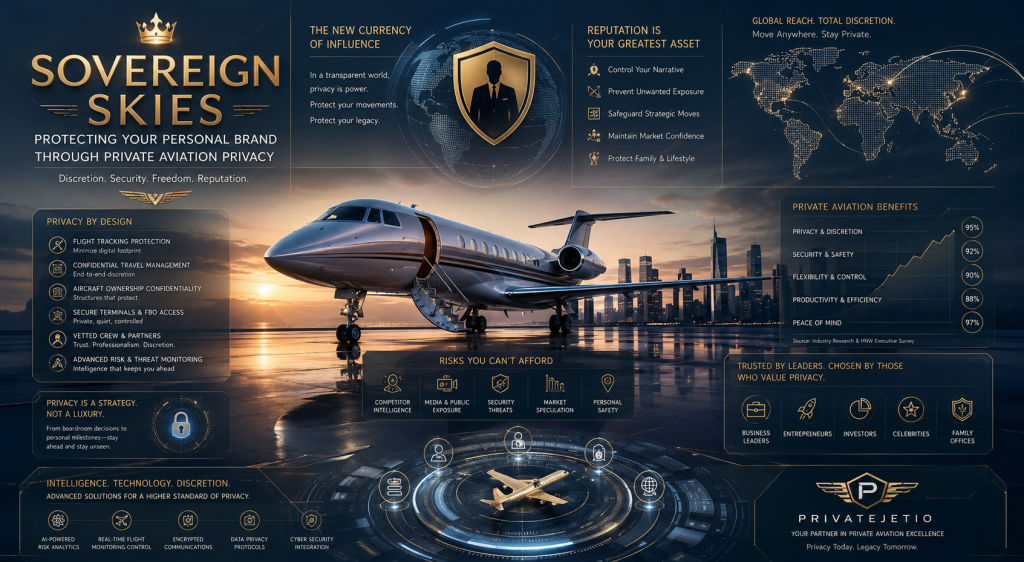
In an era where information travels faster than aircraft, reputation has become one of the most valuable assets an individual can possess. For ultra-high-net-worth individuals, entrepreneurs, public figures, investors, athletes, and corporate leaders, privacy is no longer merely a personal preference, it is a strategic necessity. Every movement, business meeting, acquisition discussion, family vacation, and political engagement can become a source of unwanted exposure.
Private aviation privacy has emerged as one of the most effective tools for protecting personal brands, reducing security risks, and preserving strategic confidentiality. While private aviation is often associated with convenience and luxury, sophisticated decision-makers increasingly view it as a reputation management and risk mitigation solution.
The aircraft itself may be a transportation asset, but the privacy ecosystem surrounding private aviation can be a powerful shield against reputational damage, operational vulnerabilities, and unwanted public scrutiny.
By: Private Jetio – Research Council
Why Personal Brand Protection Matters More Than Ever
The modern reputation landscape has changed dramatically.
A decade ago, a business leader could travel internationally with relatively little public visibility. Today, social media, public flight databases, mobile cameras, artificial intelligence, geolocation technology, and open-source intelligence platforms have transformed privacy into a scarce commodity.
For prominent individuals, a single public sighting can generate:
- Media speculation
- Competitive intelligence leaks
- Security concerns
- Market rumors
- Investor uncertainty
- Personal safety threats
The value of a personal brand often extends far beyond public perception. It influences investment opportunities, partnership negotiations, acquisition discussions, board appointments, and overall market credibility.
A damaged reputation can take years to rebuild.
Protecting that reputation requires proactive measures rather than reactive damage control.
The Growing Transparency of Global Travel
Many travelers assume their movements remain private.
In reality, modern travel creates extensive digital footprints.
Commercial aviation involves:
- Airport surveillance systems
- Passenger manifests
- Crowded terminals
- Social media exposure
- Frequent public visibility
- Third-party service providers
Even private aviation faces growing transparency challenges due to publicly accessible flight tracking systems.
This new environment has created demand for enhanced private jet security measures that go far beyond traditional transportation considerations.
The objective is no longer simply reaching a destination.
The objective is reaching it discreetly.
How Private Aviation Supports Reputation Management
Private aviation privacy offers several unique advantages that directly contribute to personal brand protection.
Control of Information Exposure
One of the most significant benefits is information control.
Private aviation allows travelers to determine:
- Who knows about their travel
- When travel occurs
- Where travel originates
- Where travel concludes
- Who has access to passenger information
Reducing information exposure decreases opportunities for speculation and unwanted publicity.
Limiting Public Encounters
Commercial airports expose travelers to thousands of people.
Private terminals significantly reduce visibility.
Executives, celebrities, investors, and family offices often use private terminals specifically to avoid unnecessary public interaction.
Reduced visibility directly translates into lower reputational risk.
Protecting Strategic Meetings
Business travel often accompanies sensitive discussions involving:
- Mergers and acquisitions
- Venture capital investments
- Government relations
- Legal negotiations
- Strategic partnerships
- Crisis management
Premature disclosure of travel plans can reveal intentions before negotiations conclude.
Private aviation privacy helps preserve confidentiality throughout the process.
The Hidden Risks of Flight Tracking
Flight tracking technology has become increasingly sophisticated.
Aircraft movements can often be monitored through publicly available databases and tracking platforms.
This presents significant concerns for:
- Public companies
- Investment firms
- Political leaders
- Celebrities
- Family offices
- High-profile entrepreneurs
Market observers frequently analyze aircraft movements to identify:
- Potential acquisitions
- Executive meetings
- Corporate strategy shifts
- Government engagements
- Investment activity
Flight tracking protection has therefore become a critical component of modern privacy strategies.
Organizations and individuals increasingly seek consulting expertise to assess and mitigate these visibility risks.
Celebrity Travel Privacy: Lessons from Public Exposure
Celebrities have long faced the consequences of excessive travel visibility.
Public aircraft tracking has fueled:
- Tabloid reporting
- Social media controversy
- Environmental criticism
- Personal security concerns
- Harassment incidents
Several high-profile figures have experienced significant reputational challenges because aircraft movements became public narratives.
The lesson extends far beyond entertainment.
Corporate leaders face similar exposure risks.
Investors, founders, and executives may not generate headlines daily, but sensitive travel information can still influence markets, negotiations, and stakeholder perceptions.
Celebrity travel privacy strategies often serve as useful models for broader executive protection programs.
Executive Travel Security in the Modern Threat Environment
Security and reputation are closely linked.
A security incident often evolves into a reputation crisis.
Modern executive travel security programs consider multiple risk dimensions:
Physical Risks
These include:
- Stalking
- Kidnapping threats
- Protest activity
- Organized crime targeting
- Opportunistic attacks
Digital Risks
Digital threats include:
- Geolocation tracking
- Data aggregation
- Open-source intelligence collection
- Social engineering attacks
Reputational Risks
Reputational threats may involve:
- Media leaks
- False narratives
- Competitive exploitation
- Public controversy
Private aviation provides a controlled environment that reduces exposure across all three categories.
The Business Intelligence Value of Confidential Travel
Confidentiality is often misunderstood.
It is not secrecy for its own sake.
It is strategic protection of information.
When major transactions occur, travel patterns can reveal intentions.
Imagine:
A private equity firm evaluating an acquisition.
A technology company pursuing a strategic partnership.
An energy executive meeting government officials.
An investor exploring opportunities in emerging markets.
If competitors identify those movements, valuable intelligence can be extracted.
Aircraft ownership confidentiality and secure travel planning help preserve strategic advantages during sensitive engagements.
The Connection Between Aviation and Corporate Reputation
Corporate reputation increasingly depends on executive behavior.
Stakeholders often view leadership visibility as a reflection of organizational discipline.
Poorly managed travel exposure can create:
- Governance concerns
- Investor questions
- Media attention
- Security vulnerabilities
Companies investing in sophisticated aviation risk management frameworks often gain stronger control over executive exposure.
This approach demonstrates proactive leadership and responsible risk management.
Private Aviation Privacy as a Competitive Advantage
Privacy is frequently viewed as a defensive tool.
In reality, it can become a competitive advantage.
Organizations that protect sensitive activities effectively can:
- Maintain negotiation leverage.
- Reduce information leakage.
- Improve strategic flexibility.
- Protect intellectual capital.
- Minimize market speculation.
- Enhance stakeholder confidence.
- Preserve operational security.
These benefits directly influence long-term enterprise value.
The Role of Aviation Consultants in Privacy Protection
Many individuals focus solely on aircraft selection.
However, aircraft selection represents only one aspect of the equation.
Professional aviation advisors evaluate:
Operational Privacy
How visible are travel activities?
Ownership Structures
How can ownership be structured efficiently and responsibly?
Security Protocols
What procedures reduce exposure?
Reputation Risk
What travel-related activities could generate unwanted attention?
Technology Risks
How vulnerable is the operation to tracking and data collection?
A sophisticated advisory process considers the complete privacy ecosystem.
High-Net-Worth Security Beyond Transportation
For many wealthy individuals, security planning includes:
- Residential security
- Cybersecurity
- Family office protection
- Executive protection
- Crisis response
Travel security should be integrated into this broader framework.
High-net-worth security programs increasingly recognize aircraft operations as an essential component of personal risk management.
Travel often represents the most visible aspect of an individual’s lifestyle.
Managing that visibility is critical.
Understanding Confidential Travel Management
Confidential travel management involves far more than booking flights.
It includes:
- Route planning
- Passenger confidentiality
- Ground transportation coordination
- Secure communication procedures
- Exposure assessments
- Travel intelligence monitoring
Sophisticated travelers increasingly seek comprehensive solutions rather than simple charter arrangements.
This shift reflects the growing complexity of modern risk environments.
Reputation Protection During Business Expansion
International growth introduces new challenges.
Executives exploring opportunities abroad often enter unfamiliar political, regulatory, and security environments.
Visibility can create:
- Competitive interference
- Political scrutiny
- Media speculation
- Regulatory complications
Private aviation privacy helps reduce unnecessary exposure while maintaining flexibility.
For organizations entering emerging markets, travel discretion can significantly enhance operational effectiveness.
The Future of Privacy in Aviation
Technology continues to evolve.
Artificial intelligence, satellite monitoring, open-source intelligence tools, and predictive analytics are increasing transparency across industries.
As visibility expands, privacy becomes more valuable.
Future aviation strategies will likely emphasize:
- Enhanced tracking protection
- Advanced digital security
- Stronger confidentiality frameworks
- Integrated intelligence support
- Reputation-focused travel planning
Individuals who adapt early will enjoy substantial advantages.
Those who ignore these developments may face increasing exposure risks.
Key Questions Every Private Aviation User Should Ask
Before purchasing or chartering an aircraft, decision-makers should evaluate:
- What privacy risks currently exist?
- How visible are travel activities?
- Can competitors infer strategic intentions?
- What reputation vulnerabilities are associated with travel?
- Are existing security measures sufficient?
- How effective is flight tracking protection?
- Does the aviation strategy align with broader personal or corporate objectives?
These questions often reveal opportunities for improvement.
Why Privacy Should Influence Aircraft Decisions
Many buyers focus on:
- Range
- Cabin size
- Operating costs
- Performance
- Acquisition price
While these factors matter, privacy considerations deserve equal attention.
The ideal aviation strategy balances:
- Performance
- Efficiency
- Security
- Confidentiality
- Reputation protection
Aircraft decisions should support long-term strategic objectives rather than short-term convenience alone.
Sovereign Mobility in a Transparent World
The concept of sovereign mobility has become increasingly relevant.
True mobility means more than unrestricted movement.
It means retaining control over information, reputation, and personal security while moving through a highly connected world.
Private aviation privacy supports that objective.
It enables leaders to operate with greater confidence, discretion, and strategic freedom.
For influential individuals, protecting reputation is not an optional luxury.
It is a business necessity.
Conclusion
The value of private aviation extends far beyond speed, convenience, and comfort. In today’s information-driven environment, private aviation privacy represents a powerful mechanism for protecting personal brands, preserving strategic confidentiality, and enhancing overall security.
Executives, entrepreneurs, investors, celebrities, family offices, and corporate leaders face unprecedented visibility risks. Flight tracking technologies, social media, open-source intelligence tools, and digital surveillance have transformed travel into a potential source of exposure.
A carefully designed aviation strategy can reduce those risks significantly.
Whether acquiring an aircraft, evaluating charter options, restructuring ownership, or enhancing travel confidentiality, informed decision-making is essential.
At PrivateJetio, we help buyers, owners, family offices, and aviation stakeholders evaluate private aviation through a strategic lens balancing privacy, security, operational efficiency, ownership considerations, and long-term value.
If your travel decisions influence your reputation, investments, negotiations, or security posture, a professional aviation advisory consultation may be one of the most valuable investments you make.
Frequently Asked Questions
How does private aviation help protect personal privacy?
Private aviation reduces public exposure by limiting interactions in crowded terminals, protecting passenger information, and providing greater control over travel logistics and visibility.
Can private jet flights still be tracked publicly?
Yes. Certain aircraft movements may appear on public tracking systems. However, various privacy and compliance measures can reduce visibility and enhance confidentiality.
Why is travel privacy important for business executives?
Travel patterns can reveal strategic activities such as acquisitions, negotiations, investments, or government engagements. Protecting that information helps preserve competitive advantages.
Is private aviation only about luxury?
No. While comfort is a benefit, many users prioritize security, confidentiality, flexibility, and operational efficiency over luxury alone.
Should privacy be considered when buying a private jet?
Absolutely. Privacy considerations should be integrated into aircraft selection, ownership structures, operational planning, and long-term aviation strategy.
References:
National Business Aviation Association
https://nbaa.org
Federal Aviation Administration
https://www.faa.gov
International Civil Aviation Organization
https://www.icao.int
International Air Transport Association – Security & Facilitation
https://www.iata.org
European Union Aviation Safety Agency
https://www.easa.europa.eu


