
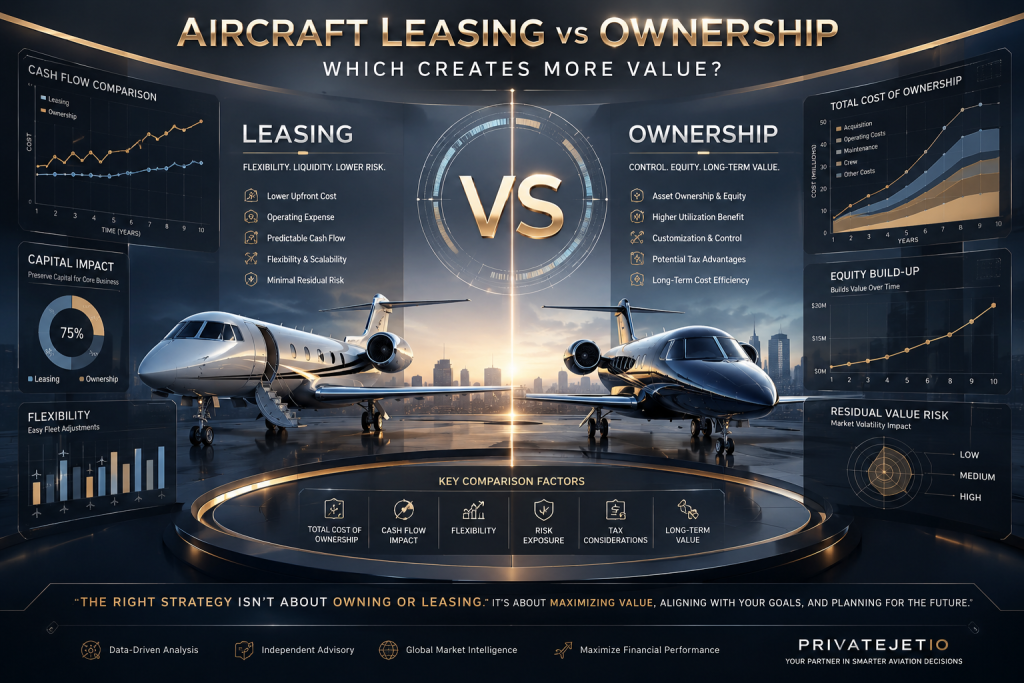
Aircraft Leasing vs Ownership: Which Creates More Value?
The decision between leasing and owning an aircraft is one of the most significant financial choices in private aviation. For ultra-high-net-worth individuals, corporate flight departments, family offices, and aviation operators, the question extends far beyond monthly payments or acquisition costs. It involves capital allocation, operational flexibility, tax planning, risk management, and long-term wealth preservation.
Many aircraft buyers initially assume ownership is always the superior path because it provides control and asset appreciation potential. Others view leasing as a flexible alternative that reduces risk and preserves liquidity. In reality, neither approach is universally superior. The optimal strategy depends on utilization patterns, investment objectives, balance sheet considerations, and future market expectations.
Understanding the financial performance implications of aircraft leasing versus ownership requires a comprehensive analysis of both direct and indirect costs, opportunity costs, asset depreciation, financing structures, and operational requirements.
For sophisticated aviation stakeholders, the objective is not simply to acquire access to an aircraft. The objective is to maximize value while minimizing unnecessary financial exposure.
By: PrivateJetio Aviation Advisory Team
Understanding the Economics of Aircraft Ownership
Aircraft ownership represents the traditional model of private aviation. An individual, corporation, or entity acquires full or majority ownership rights to an aircraft and assumes responsibility for all associated expenses and operational decisions.
Ownership provides complete control over scheduling, customization, maintenance standards, crew selection, and operational deployment.
However, control comes with significant financial commitments.
The Initial Capital Requirement
Modern business aircraft require substantial capital investments.
A light jet may cost several million dollars, while large-cabin and ultra-long-range aircraft frequently exceed tens of millions of dollars. Flagship aircraft can surpass $70 million depending on configuration and market conditions.
This capital commitment immediately raises an important financial question:
Could the capital deployed into aircraft ownership generate superior returns elsewhere?
For many investors and entrepreneurs, the answer is yes.
When $30 million is allocated to an aircraft purchase, that capital is no longer available for business expansion, acquisitions, portfolio investments, or other wealth-generating opportunities.
This introduces the concept of opportunity cost, which is often overlooked in aviation acquisition discussions.
Depreciation and Asset Value
Aircraft are assets, but they are not always appreciating assets.
Unlike certain categories of real estate or alternative investments, aircraft generally depreciate over time.
Depreciation rates depend on factors including:
- Aircraft model
- Manufacturer reputation
- Maintenance history
- Market demand
- Regulatory changes
- Engine program participation
- Technological relevance
New aircraft often experience the most significant depreciation during the first several years of ownership.
The owner bears this risk directly.
If market conditions deteriorate or new technologies emerge, residual values may decline faster than anticipated.
This residual value risk represents one of the most important financial considerations in aircraft ownership.
Operating Costs
Ownership also transfers responsibility for ongoing aircraft operating expenses.
Typical costs include:
- Crew salaries
- Crew training
- Insurance
- Fuel
- Maintenance
- Engine reserves
- Hangar fees
- Navigation charges
- Compliance requirements
- Management fees
These expenses continue regardless of utilization.
Whether an aircraft flies 100 hours or 500 hours annually, many fixed costs remain largely unchanged.
This creates inefficiencies for owners with inconsistent utilization patterns.
Why Leasing Has Become Increasingly Popular
Over the past decade, private jet leasing options have gained significant traction among sophisticated aviation users.
Several factors have contributed to this trend:
- Increased focus on capital efficiency
- Market volatility
- Desire for operational flexibility
- Technological advancement cycles
- Changing tax environments
Leasing allows organizations and individuals to access aircraft capabilities without assuming full ownership responsibilities.
In many cases, leasing transforms aviation from a capital-intensive asset purchase into a more predictable operating expense.
Preserving Capital
One of the strongest arguments in favor of leasing is capital preservation.
Instead of allocating millions of dollars toward aircraft acquisition, organizations can deploy capital toward strategic initiatives with potentially higher returns.
This becomes particularly relevant for:
- Private equity firms
- Family offices
- Entrepreneurs
- High-growth companies
- Investment-focused organizations
A company generating 15% annual returns on invested capital may find leasing significantly more attractive than tying substantial funds into a depreciating aviation asset.
The decision therefore becomes a comparison between expected investment returns and aircraft ownership economics.
Enhanced Flexibility
Leasing also provides flexibility that ownership often cannot match.
Aviation requirements evolve.
A company requiring a midsize aircraft today may need a long-range jet in three years.
An entrepreneur conducting regional travel may eventually require intercontinental capabilities.
Ownership can make these transitions expensive.
Selling an aircraft involves brokerage fees, market timing risks, inspection requirements, and transaction costs.
Leasing structures often allow easier fleet adjustments.
This flexibility creates strategic advantages in rapidly changing business environments.
Predictable Financial Planning
Budget predictability is another major advantage.
Many lease agreements include maintenance provisions, support programs, or structured cost frameworks that simplify financial forecasting.
Predictable expenses improve:
- Budget planning
- Cash flow management
- Financial reporting
- Capital allocation decisions
For publicly traded companies and institutional operators, predictability often carries substantial value.
Total Cost of Ownership Aviation Analysis
One of the most misunderstood areas in private aviation is the true total cost of ownership aviation calculation.
Many prospective buyers focus on acquisition costs while underestimating ongoing expenses.
A comprehensive ownership analysis includes:
- Acquisition cost
- Financing cost
- Insurance
- Maintenance
- Fuel
- Crew expenses
- Hangar costs
- Management fees
- Depreciation
- Opportunity cost of capital
The final category is particularly important.
An aircraft may appear financially attractive until opportunity cost is incorporated.
For example, if a $25 million aircraft purchase prevents deployment of capital into investments generating meaningful returns, the effective ownership cost increases substantially.
Sophisticated aviation asset management strategies therefore evaluate both direct and indirect financial implications.
The Role of Utilization in the Decision
Utilization frequently determines whether ownership or leasing delivers superior economic performance.
There is no universal threshold applicable to every situation.
However, utilization remains a critical factor.
Low Utilization Profiles
For users flying fewer annual hours, leasing often delivers stronger economics.
Fixed ownership costs become disproportionately expensive when spread across limited flight activity.
Examples include:
- Family offices with occasional travel
- Seasonal business operations
- Executives with variable schedules
- Organizations testing aviation requirements
In these scenarios, ownership may create unnecessary financial inefficiencies.
High Utilization Profiles
As annual flight hours increase, ownership becomes more attractive.
Higher utilization spreads fixed expenses across a greater number of flight hours.
Organizations with consistent travel requirements often benefit from:
- Greater scheduling control
- Enhanced operational customization
- Improved long-term cost efficiency
This is particularly relevant for corporations operating aircraft as mission-critical business tools.
When utilization reaches substantial levels, ownership frequently becomes economically competitive.
Business Aircraft Financing Considerations
Financing structures can dramatically influence ownership economics.
Aircraft acquisitions rarely involve simplistic cash purchases.
Instead, many transactions utilize sophisticated financing solutions.
Common structures include:
- Traditional loans
- Asset-backed financing
- Operating leases
- Finance leases
- Cross-border structures
- Tax-efficient ownership vehicles
The cost of capital significantly impacts overall financial performance.
During periods of low interest rates, ownership may become more attractive.
Conversely, higher financing costs can shift the balance toward leasing solutions.
This dynamic explains why aviation acquisition strategy must be evaluated within broader economic conditions rather than in isolation.
Interest Rates and Capital Markets
Interest rate environments affect nearly every aircraft acquisition decision.
Higher borrowing costs increase ownership expenses while simultaneously influencing residual values and secondary market demand.
Experienced aviation advisors therefore monitor:
- Credit markets
- Interest rate trends
- Aircraft liquidity
- Secondary market activity
- Manufacturer production levels
These factors collectively shape the long-term financial outlook of ownership versus leasing decisions.
Residual Value Risk: The Silent Financial Variable
Many first-time aircraft buyers underestimate the importance of residual value risk.
Yet it frequently represents one of the largest financial variables in the entire ownership equation.
Aircraft values are influenced by numerous external factors beyond the owner’s control.
Examples include:
- Economic recessions
- Fuel price fluctuations
- Regulatory changes
- New aircraft programs
- Environmental requirements
- Technological innovation
- Manufacturer production decisions
An aircraft acquired during a strong market may experience value compression if market conditions change.
Leasing transfers much of this exposure away from the operator.
For organizations prioritizing risk reduction, this transfer can represent a substantial strategic advantage.


