
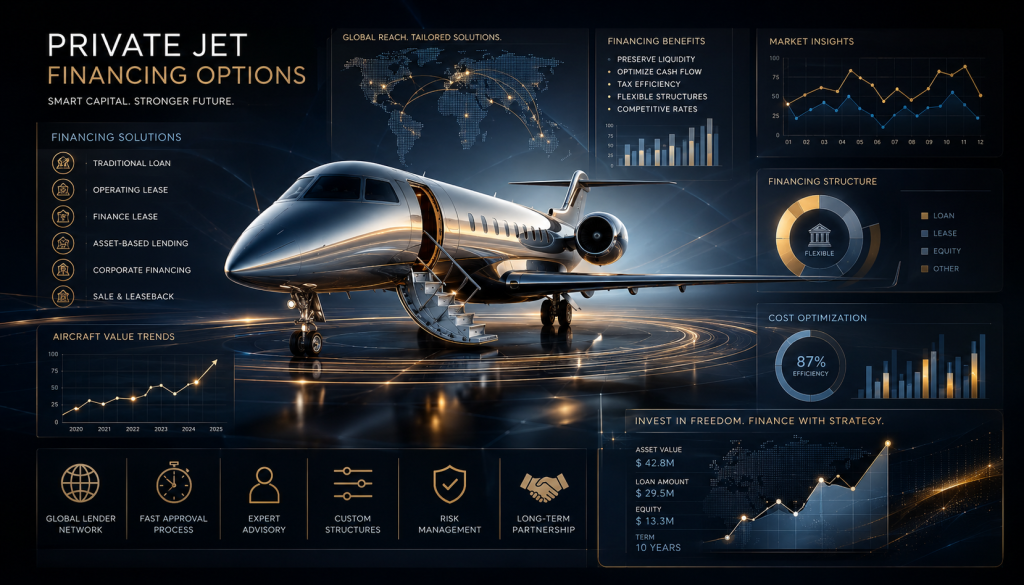
Purchasing a private aircraft represents one of the most significant financial decisions many entrepreneurs, family offices, corporations, and ultra-high-net-worth individuals will ever make. While some buyers acquire aircraft entirely with cash, a substantial percentage of modern private jet acquisitions involve carefully structured financing solutions designed to preserve liquidity, optimize tax efficiency, and strengthen long-term financial flexibility.
Understanding today’s private jet financing options requires far more than comparing interest rates. Aircraft financing has evolved into a sophisticated financial discipline involving international regulations, asset valuation, depreciation strategies, ownership structures, residual value analysis, and long-term wealth management planning. Choosing the wrong financing structure may increase ownership costs by millions of dollars over the life of an aircraft, while the right strategy can preserve capital for investments that generate significantly higher returns.
At PrivateJetio, we believe financing should never be viewed as simply borrowing money. Instead, it should become an integral component of a broader aviation ownership strategy that aligns with your business objectives, tax planning, operational requirements, and long-term exit strategy.
Whether you are purchasing your first business jet or expanding an existing fleet, understanding the available financing structures allows you to negotiate with confidence and make decisions that continue creating value long after delivery.
PrivateJetio Advisory Team
Independent Private Aviation Consulting | Aircraft Acquisition | Strategic Advisory | Market Intelligence
Why Financing Often Makes More Sense Than Paying Cash
Many first-time buyers assume that paying cash automatically represents the smartest financial decision. While debt-free ownership may appear attractive, experienced aircraft owners frequently choose financing even when they possess sufficient liquidity to purchase the aircraft outright.
The reason is straightforward: capital is valuable.
Every dollar allocated toward an aircraft purchase is capital that can no longer generate returns through business expansion, private equity investments, commercial real estate, venture capital opportunities, or diversified investment portfolios.
For successful entrepreneurs, liquidity often delivers greater strategic value than owning an aircraft without leverage.
Financing allows owners to maintain cash reserves while still benefiting from immediate aircraft availability. This flexibility becomes especially valuable during periods of market uncertainty when investment opportunities emerge unexpectedly or when businesses require additional working capital.
Modern aircraft financing also allows borrowers to match debt repayment schedules with expected cash flow, creating predictable financial planning rather than a significant one-time capital expenditure.
Rather than viewing financing as a cost, sophisticated buyers frequently consider it a tool for capital optimization.
Understanding the Current Aircraft Finance Market
The global aircraft finance market has changed considerably over the past several years. Rising interest rates, stronger lending standards, increased aircraft values, and limited production capacity have reshaped how lenders evaluate transactions.
Unlike residential mortgages or automobile financing, private jet loans require specialized underwriting performed by institutions that understand aviation assets.
Aircraft lenders evaluate significantly more than personal credit history.
They typically analyze:
- Net worth
- Global asset portfolio
- Business performance
- Source of income
- Aircraft mission profile
- Aircraft age
- Aircraft manufacturer
- Maintenance history
- Market liquidity
- Expected depreciation
- Geographic registration
- Exit value
Because aircraft are highly specialized assets, lenders also examine future resale potential before approving financing.
An aircraft with strong global demand and stable residual value often qualifies for more favorable lending terms than an older aircraft with limited resale liquidity.
For this reason, selecting the right aircraft model may improve financing opportunities before negotiations even begin.
The Most Common Private Jet Financing Options
Today’s buyers have access to multiple financing structures depending on ownership objectives, jurisdiction, tax considerations, and operational requirements.
Understanding each option allows buyers to select the structure that best aligns with their financial goals.
Traditional Aircraft Loan
The most common financing solution remains the secured aircraft loan.
In this structure, the aircraft itself serves as collateral while the lender provides financing based upon a percentage of the purchase price.
Loan terms typically range between five and twenty years depending on aircraft age, borrower profile, and lender requirements.
Most traditional lenders require:
- Down payment
- Financial statements
- Tax documentation
- Asset verification
- Aircraft appraisal
- Purchase agreement
- Insurance confirmation
Borrowers generally retain full ownership while making scheduled principal and interest payments throughout the loan term.
For many business owners, this remains the simplest and most straightforward financing solution.
Asset-Based Lending
Many high-net-worth buyers possess diversified investment portfolios that significantly exceed the aircraft purchase price.
Rather than liquidating appreciated investments, asset-based lending allows borrowers to secure financing using investment portfolios, securities, or other qualified assets.
This approach offers several advantages.
Capital gains taxes may be deferred.
Investment portfolios remain invested.
Liquidity is preserved.
Portfolio growth may exceed financing costs over time.
Asset-based financing has become increasingly attractive for family offices and investment professionals seeking efficient capital deployment.
Corporate Aircraft Financing
Many aircraft acquisitions occur through operating companies rather than individual ownership.
Corporate financing evaluates both the company and the aircraft.
Lenders review revenue history, profitability, industry outlook, debt ratios, and future growth expectations.
Companies with stable financial performance often qualify for highly competitive financing packages.
Corporate ownership may also simplify accounting, operational expenses, depreciation planning, and business use documentation.
However, each jurisdiction applies different regulations regarding corporate aircraft ownership, making professional legal and tax guidance essential before finalizing any transaction.
Operating Lease
An operating lease provides aircraft access without full ownership responsibilities.
Rather than purchasing the aircraft, the operator leases it for a defined period before returning it to the lessor.
Operating leases may benefit organizations that:
Need temporary aircraft capacity.
Prefer newer aircraft every few years.
Avoid long-term ownership risk.
Reduce balance sheet exposure.
Minimize resale uncertainty.
For businesses with evolving travel requirements, operating leases offer operational flexibility while reducing long-term capital commitment.
Finance Lease
A finance lease closely resembles ownership.
Although legal ownership remains with the financing company during the lease period, the lessee assumes many ownership responsibilities including maintenance, insurance, operational expenses, and aircraft management.
Many finance leases conclude with an option to purchase the aircraft for a predetermined residual amount.
For buyers planning eventual ownership, this structure provides predictable acquisition planning while reducing initial capital requirements.
How Lenders Determine Financing Eligibility
Aircraft financing differs substantially from consumer lending.
Private aviation lenders evaluate risk from multiple perspectives.
Personal financial strength remains important, but lenders also analyze how the aircraft itself supports the financing decision.
Several key factors influence approval.
Credit Quality
Although wealthy borrowers sometimes assume credit scores matter less, lenders still review personal and corporate credit histories carefully.
Strong payment history demonstrates financial discipline and reduces perceived lending risk.
Net Worth and Liquidity
Most lenders prefer borrowers whose liquid assets comfortably exceed financing obligations.
Maintaining significant post-closing liquidity reassures lenders that unexpected economic changes are unlikely to affect repayment ability.
Aircraft Age
Newer aircraft generally qualify for longer repayment terms and lower interest rates.
Older aircraft often require larger down payments because depreciation and maintenance uncertainty increase lending risk.
Aircraft manufactured by globally recognized OEMs with active resale markets typically receive more favorable financing treatment than niche or discontinued models.
Aircraft Appraisal
Independent aircraft valuation remains one of the most important components of financing approval.
Professional appraisers evaluate:
Current market value
Maintenance status
Engine programs
Airframe condition
Cabin upgrades
Avionics modernization
Damage history
Future marketability
An accurate appraisal protects both lender and buyer while establishing an objective financing foundation.
Debt-to-Income Analysis
For individual borrowers, lenders compare annual income against existing financial obligations.
Corporate borrowers undergo broader financial ratio analysis including profitability, leverage, and cash flow stability.
Healthy financial metrics improve financing flexibility and negotiation leverage.
Choosing the Right Loan Structure
Interest rates receive considerable attention during financing discussions, yet they represent only one component of total ownership cost.
Sophisticated buyers compare complete financing structures rather than simply selecting the lowest advertised rate.
Important considerations include:
Loan duration
Balloon payment options
Prepayment flexibility
Variable versus fixed interest
Closing costs
Origination fees
Collateral requirements
Cross-border financing limitations
Currency exposure
Residual value assumptions
The optimal financing solution depends entirely upon individual ownership objectives rather than standardized lending formulas.
For example, an entrepreneur expecting significant liquidity within three years may prioritize flexible prepayment options over the absolute lowest interest rate.
A multinational corporation, however, may prioritize long-term payment stability to support budgeting and international financial reporting.
Understanding these differences allows buyers to negotiate financing that supports broader business strategy rather than simply funding an aircraft purchase.
Fixed Interest vs Variable Interest Financing
One of the most important decisions during aircraft financing involves selecting between fixed and variable interest structures.
Neither option is universally superior. The appropriate choice depends on market conditions, risk tolerance, expected ownership duration, and broader investment strategy.
Fixed-rate financing provides predictable monthly payments throughout the loan term. Owners benefit from payment stability, making long-term budgeting considerably easier. During periods of rising interest rates, fixed financing protects borrowers from increasing borrowing costs while preserving certainty over future cash flow.
Variable-rate financing, on the other hand, often begins with a lower initial rate. As benchmark interest rates change, financing costs fluctuate accordingly. When economic conditions favor lower rates, borrowers may benefit from reduced financing expenses. However, variable-rate loans also expose owners to potential increases if monetary policy changes.
Sophisticated buyers often evaluate projected ownership timelines before making this decision. If the aircraft is expected to be sold within only a few years, accepting limited interest rate variability may prove financially advantageous. Longer ownership periods generally increase the value of predictable financing expenses.
The Importance of Aircraft Down Payments
Private aircraft financing rarely covers one hundred percent of the purchase price.
Most lenders require buyers to contribute meaningful equity at closing, demonstrating financial commitment while reducing lender exposure.
Typical down payments vary according to several factors, including aircraft age, manufacturer reputation, market liquidity, borrower profile, and overall financing structure.
New aircraft from globally recognized manufacturers frequently qualify for higher loan-to-value ratios than older aircraft approaching major maintenance events.
Providing a larger down payment often delivers multiple advantages.
Borrowers may secure lower interest rates.
Monthly payments decrease.
Overall financing costs decline throughout the loan term.
Loan approval may become faster.
Negotiating leverage frequently improves.
Some experienced owners intentionally contribute additional equity despite qualifying for higher leverage. This strategy reduces financing costs while strengthening long-term asset equity.
Others deliberately preserve liquidity by minimizing the initial contribution, allowing capital to remain invested elsewhere.
Neither approach is inherently correct. The optimal strategy depends entirely upon broader financial objectives.
Financing New Aircraft Versus Pre-Owned Aircraft
The financing process differs significantly between factory-new aircraft and previously owned business jets.
New aircraft generally present lower risk for lenders because maintenance history begins at delivery, manufacturer warranties remain active, and resale demand typically remains strong during the early ownership years.
As a result, financing institutions often provide:
Longer repayment periods
Higher loan-to-value ratios
Lower interest rates
Simplified underwriting
Greater lender competition
Pre-owned aircraft require more comprehensive evaluation.
Lenders closely review maintenance records, engine programs, service bulletins, avionics upgrades, inspection schedules, damage history, and future maintenance obligations.
An exceptionally maintained pre-owned aircraft may qualify for financing terms nearly identical to those offered for new aircraft.
Conversely, deferred maintenance or incomplete documentation can significantly affect financing availability.
This reinforces the importance of conducting thorough aviation due diligence before committing to any acquisition.
International Aircraft Financing Considerations
Private aviation is inherently global.
Aircraft frequently operate across multiple jurisdictions while ownership structures span several countries.
International acquisitions introduce additional financing considerations beyond domestic transactions.
Among the most important are:
Currency exposure
Registration jurisdiction
Import duties
Value Added Tax
Sales tax obligations
Cross-border collateral registration
Cape Town Convention compliance
International insurance requirements
Foreign lender participation
Each jurisdiction maintains unique legal requirements governing aircraft ownership and secured lending.
Failure to structure financing correctly may produce unnecessary taxation, operational limitations, or registration complications.
For multinational buyers, coordination between aviation attorneys, tax advisors, lenders, escrow providers, and aircraft consultants becomes essential.
Successful international acquisitions rely on integrated planning rather than isolated financial decisions.
The Role of Aircraft Appraisals in Financing
Aircraft valuation serves as the foundation of every financing transaction.
Unlike residential real estate, aircraft values change continuously due to technological advances, maintenance status, market demand, production rates, regulatory changes, and global economic conditions.
Independent appraisers evaluate numerous variables before determining market value.
These include:
Airframe total time
Engine cycles
Maintenance tracking
Inspection status
Interior condition
Exterior paint quality
Avionics configuration
Connectivity upgrades
Damage history
Modification records
Current market demand
Comparable transactions
Residual value forecasts
Lenders depend upon accurate appraisals when determining acceptable financing levels.
For buyers, an independent valuation also prevents overpaying for an aircraft during periods of elevated market demand.
Professional valuation should always precede financing approval rather than follow it.
Tax Planning and Aircraft Financing
Tax strategy frequently influences financing decisions as much as interest rates.
Depending on jurisdiction and ownership structure, aircraft purchases may qualify for various depreciation methods, business expense deductions, or investment incentives.
Potential considerations include accelerated depreciation, bonus depreciation where applicable, operating expense deductions, capital allowance programs, and business-use documentation.
However, tax treatment varies substantially between countries and frequently changes through legislative updates.
Improper ownership structures can unintentionally eliminate valuable tax advantages while increasing compliance obligations.
For this reason, financing discussions should always occur alongside experienced aviation tax advisors rather than after the acquisition has already been completed.
The objective is not merely to finance an aircraft but to create an ownership structure that supports long-term wealth preservation.
Common Financing Mistakes Buyers Should Avoid
Aircraft financing mistakes rarely become apparent during closing.
Instead, they emerge years later through higher ownership costs, reduced resale flexibility, or unnecessary financial exposure.
Several recurring mistakes appear consistently among first-time buyers.
The first is focusing exclusively on interest rates.
While borrowing costs matter, financing represents only one component of total ownership expenses.
Insurance, maintenance, fuel, crew salaries, hangar fees, management costs, inspections, upgrades, and depreciation frequently exceed financing expenses throughout the ownership lifecycle.
Another common mistake involves selecting financing before selecting the right aircraft.
Aircraft choice directly influences financing availability, future maintenance obligations, and residual value.
Choosing the wrong aircraft can significantly reduce financing flexibility.
Some buyers also underestimate liquidity requirements after delivery.
Owning a business jet requires sufficient ongoing capital to support operations regardless of financing structure.
Preserving healthy cash reserves remains essential.
Finally, many acquisitions proceed without independent advisory representation.
Manufacturers, brokers, and lenders each represent their own commercial interests.
An independent aviation consultant represents only the buyer’s objectives, helping negotiate pricing, evaluate financing alternatives, coordinate due diligence, and reduce long-term ownership risk.
Financing Through Manufacturer Programs
Several major aircraft manufacturers maintain preferred financing relationships with banks and aviation finance specialists.
These partnerships may simplify transactions by providing coordinated financing during the purchase process.
Manufacturer-supported financing occasionally includes attractive incentives such as reduced closing costs, promotional interest rates, deferred initial payments, or expedited underwriting.
While these programs can provide excellent value, buyers should still compare independent financing proposals.
Competitive lending often produces better long-term outcomes than accepting the first available financing offer.
Independent comparison remains an essential component of responsible aircraft acquisition.
The Growing Influence of Family Offices
Family offices have become increasingly influential participants within the private aviation market.
Unlike traditional individual ownership, family offices typically evaluate aircraft acquisitions as components of diversified investment and wealth preservation strategies.
Financing decisions therefore extend beyond monthly loan payments.
Considerations often include:
Generational wealth transfer
Portfolio liquidity
Risk diversification
Asset allocation
International mobility
Estate planning
Operating efficiency
Long-term capital preservation
Aircraft ownership becomes part of a broader financial ecosystem rather than an isolated purchase.
Financing structures must therefore align with family governance objectives and multi-generational planning.
Digital Transformation in Aircraft Financing
Technology continues reshaping aviation finance.
Digital documentation, secure electronic escrow services, automated maintenance record analysis, AI-assisted market valuation tools, blockchain-enabled document verification, and enhanced financial analytics have accelerated financing timelines considerably.
While relationships remain fundamental in private aviation, technology has improved transparency and efficiency throughout the lending process.
Buyers now gain access to broader lender networks, faster underwriting decisions, improved valuation analytics, and enhanced market intelligence.
These developments benefit sophisticated buyers who combine digital efficiency with experienced professional guidance.
Building a Financing Strategy Before Shopping
One of the most overlooked aspects of aircraft acquisition is financing preparation.
Many buyers begin evaluating aircraft before understanding realistic financing parameters.
This approach often creates unnecessary delays and weakens negotiating leverage.
Instead, experienced buyers typically follow a structured process.
- Define operational requirements.
- Establish acquisition budget.
- Evaluate ownership structure.
- Obtain preliminary financing approval.
- Consult aviation tax professionals.
- Identify suitable aircraft models.
- Perform market valuation analysis.
- Conduct technical due diligence.
- Negotiate purchase agreement.
- Finalize financing and complete closing.
Entering negotiations with financing already organized positions buyers as credible purchasers and frequently improves negotiating outcomes.
Why Independent Advisory Creates Long-Term Value
Aircraft financing is rarely just about securing capital.
Every financing decision influences ownership costs, operational flexibility, taxation, depreciation, future resale opportunities, and overall investment performance.
Independent advisors help buyers evaluate opportunities objectively without manufacturer incentives or lending commissions influencing recommendations.
At PrivateJetio, our advisory process begins long before financing discussions start.
We evaluate the intended mission, ownership objectives, travel patterns, operational costs, market timing, residual value expectations, and long-term exit strategy before recommending financing alternatives.
This integrated approach helps clients make informed decisions based on lifetime ownership value rather than short-term financing offers.
For high-value aviation acquisitions, objective guidance frequently delivers greater financial benefit than negotiating a marginally lower interest rate.
The goal is not simply purchasing an aircraft.
The goal is building an ownership strategy that preserves capital, reduces unnecessary risk, and supports long-term financial success.
Private jet financing should therefore be viewed as a strategic investment decision rather than a transactional loan. Buyers who carefully align financing with operational requirements, wealth management objectives, tax planning, and future resale considerations consistently achieve stronger ownership outcomes than those who focus solely on the purchase price. Whether acquiring a light business jet for regional travel or a long-range flagship aircraft for global operations, selecting the appropriate financing structure is one of the most influential decisions made throughout the ownership journey. Working with experienced aviation advisors, specialized lenders, tax professionals, and legal experts ensures that every financial decision contributes to a more efficient, resilient, and valuable ownership experience.
For buyers seeking objective guidance, PrivateJetio provides independent strategic advisory throughout every stage of the acquisition process—from aircraft selection and market intelligence to financing evaluation, technical due diligence, ownership structuring, and long-term asset strategy. Our role is to help clients make informed decisions with confidence while protecting their capital and maximizing the long-term value of their aviation investment.
Frequently Asked Questions
What credit score is typically required for private jet financing?
While lenders consider credit history, they place greater emphasis on overall financial strength, liquidity, business performance, and net worth. Strong financial profiles often matter more than a specific credit score.
Can I finance a pre-owned private jet?
Yes. Many lenders finance pre-owned aircraft provided they have complete maintenance records, satisfactory appraisals, and strong residual value prospects.
How much should I expect to pay as a down payment?
Down payment requirements vary depending on the aircraft, lender, and borrower profile. Newer aircraft with strong market demand generally qualify for more favorable loan-to-value ratios.
Is financing better than paying cash?
For many business owners and investors, financing preserves liquidity and allows capital to remain invested elsewhere. The best choice depends on individual financial goals and overall wealth strategy.
Should I arrange financing before selecting an aircraft?
Obtaining preliminary financing approval before negotiating an aircraft purchase often strengthens your position, simplifies the acquisition process, and helps establish a realistic acquisition budget.
References:
- Federal Aviation Administration – Aircraft Registry
https://www.faa.gov - National Business Aviation Association – Ownership & Operations Resources
https://nbaa.org - International Civil Aviation Organization – Global Aviation Standards
https://www.icao.int - Aircraft Owners and Pilots Association – Aircraft Finance Resources
https://www.aopa.org - International Society of Transport Aircraft Trading – Industry Guidance
https://www.istat.org


