
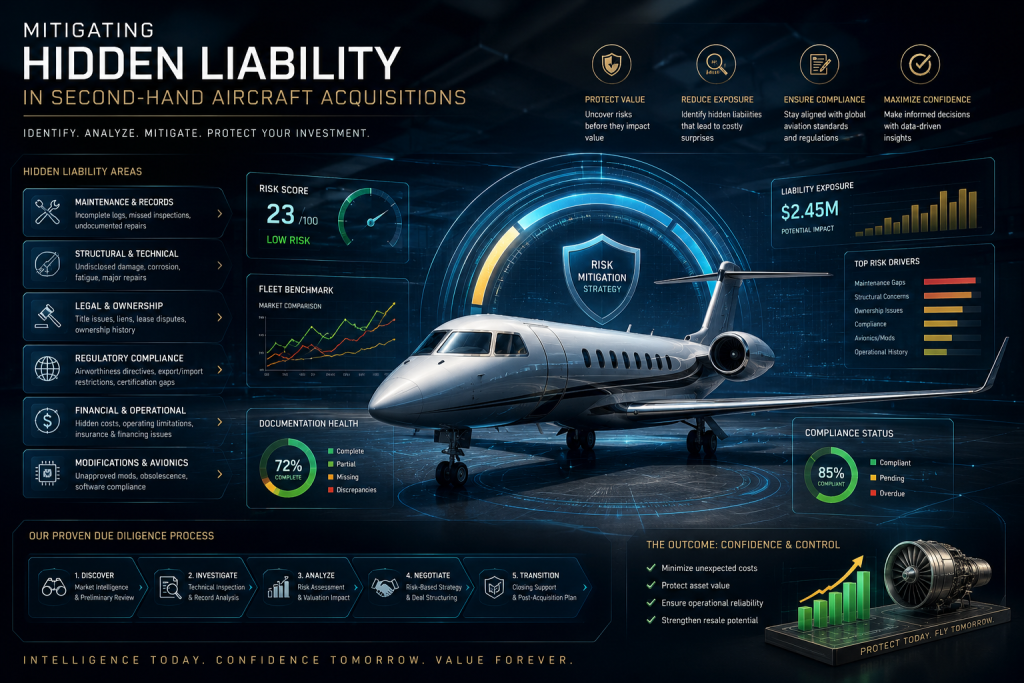
The Hidden Risks Lurking Behind Attractive Aircraft Deals
A second-hand aircraft can represent exceptional value. In many cases, buyers gain access to a significantly more capable aircraft while avoiding the steep depreciation associated with a new delivery. However, beneath an attractive purchase price often lies a complex web of legal, operational, technical, and financial liabilities that may not be immediately visible.
Experienced buyers understand that acquiring a pre-owned aircraft is not simply a transaction. It is an exercise in risk management. A single overlooked issue can result in unexpected maintenance costs, regulatory restrictions, legal disputes, diminished resale value, or operational downtime that far exceeds any initial savings achieved during negotiations.
The most successful aircraft acquisitions are not necessarily the ones secured at the lowest price. They are the acquisitions that uncover risk before capital is deployed.
This guide explores how sophisticated buyers mitigate hidden liability during a used aircraft acquisition and how strategic advisory support can protect both the asset and the owner’s long-term financial interests.
By: PrivateJetio Aviation Advisory Team
Why Hidden Liability Is One of the Largest Threats in Aviation Transactions
Aircraft are among the most heavily regulated and technically complex assets in the world. Unlike conventional luxury assets, they operate within a framework involving international regulations, maintenance obligations, ownership documentation, tax considerations, operational restrictions, and safety compliance requirements.
Many liabilities remain invisible during initial evaluations.
Some examples include:
- Incomplete maintenance history
- Unrecorded damage repairs
- Regulatory non-compliance
- Outstanding liens
- Improper ownership documentation
- Environmental compliance issues
- Tax exposure
- Airworthiness directive violations
- Inaccurate logbooks
- Undisclosed operational incidents
A buyer may believe they are acquiring a well-maintained aircraft only to discover significant corrective actions are required after closing.
In high-value aviation transactions, surprises are expensive.
Understanding the True Cost of Liability
Most buyers focus heavily on acquisition cost.
Elite buyers focus on total exposure.
Consider a scenario where an aircraft appears competitively priced compared with similar market offerings. During ownership, however, the buyer discovers:
- Corrosion requiring structural remediation
- Missing maintenance documentation
- Engine program enrollment issues
- Unapproved modifications
- Regulatory deficiencies
- Disputed ownership claims
The resulting financial impact can reach hundreds of thousands—or even millions—of dollars.
More importantly, these issues often reduce liquidity when the owner decides to sell.
A hidden liability today frequently becomes a valuation discount tomorrow.
Aircraft Due Diligence: The First Line of Defense
Effective aircraft due diligence forms the foundation of every successful acquisition strategy.
Due diligence extends far beyond reviewing photographs, specifications, and seller representations.
It involves a comprehensive examination of:
Technical Condition
The aircraft’s physical condition must be independently verified.
This includes:
- Airframe condition
- Engine condition
- Avionics systems
- Cabin systems
- Structural integrity
- Corrosion assessment
- Modification history
Independent experts often discover discrepancies that would remain invisible to untrained buyers.
Operational History
How the aircraft was operated matters.
Questions include:
- Was it used privately or commercially?
- Was it frequently operated in corrosive environments?
- Did it spend significant time in coastal regions?
- Were maintenance intervals consistently respected?
Operational history frequently predicts future maintenance requirements.
Documentation Analysis
Documentation often reveals risks before physical inspections do.
Areas requiring detailed review include:
- Logbooks
- Airworthiness certificates
- Modification approvals
- Maintenance tracking systems
- Service bulletins
- Airworthiness directives
Documentation inconsistencies should never be dismissed as administrative issues.
In aviation, paperwork often determines asset value.
The Critical Role of the Pre-Purchase Inspection
A professional pre-purchase inspection remains one of the most important safeguards available to buyers.
Yet many purchasers underestimate its scope.
A true pre-purchase inspection is not a routine maintenance event. It is a forensic examination designed specifically to identify liability.
Structural Analysis
Inspectors evaluate:
- Fuselage integrity
- Wing structures
- Corrosion exposure
- Previous repairs
- Fatigue indicators
Even minor structural concerns can dramatically influence future maintenance expenses.
Engine Assessment
Engines represent one of the largest cost components of any aircraft.
Inspectors analyze:
- Remaining service life
- Maintenance history
- Trend monitoring data
- Program participation
- Compliance records
Unexpected engine issues often become the largest financial shock after acquisition.
Avionics Evaluation
Modern avionics systems are expensive to upgrade.
A seemingly attractive aircraft may require substantial investment to satisfy future airspace requirements.
Inspectors review:
- Software status
- Equipment compliance
- Upgrade requirements
- Obsolescence risks
Failure to identify these issues can create immediate capital expenditure obligations after closing.
Why Maintenance Records Review Is Essential
The aircraft itself tells only part of the story.
The records tell the rest.
A comprehensive maintenance records review often reveals liabilities invisible during physical inspections.
Sophisticated buyers examine:
Maintenance Consistency
Regular maintenance demonstrates disciplined ownership.
Gaps raise questions.
Extended periods without proper documentation often require further investigation.
Compliance Tracking
Every aircraft must comply with numerous regulatory directives.
Reviewing compliance history helps determine whether mandatory actions were completed correctly.
Repair Documentation
Past repairs are not necessarily negative.
Poorly documented repairs are.
The distinction matters significantly during future resale transactions.
Component Tracking
Many aircraft components operate under strict lifecycle limitations.
Incomplete component records can reduce aircraft value and create future maintenance exposure.
Experienced acquisition advisors frequently uncover six-figure liabilities simply through documentation analysis.
Ownership History Can Reveal Hidden Problems
Aircraft ownership history provides valuable intelligence.
A detailed investigation should identify:
Previous Owners
Understanding who owned the aircraft matters.
Corporate flight departments often maintain aircraft differently than charter operators or private individuals.
Registration History
Frequent changes in registration may warrant closer examination.
While not inherently problematic, repeated ownership transfers sometimes indicate underlying concerns.
Geographic Exposure
Climate significantly impacts aircraft condition.
Aircraft based in humid or coastal environments may experience increased corrosion exposure.
Aircraft operating in harsh conditions require additional scrutiny during evaluation.
Accident and Incident History
Not all incidents eliminate an aircraft from consideration.
However, every incident deserves detailed investigation.
The key question is not whether an event occurred.
The key question is how the event was repaired, documented, and certified.
Aircraft Title Search: Protecting Against Legal Exposure
Many buyers underestimate the importance of an aircraft title search.
This oversight can become catastrophic.
Unlike automobiles, aircraft ownership structures can be highly complex.
Potential issues include:
- Outstanding liens
- Financing claims
- Security interests
- Ownership disputes
- Registration discrepancies
A comprehensive title search helps confirm that ownership can transfer cleanly.
Without this verification, buyers risk inheriting legal complications attached to the aircraft itself.
In large transactions, title review is not optional.
It is fundamental.
Aviation Legal Compliance Cannot Be Assumed
Many buyers assume regulatory compliance automatically follows aircraft operation.
That assumption is dangerous.
Aircraft frequently cross multiple jurisdictions throughout their operational lives.
Compliance requirements evolve continuously.
Areas requiring evaluation include:
Airworthiness Compliance
All mandatory directives must be satisfied.
Incomplete compliance creates both safety and legal exposure.
Modification Approval
Not every modification receives proper certification.
Undocumented modifications can create operational restrictions and insurance complications.
International Regulatory Requirements
Aircraft operating globally may face requirements from multiple regulatory authorities.
Buyers should verify compatibility with intended operational regions.
Tax and Importation Compliance
Cross-border aircraft transactions often involve complex tax considerations.
Improper structuring can generate significant future liabilities.
Aviation legal compliance should be reviewed by specialists familiar with international aircraft transactions.
Evaluating Aircraft Ownership Structure Before Closing
One of the most overlooked areas of a used aircraft acquisition is the aircraft ownership structure. Many buyers focus exclusively on the aircraft itself while paying insufficient attention to how ownership is organized.
The ownership structure affects:
- Liability exposure
- Tax efficiency
- Privacy protection
- Financing flexibility
- Future resale options
- Estate planning considerations
Sophisticated aircraft owners rarely hold high-value aviation assets without careful planning.
Direct Ownership
Direct ownership appears simple but may expose the owner to greater liability depending on operational circumstances.
While suitable for some buyers, direct ownership should be evaluated alongside alternative structures.
Special Purpose Entities
Many aircraft are owned through limited liability companies or special purpose entities.
These structures may provide:
- Enhanced asset protection
- Privacy benefits
- Operational flexibility
- Simplified transfer procedures
However, buyers must verify that entity documentation is complete and that ownership transfers can occur without complications.
Trust Structures
In some jurisdictions, trusts play an important role in aircraft ownership.
Trust arrangements require careful legal review to ensure compliance and operational suitability.
Improperly structured ownership arrangements can create unexpected challenges long after the acquisition is completed.
Asset Protection Strategy Starts Before Acquisition
Many aircraft buyers think about asset protection after closing.
The most effective asset protection strategy begins before a purchase agreement is signed.
Aircraft ownership introduces a unique risk profile.
Potential exposures include:
- Operational claims
- Regulatory investigations
- Contract disputes
- Third-party liability
- International jurisdictional issues
Strategic planning helps separate ownership risk from personal and business assets.
This process often includes collaboration between:
- Aviation attorneys
- Tax advisors
- Acquisition consultants
- Insurance specialists
- Corporate structuring experts
The objective is not merely to acquire an aircraft.
The objective is to acquire an aircraft without unnecessarily increasing overall risk exposure.
Insurance Due Diligence Is Often Ignored
Insurance review deserves far more attention than it typically receives during aircraft acquisitions.
Many buyers focus on future insurance costs while overlooking historical insurance information.
Previous insurance records may reveal:
- Incident history
- Operational concerns
- Claim frequency
- Repair history
- Regulatory findings
Insurance providers frequently identify risks that are not immediately obvious during technical evaluations.
Reviewing historical insurance information can provide valuable insight into the aircraft’s operational background.
Understanding Maintenance Program Obligations
Many modern aircraft participate in maintenance programs administered by manufacturers or third-party providers.
Examples include:
- Engine maintenance programs
- Auxiliary power unit programs
- Avionics support plans
- Airframe maintenance programs
These programs significantly influence aircraft value.
However, buyers must understand:
- Transfer requirements
- Enrollment status
- Future obligations
- Coverage limitations
An aircraft advertised as being on a desirable maintenance program may have transfer conditions that impact future ownership costs.
Failing to investigate program details can create unexpected financial obligations immediately after closing.
Hidden Environmental and Regulatory Exposure
Environmental compliance is becoming increasingly important in aviation.
Future buyers and operators may encounter requirements related to:
- Emissions regulations
- Noise compliance standards
- Sustainable aviation initiatives
- Regional operating restrictions
Aircraft that appear attractive today may face reduced operational flexibility in certain markets if future regulatory requirements are not anticipated.
Forward-thinking buyers evaluate not only current compliance but also future compliance risks.
This approach protects long-term asset value.
International Transactions Introduce Additional Complexity
Cross-border aircraft acquisitions present unique challenges.
An aircraft may have operated under multiple regulatory frameworks during its lifetime.
Potential areas requiring investigation include:
Import and Export Documentation
Documentation errors can create significant complications.
Verification should confirm:
- Proper importation procedures
- Customs compliance
- Tax treatment
- Registration history
Jurisdictional Differences
Maintenance standards, documentation practices, and regulatory interpretations can vary between countries.
Buyers should ensure historical records satisfy the standards of the intended registration authority.
Sanctions and Restricted Party Exposure
International transactions require verification that no prohibited parties are involved in ownership chains or prior transactions.
Failure to conduct proper checks may create legal complications that extend beyond the aircraft itself.
Aviation Risk Management During Negotiations
Effective aviation risk management does not end when liabilities are identified.
The next step involves integrating findings into negotiation strategy.
Many buyers make the mistake of treating due diligence as a simple pass-or-fail process.
In reality, findings create leverage.
Identifying Negotiable Items
Not every issue should terminate a transaction.
Some findings justify:
- Purchase price adjustments
- Seller-funded repairs
- Escrow arrangements
- Warranty protections
- Contract modifications
The objective is to align pricing with actual risk.
Prioritizing Material Risks
Sophisticated buyers distinguish between:
- Cosmetic issues
- Operational issues
- Financial issues
- Legal issues
Material risks deserve immediate attention.
Minor issues should not distract from significant exposure.
Building Contractual Protection
Purchase agreements should address discovered risks through carefully structured provisions.
Potential protections include:
- Representations and warranties
- Indemnification clauses
- Escrow arrangements
- Post-closing obligations
- Disclosure requirements
Well-structured agreements can significantly reduce future liability exposure.
Common Red Flags Buyers Should Never Ignore
Over the years, acquisition specialists have repeatedly encountered warning signs that deserve immediate investigation.
These include:
- Missing logbooks
- Significant documentation gaps
- Unexplained maintenance delays
- Frequent ownership transfers
- Poor repair documentation
- Inconsistent engine records
- Outstanding regulatory issues
- Seller resistance to inspections
- Unusually low asking prices
- Complex ownership chains
None of these factors automatically disqualify an aircraft.
However, each warrants careful analysis.
In aviation, unexplained anomalies rarely improve with time.
The Cost of Skipping Professional Advisory Services
Some buyers attempt to reduce transaction costs by minimizing advisory involvement.
This approach often proves expensive.
A professional acquisition team typically costs a fraction of the financial exposure associated with a single overlooked liability.
Experienced advisors help identify:
- Technical risks
- Financial risks
- Legal risks
- Regulatory risks
- Operational risks
- Market valuation concerns
More importantly, they provide objective guidance throughout the transaction process.
An advisor’s role is not to complete a transaction.
It is to ensure the client completes the right transaction.
Case Study: The Expensive Bargain
Consider a hypothetical example.
A buyer identifies a pre-owned business jet priced $1.5 million below comparable market offerings.
The aircraft appears attractive based on specifications and photographs.
Initial enthusiasm drives rapid negotiations.
However, during advanced due diligence, specialists discover:
- Incomplete maintenance documentation
- Deferred airworthiness directives
- Engine program enrollment complications
- Historical corrosion repairs
- Ownership transfer inconsistencies
Corrective actions are estimated at nearly $2 million.
The apparent bargain disappears immediately.
Without comprehensive due diligence, the buyer would have inherited substantial liabilities hidden beneath an attractive purchase price.
Stories like this occur regularly across the aviation market.
The lesson is clear.
The cheapest aircraft rarely remains the cheapest aircraft.
Building a Comprehensive Acquisition Framework
The most successful buyers follow a structured acquisition process.
A proven framework includes:
Phase 1: Market Evaluation
Identify suitable aircraft candidates based on mission requirements and operational objectives.
Phase 2: Preliminary Screening
Review documentation, ownership history, maintenance status, and market positioning.
Phase 3: Technical Investigation
Conduct detailed inspections and specialist evaluations.
Phase 4: Legal and Financial Review
Verify title, ownership, compliance, taxation, and contractual issues.
Phase 5: Negotiation and Structuring
Use findings to optimize pricing and transaction terms.
Phase 6: Closing and Transition
Ensure proper transfer, registration, insurance, and operational readiness.
This structured approach significantly reduces the probability of unpleasant surprises.
Why Elite Buyers Prioritize Intelligence Over Price
Ultra-high-net-worth individuals, family offices, and sophisticated aviation operators rarely pursue acquisitions based solely on price.
Instead, they focus on information asymmetry.
The party possessing the best intelligence typically achieves the best outcome.
In aviation, intelligence comes from:
- Aircraft due diligence
- Technical analysis
- Market insight
- Legal review
- Operational assessment
- Financial evaluation
The acquisition process is fundamentally a risk discovery exercise.
Every risk identified before closing represents a future problem avoided.
Conclusion: Liability Prevention Is the Real Investment
A successful used aircraft acquisition is not defined by the purchase price alone.
It is defined by the quality of the decisions made before ownership transfers.
Hidden liabilities can exist in maintenance records, ownership structures, regulatory compliance, technical condition, legal documentation, and operational history. Each represents a potential threat to capital, operational reliability, and future resale value.
The most sophisticated buyers understand that due diligence is not an expense. It is an investment in certainty.
At Private Jetio, our advisory process is designed to help buyers evaluate opportunities with institutional-level rigor. From aircraft due diligence and pre-purchase inspection coordination to aviation legal compliance reviews and aviation risk management assessments, we help clients make informed acquisition decisions with confidence.
Before committing millions to a second-hand aircraft acquisition, ensure every hidden liability has been identified, quantified, and addressed.
The cost of thorough analysis is small.
The cost of discovering problems after closing can be enormous.
FAQ
What is the biggest risk when buying a used aircraft?
The biggest risk is acquiring undisclosed liabilities such as incomplete maintenance records, title issues, regulatory non-compliance, or hidden structural damage that can significantly impact value and operating costs.
How important is a pre-purchase inspection?
A pre-purchase inspection is critical. It provides an independent technical assessment that can reveal mechanical, structural, and documentation issues before the transaction closes.
Why is an aircraft title search necessary?
An aircraft title search helps identify liens, ownership disputes, security interests, and registration inconsistencies that could complicate ownership transfer or create future legal problems.
Can maintenance records affect aircraft value?
Yes. Complete and accurate maintenance records often increase market value, while documentation gaps can reduce value and create uncertainty for future buyers.
Should buyers use an aircraft acquisition consultant?
For high-value transactions, professional advisory services can help identify technical, legal, operational, and financial risks that might otherwise remain hidden until after closing.
References:
Federal Aviation Administration (FAA) Aircraft Registry
https://www.faa.gov
National Business Aviation Association (NBAA) Aircraft Transactions Resource Center
https://nbaa.org
International Civil Aviation Organization (ICAO) Standards and Recommended Practices
https://www.icao.int
European Union Aviation Safety Agency (EASA) Continuing Airworthiness Guidance
https://www.easa.europa.eu
Aircraft Owners and Pilots Association (AOPA) Aircraft Buying Guide
https://www.aopa.org
National Aircraft Finance Association (NAFA) Aircraft Acquisition Resources
https://www.nafa.aero


