
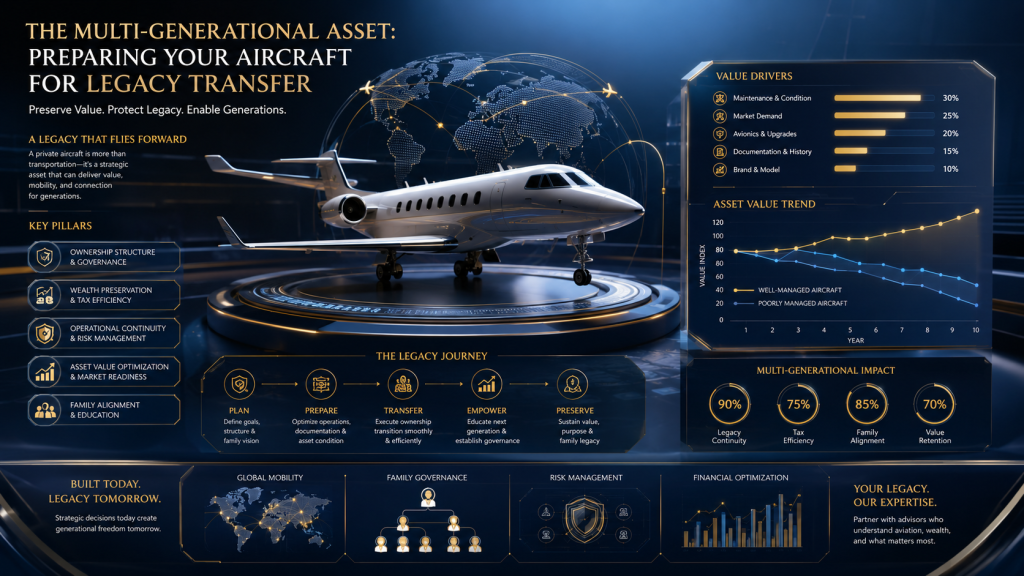
Private aircraft are often viewed as transportation assets, luxury purchases, or business tools. Yet for many ultra-high-net-worth families, family offices, and entrepreneurial dynasties, an aircraft can become something far more significant: a multi-generational asset.
An aircraft that remains strategically managed for decades can support family mobility, business continuity, wealth preservation, and legacy planning. However, transferring an aircraft to the next generation requires much more than updating ownership documents. It demands careful planning across taxation, governance, maintenance, operational structures, valuation management, and succession strategy.
The most successful families understand a critical reality: aircraft legacy transfer begins years before ownership changes hands.
This guide explores how sophisticated aircraft owners prepare aviation assets for long-term family stewardship while protecting value and operational flexibility.
By: PrivateJetio Aviation Advisory Team
Why Aircraft Legacy Transfer Matters More Than Ever
The world’s largest wealth transfer is underway.
Over the next two decades, trillions of dollars in assets will move from one generation to the next. Family businesses, investment portfolios, real estate holdings, and aviation assets are all part of this transition.
For aircraft owners, the challenge is unique.
Unlike passive investments, aircraft require:
- Active management
- Regulatory compliance
- Operational oversight
- Capital expenditure planning
- Crew management
- Insurance administration
- Asset preservation strategies
Without a clear transition plan, even highly valuable aviation assets can become financial burdens for heirs.
Proper aircraft succession planning transforms a potentially complex transfer into a structured continuation of family mobility and business capability.
Understanding the Aircraft as a Legacy Asset
Many owners mistakenly view aircraft solely through the lens of transportation.
Elite families often take a different perspective.
They view aircraft as:
Strategic Business Infrastructure
Business aviation frequently supports:
- International deal-making
- Corporate oversight
- Executive mobility
- Family office operations
- Investment management
The aircraft becomes integrated into the family’s broader economic ecosystem.
Family Connectivity
Global families increasingly operate across multiple jurisdictions.
Children may live in London.
Business interests may be based in New York.
Investments may be located in Dubai, Singapore, or Zurich.
Aircraft ownership provides continuity and connectivity that commercial aviation cannot always deliver.
Wealth Preservation Tool
A carefully managed aircraft can preserve substantial value through:
- Maintenance discipline
- Strategic upgrades
- Strong documentation
- Professional asset management
This approach supports long-term aviation wealth preservation while maintaining operational utility.
Building the Right Aircraft Ownership Structure
One of the most important decisions involves ownership architecture.
Aircraft transferred improperly can create tax complications, liability exposure, and operational restrictions.
Sophisticated families often evaluate several structures.
Individual Ownership
Simple but often inefficient.
Advantages include:
- Direct control
- Straightforward documentation
- Simplified decision-making
Disadvantages include:
- Estate tax exposure
- Probate complications
- Potential liability concentration
Corporate Ownership
Many entrepreneurs place aircraft inside operating companies.
Benefits may include:
- Operational flexibility
- Centralized management
- Business-use alignment
However, succession planning becomes tied to broader corporate governance considerations.
Family Holding Companies
A dedicated holding structure frequently provides greater continuity.
Benefits often include:
- Asset segregation
- Governance flexibility
- Multi-generational control mechanisms
- Improved transition planning
Aircraft Trust Structure
An aircraft trust structure can provide additional flexibility in certain jurisdictions.
Trust arrangements may help:
- Simplify succession
- Define beneficiary rights
- Establish governance frameworks
- Support long-term stewardship
Because regulations vary internationally, specialized legal and tax guidance is essential before implementation.
The Role of Family Office Aviation Management
Many sophisticated families integrate aircraft into a larger family office aviation strategy.
This approach treats aviation as one component of an overall wealth management framework.
Family offices typically coordinate:
Asset Oversight
Aircraft performance is monitored alongside:
- Real estate portfolios
- Private equity investments
- Public market holdings
- Alternative investments
Cost Management
The objective is not merely reducing expenses.
The goal is maximizing value derived from aviation operations.
This includes:
- Route optimization
- Charter offset programs
- Maintenance forecasting
- Fuel strategy planning
Governance
Family offices often establish policies defining:
- Aircraft access rights
- Usage priorities
- Cost allocation
- Approval authorities
These frameworks reduce future disputes among heirs.
Creating an Aircraft Succession Planning Roadmap
Successful transitions rarely happen by accident.
A structured roadmap helps ensure continuity.
Step 1: Define Long-Term Ownership Goals
Owners should answer critical questions:
Will heirs actively use the aircraft?
Will the next generation operate family businesses requiring private aviation?
Will the aircraft remain family-owned or be sold?
Answers to these questions influence every subsequent decision.
Step 2: Identify Future Decision Makers
Aircraft ownership requires ongoing decisions.
Future leaders should understand:
- Aircraft economics
- Maintenance obligations
- Operational risks
- Regulatory responsibilities
Education should begin years before ownership transfers.
Step 3: Establish Governance Policies
Clear governance reduces ambiguity.
Policies should define:
- Access rights
- Budget authority
- Upgrade approvals
- Sale procedures
- Emergency decisions
The strongest plans prevent conflict before it emerges.
Protecting Aircraft Residual Value Across Generations
One of the most overlooked elements of aircraft legacy transfer is preserving aircraft residual value.
Aircraft depreciation is inevitable.
However, value deterioration can be controlled.
Maintenance Discipline
Consistent maintenance remains the single most important factor.
Future buyers pay premiums for aircraft with:
- Complete records
- Predictable maintenance histories
- Reputable service providers
- No deferred maintenance
Documentation quality often matters as much as mechanical condition.
Strategic Upgrades
Owners should focus on upgrades that enhance marketability.
Examples include:
- Modern avionics
- Connectivity improvements
- Cabin refurbishments
- Safety enhancements
Not every upgrade generates return on investment.
Strategic planning matters.
Engine Program Participation
Many buyers strongly favor aircraft enrolled in recognized maintenance programs.
Participation can improve:
- Predictability
- Market confidence
- Liquidity
- Valuation stability
Professional Asset Reviews
Regular valuation assessments identify market changes before they become problems.
Sophisticated owners frequently commission independent reviews every 12 to 24 months.
Preparing the Next Generation for Aircraft Stewardship
Many wealth transfers fail because heirs inherit assets they do not understand.
Aircraft ownership is no exception.
The next generation should gradually learn:
Operational Fundamentals
Future owners should understand:
- Flight department management
- Charter economics
- Crew oversight
- Maintenance planning
Knowledge reduces dependence on reactive decision-making.
Financial Management
Aircraft budgets often surprise inexperienced owners.
Education should include:
- Fixed costs
- Variable costs
- Capital expenditures
- Reserve planning
- Lifecycle forecasting
Aviation is a long-term commitment rather than a short-term expense.
Strategic Value
Perhaps most importantly, heirs must understand why the aircraft exists within the family’s broader business aviation strategy.
When the strategic purpose is clear, ownership decisions become more disciplined.
Estate Planning Considerations for Aircraft Owners
Estate planning is one of the most important components of aircraft legacy transfer. An aircraft may represent millions of dollars in value, yet many ownership structures are created without considering how the asset will eventually transition.
A well-designed plan seeks to accomplish three objectives:
- Preserve operational continuity.
- Protect asset value.
- Minimize unnecessary taxation and legal complexity.
Owners should work with aviation attorneys, tax specialists, and wealth advisors who understand the unique regulatory environment surrounding private aviation.
Timing Matters
One of the biggest mistakes owners make is waiting until retirement or a major health event to begin planning.
The most effective transitions are usually implemented years in advance.
Early planning allows owners to:
- Evaluate ownership structures.
- Prepare heirs.
- Optimize governance.
- Reduce transition risk.
- Preserve operational flexibility.
Coordinating Aviation Assets with Broader Estate Plans
Aircraft should never be planned in isolation.
The most successful families coordinate aviation assets with:
- Family trusts
- Business holdings
- Investment portfolios
- Real estate assets
- Philanthropic structures
This integrated approach ensures the aircraft supports broader family objectives rather than creating administrative complexity.
International Considerations for Global Families
Many aircraft owners operate internationally.
A family may reside in one country, maintain business interests in another, and base aircraft operations in a third jurisdiction.
This complexity creates unique planning requirements.
Regulatory Compliance
Each jurisdiction may impose different requirements regarding:
- Registration
- Taxation
- Importation
- Ownership disclosure
- Operational permissions
A transfer strategy that works in one country may create challenges in another.
Cross-Border Ownership
Global families often use carefully structured ownership vehicles to support:
- International mobility
- Regulatory compliance
- Asset protection
- Operational efficiency
The correct solution depends heavily on the family’s geographic footprint and long-term objectives.
Multi-Jurisdiction Tax Planning
Tax exposure can vary significantly depending on:
- Owner residency
- Aircraft location
- Operational use
- Corporate structures
- Transfer mechanisms
Professional guidance becomes particularly important when assets and beneficiaries span multiple countries.
Valuation Management During Ownership Transfer
Accurate valuation is essential for any aircraft legacy transfer.
Many owners focus exclusively on market value.
Sophisticated families evaluate multiple dimensions of value.
Current Market Value
This reflects present-day market conditions.
Factors influencing value include:
- Aircraft age
- Total time
- Maintenance status
- Equipment configuration
- Market demand
Operational Value
An aircraft may provide value beyond resale pricing.
For example:
- Executive productivity
- Time savings
- Business development
- Family connectivity
These benefits often exceed simple financial calculations.
Strategic Value
Certain aircraft support broader family objectives.
Examples include:
- Maintaining global business access
- Supporting family office operations
- Enabling rapid crisis response
- Preserving privacy
These strategic advantages should be considered during transfer discussions.
Periodic Independent Appraisals
Independent appraisals help ensure:
- Fair value assessments
- Better planning decisions
- Accurate reporting
- Improved negotiation leverage
Many family offices incorporate regular aircraft valuations into their broader asset review process.
Managing Risk Throughout the Transfer Process
Every significant asset transfer involves risk.
Aircraft ownership introduces additional operational and regulatory considerations.
Liability Management
Ownership structures should clearly define:
- Responsibility
- Authority
- Insurance obligations
- Operational oversight
Ambiguity creates unnecessary exposure.
Insurance Review
Legacy transfers provide an excellent opportunity to review:
- Liability limits
- Hull coverage
- Crew policies
- International coverage
- Additional insured requirements
Insurance strategies should evolve alongside ownership transitions.
Documentation Quality
Aircraft transactions depend heavily on documentation.
Critical records include:
- Maintenance logs
- Inspection reports
- Modification records
- Regulatory filings
- Operational documentation
Incomplete records can materially impact value and marketability.
Governance: The Hidden Key to Long-Term Success
Many families spend significant resources on tax planning while overlooking governance.
Yet governance often determines whether an aviation asset remains successful across generations.
Defining Access Rights
A governance framework should answer questions such as:
Who can use the aircraft?
How are scheduling conflicts resolved?
Who approves major expenditures?
How are operating costs allocated?
Clear answers reduce future disputes.
Establishing Decision-Making Authority
Aircraft ownership requires ongoing decisions regarding:
- Maintenance
- Upgrades
- Financing
- Crew
- Charter activity
- Eventual disposition
Governance structures should identify responsible decision-makers before issues arise.
Family Aviation Councils
Some ultra-high-net-worth families create dedicated aviation committees.
These groups may include:
- Family members
- Family office executives
- Aviation advisors
- Legal counsel
The objective is maintaining continuity and accountability.
When Transfer May Not Be the Best Option
Not every aircraft should remain in the family.
Sometimes the most financially rational decision is a strategic sale.
Owners should periodically evaluate:
Future Usage Requirements
Will future generations actually use the aircraft?
If utilization is expected to decline significantly, alternative solutions may be more efficient.
Fleet Modernization Opportunities
A transfer event can create an opportunity to upgrade into a newer aircraft that better aligns with future needs.
Market Timing
Aircraft markets experience cycles.
Strong market conditions may present attractive opportunities to monetize value and redeploy capital.
Alternative Aviation Strategies
Future generations may prefer:
- Fractional ownership
- Jet cards
- Charter programs
- Mixed-access solutions
Legacy planning should prioritize outcomes rather than assuming ownership must continue indefinitely.
The PrivateJetio Advisory Perspective
The most successful aircraft transitions share several common characteristics.
First, planning begins early.
Second, ownership structures are aligned with long-term family objectives.
Third, governance receives as much attention as tax strategy.
Fourth, the next generation is educated before ownership changes hands.
Finally, professional advisors remain involved throughout the process.
Aircraft are unique assets. They combine mobility, operational complexity, capital intensity, and emotional significance. Unlike many investments, they directly influence how families travel, conduct business, and maintain global relationships.
As a result, aircraft legacy transfer should never be viewed as a simple ownership change. It is a strategic transition that can influence family mobility and wealth preservation for decades.
Conclusion
A private aircraft can become far more than a transportation asset. When managed correctly, it becomes a multi-generational platform supporting business continuity, family connectivity, and long-term wealth preservation.
The families that achieve successful aircraft legacy transfer do not focus solely on legal documents. They build comprehensive strategies that incorporate governance, education, valuation management, maintenance excellence, and succession planning.
Whether your objective is preserving a family aviation tradition, supporting future business leadership, or maximizing long-term asset value, the planning process should begin well before ownership changes hands.
At PrivateJetio, we help aircraft owners, family offices, and corporate aviation stakeholders evaluate ownership structures, succession strategies, valuation risks, and long-term aviation objectives. Strategic decisions made today can determine whether an aircraft remains a valuable family asset for generations or becomes a missed opportunity.
Request a confidential executive consultation with PrivateJetio to evaluate your aircraft legacy strategy and build a framework designed for long-term success.
Frequently Asked Questions
What is aircraft legacy transfer?
Aircraft legacy transfer refers to the process of transitioning ownership, management, and operational responsibility of an aircraft from one generation to another while preserving value and continuity.
When should aircraft succession planning begin?
Ideally, planning should begin several years before a transfer is expected. Early preparation provides greater flexibility and reduces legal, tax, and operational risks.
Can an aircraft be held in a trust?
Yes. Many owners utilize an aircraft trust structure to support governance, asset protection, and succession objectives. The appropriate structure depends on individual circumstances and jurisdictional requirements.
How can owners protect aircraft residual value?
Consistent maintenance, complete documentation, strategic upgrades, engine program participation, and regular professional valuations are among the most effective methods.
Should every aircraft be transferred to the next generation?
Not necessarily. Some families may benefit more from selling the aircraft and reallocating capital, while others may prefer alternative aviation solutions such as fractional ownership or charter programs. Strategic analysis is essential before making a decision.
References:
National Business Aviation Association (NBAA)
https://nbaa.org
Federal Aviation Administration (FAA)
https://www.faa.gov
International Business Aviation Council (IBAC)
https://ibac.org
European Union Aviation Safety Agency (EASA)
https://www.easa.europa.eu
Aircraft Owners and Pilots Association (AOPA)
https://www.aopa.org


