Private Jetio

Future-Proofing Your Hangar: Winning the Aircraft Valuation Game

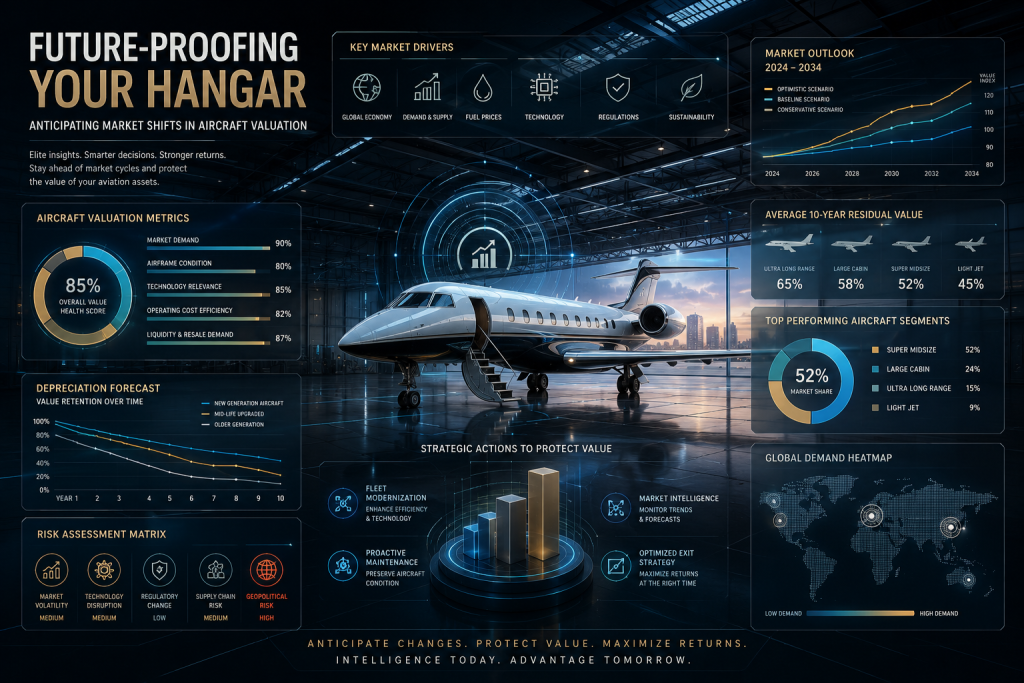
Future-Proofing Your Hangar: Winning the Aircraft Valuation Game

Future-Proofing Your Hangar: Winning the Aircraft Valuation Game

In private aviation, the most successful owners do not simply buy aircraft. They manage aviation assets with the same discipline used to manage investment portfolios. While many focus on acquisition price, elite buyers understand that long-term aircraft valuation determines the true financial outcome of ownership.

An aircraft can appear to be a bargain today and become a liability tomorrow. Conversely, the right aircraft, acquired at the right point in the market cycle and managed strategically, can preserve significant capital over time.

The challenge is that aircraft values are constantly influenced by factors far beyond the hangar. Economic cycles, fuel costs, technology advancements, environmental regulations, geopolitical developments, and buyer sentiment all play a role in determining future worth.

Understanding these forces allows owners to anticipate valuation changes rather than react to them. This proactive approach separates sophisticated aviation investors from those who simply own airplanes.

This guide explores how private jet owners, family offices, aviation companies, and ultra-high-net-worth individuals can future-proof their hangars and position themselves ahead of the next market shift.

By: PrivateJetio Aviation Advisory Team

Why Aircraft Valuation Matters More Than Most Owners Realize

Private aircraft are often viewed as luxury assets. In reality, they function more like sophisticated capital assets whose values fluctuate according to complex market dynamics.

A difference of just a few percentage points in residual value can represent millions of dollars in realized gains or losses over the ownership lifecycle.

Consider two owners purchasing comparable aircraft.

The first owner focuses solely on acquisition cost and chooses the least expensive option available.

The second owner evaluates future demand, support infrastructure, maintenance profile, regulatory outlook, and projected liquidity.

Five years later, the second owner often experiences a significantly stronger resale outcome despite paying more initially.

The lesson is simple:

Aircraft acquisition decisions should never be separated from aircraft exit strategies.

The most successful owners evaluate future resale value before signing a purchase agreement.

Understanding the Modern Aircraft Valuation Landscape

The aviation market today differs dramatically from the market of a decade ago.

Several powerful trends are reshaping how aircraft are valued.

Increased Global Demand

Private aviation demand expanded significantly following the pandemic era.

Many first-time users discovered the flexibility and efficiency of private travel, creating new demand for aircraft ownership and charter operations.

This demand surge temporarily increased values across several segments of the business jet market.

However, experienced investors recognize that extraordinary growth periods are often followed by market normalization.

Understanding where the market sits within its cycle becomes critical.

Supply Constraints

Aircraft manufacturers continue facing supply chain challenges.

Production delays have affected delivery schedules across multiple aircraft categories.

When new aircraft become difficult to obtain, demand often shifts toward pre-owned aircraft, supporting stronger valuations.

However, supply constraints eventually ease.

Owners must evaluate whether current pricing reflects sustainable value or temporary scarcity.

Technology Acceleration

Aircraft technology evolves faster than many buyers anticipate.

Cabin connectivity, avionics systems, fuel efficiency improvements, predictive maintenance capabilities, and sustainability enhancements can rapidly influence buyer preferences.

An aircraft considered technologically advanced today may appear dated within a relatively short period.

This reality directly impacts aircraft valuation.

The Role of Residual Value in Long-Term Ownership Economics

Residual value represents one of the most important yet frequently misunderstood concepts in private aviation.

Simply put, residual value is the estimated future worth of an aircraft after a defined ownership period.

Elite aviation investors place tremendous emphasis on residual value because it directly influences total ownership cost.

A jet that costs $30 million today but retains 75% of its value after seven years may prove more economical than a $25 million aircraft that retains only 50%.

This principle transforms how sophisticated buyers evaluate opportunities.

Instead of asking:

“What does this aircraft cost today?”

They ask:

“What will this aircraft be worth when I decide to sell?”

That question often produces far more valuable answers.

Aircraft Depreciation: The Silent Wealth Destroyer

Aircraft depreciation remains one of the largest financial factors affecting ownership outcomes.

Not all depreciation follows predictable patterns.

Some aircraft experience gradual value reductions.

Others face sudden market corrections driven by changing technology, regulatory developments, or shifts in customer demand.

Several factors influence depreciation rates:

Owners who actively manage these variables frequently outperform market averages.

Aircraft depreciation should never be viewed as an unavoidable consequence of ownership.

Instead, it should be managed strategically.

Identifying Future Winners Before the Market Does

The strongest gains often occur when buyers recognize emerging trends before they become mainstream.

Several indicators can reveal future valuation opportunities.

Manufacturer Stability

Strong manufacturers tend to support stronger long-term values.

Aircraft backed by established global support networks typically experience better liquidity and buyer confidence.

When evaluating any aircraft, consider:

Strong support ecosystems contribute significantly to valuation resilience.

Fleet Modernization Trends

Fleet modernization continues influencing demand across the private aviation sector.

Operators increasingly seek aircraft offering:

Aircraft aligned with these trends often enjoy stronger demand during resale cycles.

Emerging Buyer Preferences

The next generation of aircraft buyers is changing market dynamics.

Modern buyers increasingly prioritize:

Aircraft that align with these expectations are often better positioned for future value preservation.

How Sustainability Is Reshaping Aircraft Values

Environmental considerations are no longer peripheral issues.

They increasingly influence investment decisions across aviation.

Corporate flight departments, publicly traded companies, and institutional buyers face growing pressure to demonstrate sustainability commitments.

As a result, aircraft with stronger environmental performance may command valuation advantages.

Key areas include:

Sustainable Aviation Fuel Compatibility

Aircraft capable of operating efficiently with Sustainable Aviation Fuel (SAF) may benefit from stronger future demand.

Fuel Efficiency

Fuel-efficient platforms reduce operating expenses and environmental impact simultaneously.

This dual advantage enhances attractiveness in both ownership and charter markets.

Carbon Reduction Strategies

Aircraft integrated into broader carbon reduction programs may become increasingly desirable as regulatory frameworks evolve.

Owners who ignore these developments risk holding assets that become less competitive over time.

The Impact of Economic Cycles on Aircraft Market Trends

Private aviation remains closely connected to macroeconomic conditions.

Although ultra-high-net-worth individuals possess significant financial resilience, broader economic trends still influence aircraft transactions.

Several indicators deserve continuous monitoring:

Interest Rates

Financing costs directly affect aircraft demand.

Higher rates often reduce transaction activity.

Lower rates typically stimulate acquisitions.

Equity Markets

Strong stock markets frequently correlate with increased private aviation investment activity.

Wealth creation drives aircraft demand.

Corporate Profits

Corporate profitability influences fleet expansion decisions.

Business jet acquisitions often increase during periods of economic confidence.

Understanding these relationships helps owners anticipate valuation movements before they appear in transaction data.

Building an Aviation Asset Management Strategy

Aircraft ownership should never operate independently from broader wealth management objectives.

Sophisticated owners increasingly adopt comprehensive aviation asset management strategies.

These strategies integrate:

  1. Acquisition planning
  2. Ownership optimization
  3. Maintenance planning
  4. Risk management
  5. Exit planning

Every decision influences future aircraft valuation.

The objective is not merely operating an aircraft efficiently.

The objective is maximizing long-term asset performance.

Why Liquidity Matters More Than Purchase Price

Many buyers focus heavily on acquisition negotiations.

Yet resale liquidity often proves more important than purchase discounts.

An aircraft may appear attractively priced, but if future demand becomes limited, resale opportunities can become challenging.

Liquidity depends on several factors:

Aircraft with broader buyer pools generally experience stronger valuation stability.

For sophisticated owners, liquidity functions as a form of financial insurance.

The Growing Importance of Data-Driven Valuation Intelligence

Modern aviation investors increasingly rely on advanced market intelligence rather than instinct alone.

Today’s valuation decisions leverage:

This evolution has transformed aircraft valuation from an art into a sophisticated analytical discipline.

Owners who use intelligence-based decision-making consistently gain advantages over those relying solely on broker opinions or anecdotal market sentiment.

How Geopolitical Events Influence Aircraft Values

Many owners underestimate the impact geopolitical developments can have on aviation assets.

Aircraft markets are global by nature. Buyers, sellers, operators, lenders, and manufacturers operate across multiple jurisdictions. A significant event in one region can quickly influence demand and valuations worldwide.

Examples include:

  • Trade disputes affecting aircraft deliveries
  • Sanctions impacting ownership transfers
  • Currency fluctuations changing purchasing power
  • Regional conflicts altering travel patterns
  • Regulatory changes affecting aircraft registration

Aviation history demonstrates that geopolitical shifts often create both risks and opportunities.

Owners who monitor global developments closely are better positioned to protect value and identify acquisition opportunities before competitors react.

This is one reason family offices and institutional investors increasingly integrate geopolitical intelligence into aviation decision-making.

The Aircraft Segments Most Likely to Retain Value

Not all aircraft categories perform equally across market cycles.

Some segments consistently demonstrate stronger resilience than others.

Ultra-Long-Range Jets

Ultra-long-range aircraft continue attracting global demand because they support international missions without operational compromises.

Their appeal spans:

  • Corporate operators
  • Family offices
  • Heads of state
  • Ultra-high-net-worth individuals

The global nature of their mission profile often supports stronger valuation performance.

Super-Midsize Aircraft

The super-midsize category remains one of the most balanced sectors in private aviation.

These aircraft typically offer:

  • Strong range capability
  • Efficient operating economics
  • Wide buyer appeal
  • Flexible mission profiles

Their versatility contributes to sustained demand.

New-Generation Platforms

Aircraft featuring the latest technology generally experience stronger demand from future buyers.

Modern avionics, connectivity, fuel efficiency, and passenger experience enhancements contribute to longer market relevance.

Warning Signs That Future Value May Be at Risk

Future-proofing a hangar requires identifying risks before they become obvious.

Several warning indicators deserve attention.

Declining Fleet Utilization

When operators begin reducing utilization across a particular aircraft type, it may signal weakening demand.

Shrinking Manufacturer Support

Reduced investment in parts, service infrastructure, or product development can negatively affect market confidence.

Technological Obsolescence

Rapid advances in competing aircraft may reduce the attractiveness of older platforms.

Regulatory Pressure

Environmental or operational regulations can alter market demand unexpectedly.

Excess Inventory

When inventory grows faster than buyer demand, valuation pressure often follows.

Monitoring these factors helps owners avoid becoming trapped in declining asset classes.

Why Timing Matters in Aircraft Transactions

Even exceptional aircraft can produce disappointing financial outcomes if acquired or sold at the wrong moment.

Market timing is not about speculation.

It is about understanding supply, demand, and market cycles.

Sophisticated buyers monitor:

  • Inventory levels
  • Days on market
  • Manufacturer backlog
  • Transaction volume
  • Charter demand
  • Financing conditions

These indicators often reveal opportunities before pricing adjusts.

A disciplined acquisition strategy can save millions of dollars over an ownership cycle.

Similarly, exiting before oversupply develops can preserve substantial equity.

The Future of Aircraft Valuation in the Next Decade

Several structural changes are likely to influence valuations over the coming years.

Artificial Intelligence and Predictive Maintenance

Advanced maintenance analytics are reducing uncertainty around aircraft condition.

Buyers increasingly value transparent operational data.

Aircraft equipped with predictive maintenance capabilities may command stronger market interest.

Enhanced Connectivity

Future aircraft buyers will expect connectivity standards comparable to modern offices.

Cabins that support productivity, communication, and digital collaboration will remain highly desirable.

Sustainability Requirements

Environmental performance will continue becoming more important.

The market may eventually assign valuation premiums to aircraft demonstrating superior sustainability credentials.

Alternative Ownership Structures

Fractional ownership, jet cards, and innovative aviation investment models may influence future acquisition patterns.

Understanding these trends allows owners to position assets accordingly.

How Elite Buyers Approach Private Jet Investment

The most successful aviation investors rarely view aircraft solely as transportation tools.

They view them as strategic assets.

Their process typically includes:

Comprehensive Market Analysis

Before acquisition, they evaluate:

  • Historical transaction activity
  • Long-term demand trends
  • Future supply outlook
  • Competitive aircraft platforms

Exit Strategy Planning

Elite buyers define their exit strategy before acquisition.

They understand:

  • Target ownership period
  • Future buyer profile
  • Likely market conditions
  • Value preservation requirements

Independent Advisory Support

Independent advisors provide objective guidance that is not influenced by commissions tied to specific transactions.

This often leads to better long-term outcomes.

Continuous Portfolio Monitoring

Aircraft values are not static.

Sophisticated owners regularly reassess:

  • Market position
  • Competitive threats
  • Valuation trends
  • Strategic alternatives

This proactive mindset creates significant advantages.

Building a Future-Proof Hangar Portfolio

Future-proofing extends beyond individual aircraft.

Many organizations operate multiple aviation assets.

In these cases, portfolio construction becomes important.

A balanced aviation portfolio may include:

  • Different mission capabilities
  • Multiple range categories
  • Diverse ownership structures
  • Various acquisition timelines

Diversification helps reduce exposure to specific market risks.

The same principles used in investment portfolio management can improve aviation asset performance.

The Role of Independent Aircraft Valuation Consulting

Aircraft transactions often involve substantial capital commitments.

Relying solely on seller-provided information creates unnecessary risk.

Independent valuation consulting provides:

  • Objective market analysis
  • Comparable transaction review
  • Residual value forecasting
  • Risk assessment
  • Acquisition strategy guidance

For many owners, these insights represent one of the highest-return investments made during the transaction process.

A relatively small advisory expense can prevent multimillion-dollar valuation mistakes.

Practical Framework for Future-Proofing Your Aircraft Investment

Owners seeking long-term value preservation should focus on the following framework.

Step 1: Evaluate Market Position

Determine where the aircraft sits within the broader market cycle.

Step 2: Assess Competitive Threats

Identify competing aircraft platforms likely to influence future demand.

Step 3: Analyze Residual Value Outlook

Review long-term valuation forecasts rather than focusing solely on current pricing.

Step 4: Monitor Regulatory Developments

Track environmental, operational, and certification changes.

Step 5: Maintain Asset Quality

Protect value through disciplined maintenance and documentation.

Step 6: Review Exit Opportunities Regularly

Do not wait until a sale becomes necessary.

Understand available options continuously.

Step 7: Leverage Independent Intelligence

Use market intelligence to support strategic decisions.

This framework helps transform aircraft ownership from a reactive exercise into a proactive value-management strategy.

Conclusion

Aircraft valuation is no longer determined solely by age, hours, and maintenance history. Modern values are increasingly influenced by technology, sustainability, market sentiment, geopolitical developments, financing conditions, and evolving buyer preferences.

The owners who achieve the strongest outcomes are not necessarily those who purchase the most expensive aircraft. They are the ones who understand how market forces shape future demand.

Future-proofing your hangar requires a strategic mindset. It means looking beyond today’s acquisition price and focusing on tomorrow’s market reality.

Whether you manage a single aircraft, a corporate fleet, or a family office aviation portfolio, understanding valuation drivers can protect capital, improve liquidity, and enhance long-term ownership performance.

The next decade will create significant opportunities for informed buyers and substantial risks for those relying on outdated assumptions.

The difference between the two often comes down to one factor: intelligence.

At PrivateJetio, we help aircraft buyers, sellers, family offices, and aviation operators make informed decisions through independent aircraft advisory, acquisition support, valuation analysis, and strategic aviation consulting. Before your next transaction, ensure your aviation strategy is built not only for today’s market but for tomorrow’s.

FAQ

What is the most important factor affecting aircraft valuation?

No single factor determines value. Aircraft condition, maintenance history, market demand, manufacturer support, residual value outlook, and economic conditions all play important roles.

How often should aircraft owners review valuations?

Serious owners should review valuations at least annually. During periods of significant market change, more frequent assessments may be beneficial.

Why do some aircraft retain value better than others?

Aircraft with strong demand, broad mission flexibility, modern technology, and strong manufacturer support generally maintain stronger resale performance.

How does sustainability affect private jet values?

Environmental performance is becoming increasingly important. Fuel efficiency, SAF compatibility, and future regulatory compliance may influence future demand and valuations.

Should owners use independent valuation consultants?

Yes. Independent advisors provide objective market insights that help reduce transaction risk and improve strategic decision-making.

References:

Federal Aviation Administration (FAA)
https://www.faa.gov

National Business Aviation Association (NBAA)
https://nbaa.org

General Aviation Manufacturers Association (GAMA)
https://gama.aero

International Civil Aviation Organization (ICAO)
https://www.icao.int

European Union Aviation Safety Agency (EASA)
https://www.easa.europa.eu

Aircraft Bluebook Market Data and Valuation Resources
https://www.aircraftbluebook.com

JetNet Business Aviation Market Intelligence
https://www.jetnet.com

Argus International Aviation Market Research
https://www.argus.aero

Corporate Jet Investor Market Reports
https://www.corporatejetinvestor.com

Aviation Week Business Aviation Market Analysis
https://aviationweek.com/business-aviation

Exit mobile version