
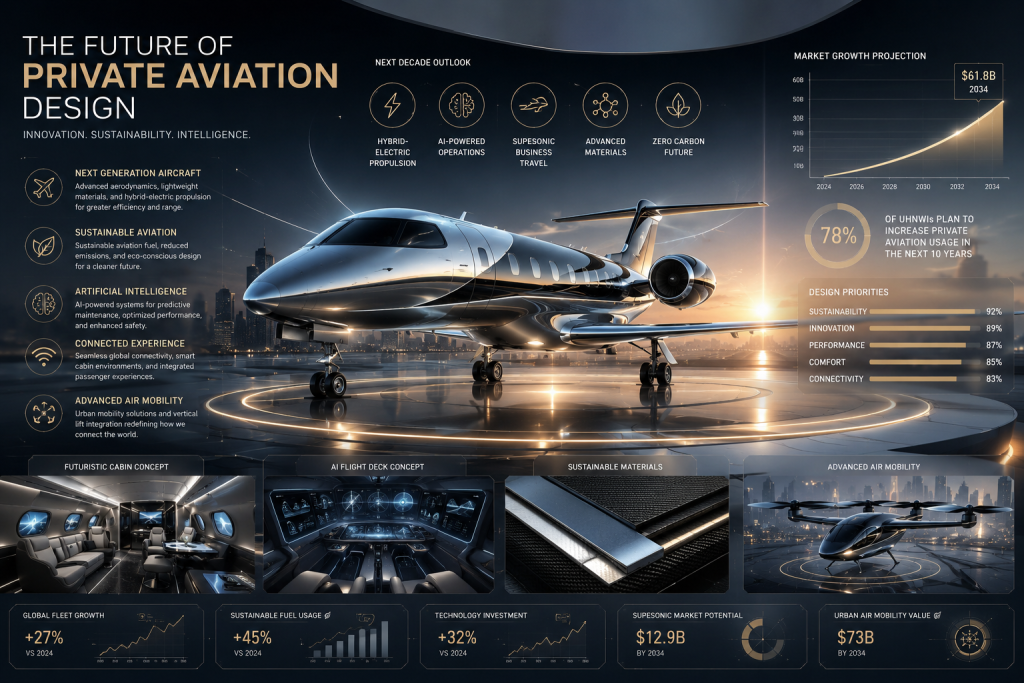
The Future of Private Aviation: Predicting the Next Decade of Design
Private aviation has always represented the intersection of technology, luxury, efficiency, and exclusivity. Yet the next ten years may bring more transformation to the industry than the previous thirty combined. New propulsion systems, intelligent cabins, autonomous technologies, and sustainability initiatives are reshaping how aircraft are designed, operated, and valued.
For ultra-high-net-worth individuals, family offices, corporate flight departments, and aviation investors, understanding the future of private aviation is no longer a matter of curiosity. It has become a strategic necessity. Decisions made today regarding acquisitions, fleet planning, aircraft upgrades, and ownership structures may be significantly affected by technological shifts expected throughout the next decade.
The aircraft that dominate executive aviation in 2035 may look remarkably different from the business jets flying today. The changes will extend beyond speed, range, and luxury. They will influence operating costs, asset values, environmental compliance, passenger experience, and even how aviation itself is perceived.
This analysis explores the forces shaping the next generation of private aviation design and what owners should consider before making long-term aviation decisions.
By: PrivateJetio Aviation Advisory Team
Why Private Aviation Is Entering a New Era
Historically, business aviation evolved gradually. Improvements typically focused on longer range, better fuel efficiency, enhanced safety systems, and more refined interiors.
Today, multiple disruptive technologies are advancing simultaneously.
These include:
- Sustainable propulsion systems
- Artificial intelligence integration
- Autonomous flight technologies
- Digital aircraft ecosystems
- Advanced manufacturing methods
- Revolutionary cabin concepts
- Enhanced connectivity platforms
- Emerging mobility solutions
Unlike previous aviation cycles, these developments are converging at the same time.
As a result, the future of private aviation may evolve faster than many owners anticipate.
Sustainability Will Become a Design Requirement
Environmental expectations are becoming increasingly influential across the aviation sector.
While private aviation represents a relatively small portion of global aviation emissions, the industry faces growing scrutiny from regulators, investors, media organizations, and environmental groups.
Future aircraft designs will prioritize sustainability from inception rather than treating it as an operational afterthought.
The Rise of Sustainable Aviation Fuel
One of the most significant developments is the increasing adoption of sustainable aviation fuel.
SAF can reduce lifecycle carbon emissions substantially compared to traditional jet fuel while requiring minimal modifications to existing aircraft.
Manufacturers are already certifying aircraft for higher SAF blends, and future designs will likely optimize performance specifically for sustainable fuel use.
Aircraft manufacturers recognize that future buyers will increasingly evaluate environmental credentials alongside traditional performance metrics.
New Materials and Lightweight Structures
Reducing aircraft weight directly improves efficiency.
The next generation of aircraft will feature:
- Advanced carbon composites
- Hybrid structural materials
- Lightweight cabin systems
- Innovative manufacturing techniques
These technologies reduce fuel consumption while maintaining structural integrity.
For owners, this translates into lower operating costs and improved environmental performance.
Carbon-Neutral Flight Operations
Future aircraft design will increasingly align with broader sustainability ecosystems.
This may include:
- Carbon-neutral airport operations
- Renewable energy integration
- Smart route optimization
- Reduced lifecycle emissions
Aircraft manufacturers that fail to adapt risk losing relevance in a rapidly changing marketplace.
The Arrival of Electric Aircraft
The concept of electric aircraft has progressed significantly over the past decade.
Although fully electric long-range business jets remain technologically challenging, substantial advancements are occurring in shorter-range segments.
What Electric Aviation Means for Business Travelers
Electric propulsion offers several advantages:
- Lower operating costs
- Reduced maintenance requirements
- Lower noise levels
- Reduced environmental impact
- Improved urban accessibility
Initially, electric aircraft will likely serve regional missions rather than transcontinental travel.
However, battery technology continues to improve.
As energy density increases, electric aviation may become viable for a growing range of business travel applications.
Hybrid-Electric Business Jets
The most realistic near-term solution may involve hybrid systems.
These aircraft combine conventional propulsion with electric assistance.
Benefits include:
- Greater efficiency
- Lower emissions
- Extended range
- Operational flexibility
Several manufacturers are actively exploring hybrid-electric concepts that could influence private aviation throughout the 2030s.
The Return of Speed: Supersonic Business Travel
The dream of faster-than-sound travel never disappeared.
Recent technological breakthroughs have revived interest in the supersonic business jet.
Why Supersonic Travel Matters
Time remains the ultimate luxury.
For executives, investors, and global decision-makers, reducing travel time can generate substantial economic value.
Imagine:
- New York to London in approximately three hours
- Los Angeles to Tokyo significantly faster than current flights
- Same-day intercontinental business schedules
These possibilities are driving renewed investment in supersonic aviation.
Design Challenges
Future supersonic aircraft must address:
- Fuel efficiency
- Sonic boom reduction
- Regulatory compliance
- Environmental impact
- Economic viability
Unlike earlier supersonic projects, new designs incorporate advanced computational modeling and materials science.
The result may be practical, sustainable high-speed travel rather than technological experimentation.
Artificial Intelligence Will Redefine Aircraft Operations
The integration of artificial intelligence in aviation represents one of the most transformative developments in aircraft design.
AI’s influence extends far beyond cockpit automation.
Predictive Maintenance
Modern aircraft generate enormous volumes of operational data.
Future AI systems will continuously monitor:
- Engine performance
- Structural health
- System efficiency
- Component wear
This enables predictive maintenance before failures occur.
Owners benefit through:
- Reduced downtime
- Lower maintenance costs
- Enhanced safety
- Improved asset value preservation
Intelligent Flight Planning
AI-driven systems will optimize:
- Routes
- Fuel consumption
- Weather avoidance
- Air traffic integration
These capabilities improve efficiency while enhancing passenger comfort.
Enhanced Safety Systems
Advanced AI may become a critical co-pilot for future flight crews.
Systems could identify anomalies, evaluate risk scenarios, and support decision-making in real time.
The result is likely to be an unprecedented level of operational safety.
The Connected Aircraft Revolution
Connectivity is rapidly becoming a core expectation rather than a premium feature.
Future aircraft design will prioritize seamless aircraft connectivity from the outset.
The Executive Office in the Sky
Modern travelers increasingly expect uninterrupted access to:
- Video conferencing
- Cloud applications
- Financial platforms
- Corporate networks
- Real-time collaboration tools
Future cabins will function as fully integrated executive offices.
Passengers will experience connectivity comparable to leading terrestrial business environments.
Digital Ecosystems
Aircraft will become nodes within broader digital ecosystems.
Integrated platforms may connect:
- Owners
- Operators
- Maintenance providers
- Airports
- Manufacturers
This connectivity enhances efficiency across the entire ownership experience.
Cabin Innovation Will Become a Competitive Differentiator
Luxury remains central to private aviation.
However, future luxury will increasingly emphasize personalization, wellness, and functionality.
This shift is driving unprecedented cabin innovation.
Adaptive Cabin Environments
Future cabins may automatically adjust:
- Lighting
- Temperature
- Humidity
- Sound environments
- Seating configurations
These adjustments could be personalized to individual passengers.
The goal is not merely comfort but optimized physical and cognitive performance.
Wellness-Oriented Design
Research increasingly highlights the effects of travel on health and productivity.
Future cabins may include:
- Circadian lighting systems
- Enhanced air purification
- Reduced cabin altitude environments
- Wellness-focused seating
- Recovery-oriented layouts
These features appeal particularly to global executives who spend significant time traveling.
Customization Beyond Luxury
Tomorrow’s buyers may seek unique cabin experiences rather than traditional luxury symbols.
Examples include:
- Mobile boardrooms
- Family-focused layouts
- Medical support capabilities
- Entertainment environments
- Productivity-focused spaces
Personalization will become a defining element of aircraft ownership.
The Emergence of Advanced Air Mobility
The rise of advanced air mobility could fundamentally alter transportation ecosystems.
Beyond Traditional Airports
Urban air mobility concepts aim to connect city centers directly.
This reduces dependence on conventional airport infrastructure.
Benefits include:
- Reduced travel times
- Improved accessibility
- Greater flexibility
- Enhanced productivity
Integration with Private Aviation
Future travel journeys may involve multiple aircraft types.
For example:
- Urban air vehicle to regional hub
- Long-range business jet for international travel
- Local mobility solution at destination
Such integrated transportation networks may redefine executive mobility.
Advanced Manufacturing Will Accelerate Innovation
Aircraft development cycles have traditionally been lengthy and expensive.
Advanced manufacturing technologies are changing this reality.
Additive Manufacturing
Three-dimensional printing enables:
- Lightweight components
- Faster prototyping
- Lower production costs
- Greater customization
Future aircraft may contain thousands of printed components.
Digital Design Optimization
Modern computational tools allow engineers to optimize structures at unprecedented levels.
Benefits include:
- Improved aerodynamics
- Reduced weight
- Enhanced performance
- Lower lifecycle costs
These advances accelerate innovation while improving operational efficiency.
The Evolution of the Next Generation Aircraft
The concept of the next generation aircraft extends beyond individual technologies.
Future platforms will integrate multiple innovations simultaneously.
What Tomorrow’s Aircraft May Include
Potential features include:
- Hybrid propulsion systems
- AI-assisted operations
- Smart cabins
- Advanced materials
- Enhanced sustainability
- Continuous connectivity
The resulting aircraft will likely outperform current models across virtually every major metric.
Changing Ownership Considerations
Future buyers must evaluate more than traditional specifications.
Key considerations may include:
- Technology upgrade pathways
- Software ecosystems
- Sustainability credentials
- Connectivity capabilities
- Long-term regulatory compliance
Aircraft acquisitions will increasingly resemble technology investments rather than simple transportation purchases.
How Design Innovation Will Affect Aircraft Values
Technological change inevitably influences residual value.
Aircraft that adapt to future requirements will likely outperform those that do not.
Value Drivers for the Next Decade
Future resale values may depend heavily on:
- Sustainability readiness
- Connectivity infrastructure
- Upgrade flexibility
- Digital integration
- Operational efficiency
Owners should consider these factors before acquiring long-term aviation assets.
The Risk of Technological Obsolescence
Just as smartphones became obsolete through software limitations, aircraft may face similar challenges.
Design flexibility will become increasingly important.
Aircraft capable of integrating future technologies may retain value more effectively.
Regulatory Changes Will Influence Design
Governments and aviation authorities will play a major role in shaping future aircraft.
Potential regulatory priorities include:
- Emissions reduction
- Noise standards
- Autonomous systems
- Data security
- Sustainability reporting
Manufacturers that anticipate regulatory trends will possess a competitive advantage.
Owners who understand these developments can make more informed acquisition decisions.
Strategic Implications for Aircraft Buyers
The future of private aviation presents both opportunities and risks.
Buyers considering acquisitions today should focus on long-term adaptability.
Important questions include:
- Can the aircraft integrate future technologies?
- Is the platform likely to remain relevant in ten years?
- How will sustainability regulations affect operations?
- What upgrades may become necessary?
- How will emerging technologies influence residual value?
The answers can significantly affect total ownership performance.
Why Independent Advisory Matters More Than Ever
As aircraft become increasingly sophisticated, acquisition decisions become more complex.
The next decade will likely produce unprecedented technological divergence between aircraft platforms.
Some models may appreciate in strategic relevance.
Others may experience accelerated obsolescence.
Independent advisory services provide objective guidance regarding:
- Aircraft selection
- Future value preservation
- Technology evaluation
- Market timing
- Fleet strategy
For high-value aviation assets, expert analysis often delivers returns that far exceed advisory costs.
Conclusion
The future of private aviation is not simply about faster aircraft or more luxurious cabins. It is about the convergence of sustainability, intelligence, connectivity, personalization, and advanced engineering.
Over the next decade, the industry will likely witness the widespread adoption of sustainable aviation fuel, growing use of electric aircraft technologies, advances in aircraft connectivity, revolutionary cabin innovation, and the emergence of next generation aircraft platforms designed for a new era of mobility.
At the same time, developments in artificial intelligence in aviation, advanced air mobility, and even the potential arrival of the supersonic business jet will reshape expectations across the market.
For aircraft owners, investors, family offices, and corporate flight departments, the greatest opportunity lies in understanding these trends before they become industry standards.
Strategic aviation decisions made today should not focus solely on current performance. They should account for where the industry will be ten years from now.
Private aviation has always rewarded foresight. The next decade may reward it more than ever.
If you are evaluating an aircraft acquisition, fleet strategy, or long-term ownership plan, Private Jetio’s advisory team can provide independent guidance designed to protect capital, preserve asset value, and align aviation investments with future market realities.
Frequently Asked Questions
Will electric private jets replace traditional business jets?
Not in the near future. Electric propulsion is expected to serve regional missions first, while long-range business aviation will likely rely on hybrid systems and sustainable fuels for many years.
What is the biggest trend shaping private aviation design?
The integration of sustainability, digital connectivity, and artificial intelligence is currently driving the most significant transformation across aircraft development programs.
Are supersonic business jets likely to return?
Several manufacturers are actively developing supersonic concepts. While challenges remain, many experts believe commercial business aviation could see a new generation of supersonic aircraft during the next decade.
How will future aircraft affect resale values?
Aircraft with strong sustainability credentials, modern connectivity systems, and upgrade flexibility are likely to maintain stronger residual values compared with less adaptable platforms.
Why should buyers consider future technologies before purchasing?
Aircraft ownership is a long-term investment. Understanding future design trends helps owners select platforms that remain competitive, compliant, and valuable throughout their ownership cycle.
References:
- Federal Aviation Administration (FAA) — https://www.faa.gov
- International Civil Aviation Organization (ICAO) — https://www.icao.int
- National Business Aviation Association (NBAA) — https://nbaa.org
- International Air Transport Association – Sustainable Aviation Fuel — https://www.iata.org
- European Union Aviation Safety Agency (EASA) — https://www.easa.europa.eu
- General Aviation Manufacturers Association (GAMA) — https://gama.aero
- Aviation Week Network — https://aviationweek.com
- McKinsey & Company: Future of Mobility and Aviation Research — https://www.mckinsey.com


