
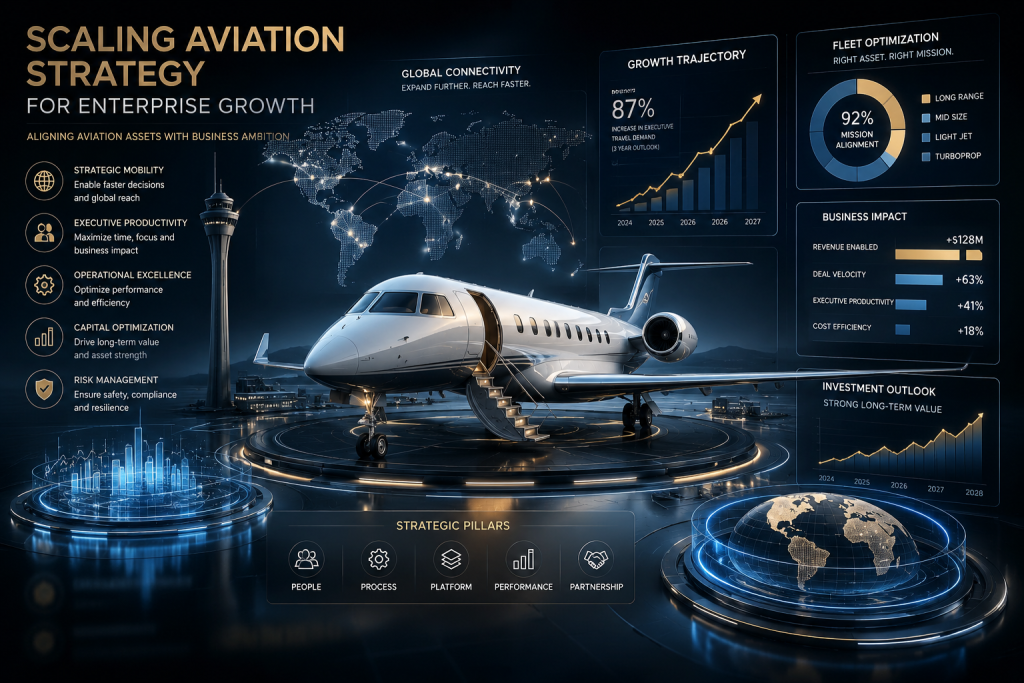
Growth changes everything.
The transportation model that served a company during its early expansion phase often becomes inadequate once operations span multiple regions, countries, or continents. As enterprises grow, executive teams face increasing demands on their time, deal opportunities emerge faster than traditional travel schedules allow, and operational complexity expands across multiple markets.
This is where aviation strategy evolves from a luxury consideration into a business performance tool.
The world’s most successful enterprises rarely view aviation as simply transportation. Instead, they see it as a strategic asset capable of accelerating growth, improving executive productivity, supporting acquisitions, strengthening client relationships, and enhancing organizational agility.
The challenge is determining how aviation capabilities should evolve alongside enterprise growth.
An aviation strategy that works for a $50 million company may become inefficient for a $500 million enterprise. Likewise, the mobility requirements of a regional business differ dramatically from those of a multinational organization operating across several continents.
Understanding how to scale aviation resources intelligently allows leadership teams to maximize value while controlling risk and protecting capital.
By: PrivateJetio Aviation Advisory Team
Why Aviation Strategy Must Evolve Alongside Enterprise Growth
Many organizations make the mistake of treating aviation decisions as isolated purchases rather than long-term strategic investments.
A growing enterprise experiences continuous shifts in operational requirements.
These changes often include:
- Expansion into new geographic markets
- Increased executive travel frequency
- Growth through mergers and acquisitions
- Multiple operating locations
- International client development
- Higher security and privacy requirements
- Greater demands on leadership time
Each of these factors directly influences aviation requirements.
An organization operating primarily within one region may find charter services sufficient. However, once executives regularly travel between multiple countries or continents, the economics and operational efficiency equation changes significantly.
Strategic aviation planning ensures mobility capabilities remain aligned with business objectives rather than becoming reactive responses to growth.
The Hidden Cost of Outgrowing Your Travel Infrastructure
Most executives focus on direct travel expenses.
The more significant costs often remain invisible.
These hidden costs include:
- Missed acquisition opportunities
- Reduced executive productivity
- Delayed market expansion
- Lost negotiation leverage
- Employee travel inefficiencies
- Increased executive fatigue
Consider a leadership team evaluating investment opportunities across several cities in a single week.
Commercial schedules may require multiple overnight stays and lengthy layovers.
A properly structured business aviation solution can enable visits to multiple locations within a single day.
The difference is not measured merely in hours saved.
It is measured in opportunities captured.
The Aviation Growth Curve
Every enterprise progresses through distinct aviation maturity stages.
Understanding where an organization currently sits on this curve helps determine the most appropriate next step.
Stage One: Commercial Travel Dominance
During the early growth phase, commercial airlines typically provide adequate transportation.
Key characteristics include:
- Limited executive travel volume
- Concentrated geographic footprint
- Controlled operational complexity
- Strong focus on capital preservation
At this stage, aviation strategy focuses on travel policy optimization rather than aircraft ownership.
Organizations should establish travel data collection processes to monitor future aviation requirements.
Stage Two: Strategic Charter Utilization
As travel demands increase, charter solutions become attractive.
This phase often emerges when:
- Executives travel frequently
- Destinations lack efficient airline service
- Time-sensitive opportunities increase
- Confidentiality becomes more important
Charter programs provide flexibility without long-term capital commitments.
For many enterprises, charter services represent the first significant step toward structured business aviation.
Stage Three: Hybrid Aviation Models
Growing enterprises frequently adopt hybrid mobility solutions.
These may combine:
- Commercial travel
- Charter flights
- Jet card programs
- Fractional ownership
- Specialized mission aircraft
Hybrid models offer flexibility while leadership teams gather data to evaluate future aviation investments.
This stage is particularly valuable because it allows organizations to understand actual utilization patterns before committing substantial capital.
Stage Four: Dedicated Aviation Assets
Once flight activity reaches sufficient levels, dedicated aircraft solutions may become financially and operationally advantageous.
At this stage, aviation becomes deeply integrated into business strategy.
Organizations begin focusing on:
- Long-term mobility planning
- Aircraft acquisition
- Operational efficiency
- Aviation asset management
- Strategic route development
Dedicated aviation resources often deliver the highest value when mobility directly influences revenue generation, market expansion, or executive effectiveness.
Aligning Aviation Resources with Corporate Objectives
Aviation decisions should never begin with aircraft selection.
They should begin with business objectives.
The most successful aviation programs are designed backward from enterprise goals.
Supporting Geographic Expansion
New markets create new mobility requirements.
Executives responsible for market development frequently need access to locations underserved by commercial airlines.
Private aviation allows organizations to:
- Evaluate opportunities faster
- Meet local partners more efficiently
- Conduct multiple site visits in one trip
- Accelerate expansion timelines
For rapidly growing enterprises, speed often becomes a competitive advantage.
The ability to move decision-makers quickly can materially influence growth outcomes.
Accelerating Mergers and Acquisitions
Acquisition activity places enormous demands on executive mobility.
Leadership teams may need to:
- Conduct due diligence visits
- Meet management teams
- Inspect facilities
- Attend negotiations
- Coordinate advisors
Time-sensitive transactions rarely align perfectly with airline schedules.
Business aviation provides flexibility during critical deal phases where timing can influence valuation and competitive positioning.
Enhancing Executive Productivity
The highest-performing executives operate under severe time constraints.
Their schedules represent one of the organization’s most valuable resources.
Private aviation transforms travel time into productive working time.
Executives can:
- Conduct confidential meetings
- Review strategic materials
- Participate in virtual conferences
- Coordinate teams
- Prepare negotiations
This productivity enhancement often represents one of the largest returns generated by business aviation.
Building an Aviation Framework for Sustainable Growth
A scalable aviation strategy requires structure.
Without a framework, aviation programs often become inefficient as organizations expand.
Establish Clear Mobility Objectives
Before evaluating aircraft options, leadership should answer several questions.
- What strategic goals will aviation support?
- Which executives require access?
- How frequently will missions occur?
- What geographic regions are involved?
- How will success be measured?
Clear objectives create alignment between aviation investments and enterprise priorities.
Define Utilization Thresholds
One of the most important decisions involves determining when mobility requirements justify different aviation solutions.
Organizations should track:
- Annual flight hours
- Passenger volume
- Route frequency
- Travel costs
- Productivity impact
- Opportunity costs
These metrics provide objective data for evaluating future transitions from charter to ownership or other structures.
Create Governance Policies
Growth introduces complexity.
Aviation programs require governance standards covering:
- Aircraft usage policies
- Executive authorization procedures
- Security protocols
- Compliance requirements
- Vendor management standards
- Financial oversight
Strong governance protects both operational efficiency and shareholder value.
Fleet Optimization as Organizations Expand
Growth often leads enterprises to believe they need larger aircraft.
That assumption is not always correct.
The most effective aviation programs focus on mission requirements rather than prestige.
Matching Aircraft Capabilities to Mission Profiles
Different missions require different capabilities.
Factors include:
- Passenger count
- Range requirements
- Airport accessibility
- International operations
- Cargo needs
- Operational flexibility
An enterprise conducting frequent regional travel may generate greater value from a super-midsize aircraft than from a large-cabin jet.
Strategic fleet optimization ensures capital is allocated efficiently.
Avoiding Excess Capacity
One of the most common mistakes in corporate aviation is acquiring more aircraft capability than operations require.
Excess capacity increases:
- Acquisition costs
- Fuel consumption
- Maintenance expenses
- Crew requirements
- Insurance costs
A disciplined approach focuses on mission alignment rather than maximum specifications.
The result is a more efficient and scalable aviation program.
Multi-Aircraft Considerations
As organizations continue expanding, a single aircraft may no longer support operational requirements.
At this stage, leadership teams must evaluate:
- Geographic distribution of operations
- Scheduling conflicts
- Fleet standardization
- Maintenance planning
- Crew management
The goal is creating a system capable of supporting enterprise growth without introducing unnecessary complexity.
Aviation Asset Management: Protecting Long-Term Enterprise Value
As aviation programs mature, executives must begin viewing aircraft as strategic business assets rather than transportation tools.
This distinction matters.
A poorly managed aviation asset can experience accelerated depreciation, rising operating costs, reduced marketability, and increased regulatory exposure. A properly managed asset, however, can support enterprise objectives while preserving residual value over the long term.
Successful aviation asset management requires a comprehensive approach that addresses operational performance, maintenance planning, regulatory compliance, technological modernization, and market positioning.
The world’s most sophisticated flight departments understand that value preservation begins on the day an aircraft enters service.
The Financial Lifecycle of an Aircraft
Every aircraft progresses through predictable stages.
These stages include:
- Acquisition
- Entry into service
- Operational utilization
- Mid-life upgrades
- Value optimization
- Exit strategy
Organizations that actively manage each phase often achieve substantially better outcomes than those that simply operate an aircraft until replacement becomes necessary.
Strategic planning should begin with the end in mind.
Executives should understand potential resale scenarios before making acquisition decisions.
Maintaining Residual Value
Several factors directly influence long-term asset performance.
These include:
- Aircraft age
- Total flight hours
- Maintenance history
- Upgrade status
- Cabin condition
- Avionics modernization
- Regulatory compliance
Buyers consistently place a premium on aircraft with documented maintenance programs and professional operational oversight.
Organizations that prioritize value preservation often experience lower ownership costs across the aircraft lifecycle.
Private Aviation Management for Growing Enterprises
As aviation operations expand, management complexity increases significantly.
What begins as occasional charter activity can evolve into a sophisticated transportation ecosystem involving multiple stakeholders, regulatory jurisdictions, operational vendors, and strategic objectives.
Professional private aviation management provides the structure necessary to scale efficiently.
Establishing a Professional Operating Model
Aviation programs should operate with the same discipline applied to other critical business functions.
Key management areas include:
- Safety oversight
- Regulatory compliance
- Budget management
- Crew coordination
- Maintenance scheduling
- Vendor negotiations
- Risk management
Organizations that treat aviation as a strategic business unit typically achieve stronger operational performance than those relying on fragmented management approaches.
Data-Driven Decision Making
Modern aviation generates substantial operational data.
Leading enterprises leverage this information to improve decision-making.
Metrics may include:
- Cost per flight hour
- Aircraft utilization
- Mission efficiency
- Passenger productivity
- Scheduling effectiveness
- Maintenance performance
Data transforms aviation from a cost center into a measurable strategic asset.
Navigating the Transition Toward Private Jet Ownership
Eventually, many enterprises reach a point where ownership deserves consideration.
The decision should be driven by business requirements rather than prestige.
Private jet ownership becomes attractive when organizations require predictable access, operational control, enhanced confidentiality, and scheduling flexibility.
However, ownership also introduces responsibilities.
These include:
- Capital commitments
- Operational oversight
- Regulatory compliance
- Crew management
- Maintenance obligations
A structured evaluation process helps determine whether ownership aligns with enterprise objectives.
Questions Leadership Should Ask
Before pursuing ownership, executives should evaluate:
- How many annual flight hours are anticipated?
- Which routes are flown most frequently?
- What level of scheduling flexibility is required?
- Are confidentiality concerns increasing?
- Will travel demands continue growing?
- How important is asset control?
- What are the long-term strategic objectives?
These questions help determine whether ownership, fractional participation, charter solutions, or hybrid structures represent the most efficient path forward.
Supporting International Growth Through Business Aviation
Global expansion creates challenges that traditional travel systems often struggle to address.
As enterprises establish operations across multiple regions, executive mobility becomes increasingly important.
Business aviation provides flexibility that supports faster decision-making and greater organizational responsiveness.
Entering New Markets Faster
International expansion frequently requires:
- Facility inspections
- Investor meetings
- Government discussions
- Regulatory engagement
- Partner evaluations
The ability to access multiple destinations efficiently can accelerate market entry timelines.
In highly competitive industries, timing often influences outcomes.
Organizations capable of moving decision-makers quickly may gain advantages unavailable to slower competitors.
Managing Global Operations
As geographic footprints expand, leadership teams must maintain visibility across multiple locations.
Private aviation enables executives to:
- Visit multiple facilities rapidly
- Respond to operational issues
- Support regional leadership teams
- Strengthen corporate culture
- Improve stakeholder relationships
Mobility becomes an organizational capability rather than a travel function.
Risk Management in a Scalable Aviation Strategy
Growth introduces risk.
Aviation programs must evolve accordingly.
The most effective organizations integrate risk management into every aspect of their aviation strategy.
Operational Risk
Operational risks may include:
- Safety incidents
- Scheduling disruptions
- Maintenance failures
- Vendor reliability issues
Mitigation strategies require structured oversight and continuous monitoring.
Financial Risk
Financial exposure often stems from:
- Inappropriate aircraft selection
- Excess capacity
- Poor asset timing
- Inefficient operations
Disciplined planning reduces these risks significantly.
Regulatory Risk
International operations frequently involve complex compliance requirements.
Areas requiring attention include:
- Aviation regulations
- Tax structures
- Cross-border operations
- Import and export considerations
- Ownership structures
Professional advisory support helps organizations navigate these complexities effectively.
The Role of Aviation Consulting in Enterprise Growth
One of the most overlooked aspects of aviation planning is independent advisory support.
Many organizations make aviation decisions only a few times during their corporate lifecycle.
Aircraft manufacturers, brokers, operators, and service providers each have their own interests.
Independent aviation consulting helps ensure decisions remain aligned with enterprise objectives.
Strategic Advisory Beyond Aircraft Selection
Professional advisors contribute value in areas such as:
- Market analysis
- Acquisition strategy
- Fleet planning
- Operational reviews
- Cost optimization
- Asset disposition
- Growth forecasting
Their role extends far beyond helping select an aircraft.
The objective is building a long-term aviation roadmap.
Avoiding Expensive Mistakes
Aviation transactions often involve millions of dollars.
Small mistakes can create significant financial consequences.
Common errors include:
- Acquiring inappropriate aircraft
- Overestimating utilization
- Underestimating operating costs
- Ignoring future growth requirements
- Failing to optimize ownership structures
Experienced advisors help enterprises avoid these costly pitfalls.
Creating a Future-Ready Aviation Strategy
The aviation landscape continues evolving.
Technology, sustainability initiatives, regulatory developments, and changing business models will influence future mobility strategies.
Organizations should build flexibility into long-term planning.
Areas to Monitor
Future aviation strategies should consider:
- Sustainable aviation fuel adoption
- Advanced air mobility developments
- Connectivity improvements
- Predictive maintenance technologies
- Data-driven operational optimization
- Emerging ownership models
The goal is creating a framework capable of adapting as conditions change.
Thinking Beyond Today’s Requirements
The most successful aviation programs are designed not only for current needs but also for future opportunities.
Leadership teams should evaluate where the organization expects to be five to ten years from now.
Questions worth considering include:
- Will international operations expand?
- Will acquisition activity increase?
- Will executive travel requirements change?
- Will security concerns grow?
- Will operational complexity increase?
The answers influence aviation decisions made today.
Conclusion
Enterprise growth creates new demands on mobility, decision-making, and operational agility.
Organizations that continue relying on travel strategies designed for earlier stages of development often encounter inefficiencies that limit expansion potential.
A well-designed aviation strategy enables leadership teams to move faster, evaluate opportunities more effectively, strengthen relationships, improve executive productivity, and support long-term growth objectives.
The most successful enterprises do not view aviation as a luxury.
They view it as infrastructure.
Whether an organization currently relies on charter services, is evaluating ownership opportunities, or is managing a mature flight department, the key is alignment.
Every aviation decision should support enterprise objectives, protect capital, and enhance strategic flexibility.
At PrivateJetIO, we help buyers, owners, family offices, corporate flight departments, and growing enterprises develop aviation strategies aligned with long-term business goals. Independent guidance can help organizations avoid costly mistakes, optimize asset performance, and build a mobility platform capable of supporting future growth.
If your enterprise is expanding into new markets, evaluating aircraft ownership, or reassessing its aviation framework, a strategic consultation can provide the clarity needed to make confident decisions.
Frequently Asked Questions
When should a growing company consider business aviation?
Companies should evaluate business aviation when executive travel frequency increases, multiple locations require regular visits, and time-sensitive opportunities begin impacting growth. The decision should be based on operational requirements rather than status considerations.
Is aircraft ownership always better than chartering?
No. Charter solutions may remain more efficient for organizations with moderate travel needs. Ownership becomes attractive when utilization, scheduling demands, confidentiality requirements, and strategic objectives justify the investment.
How does business aviation support mergers and acquisitions?
Business aviation allows leadership teams to conduct site visits, management meetings, facility inspections, and negotiations more efficiently. Faster mobility often accelerates transaction timelines and improves decision-making.
What is the biggest mistake companies make when scaling aviation operations?
Many organizations acquire aircraft based on prestige or assumptions rather than actual mission requirements. Proper planning ensures aviation assets align with business objectives and utilization patterns.
Why is independent aviation consulting important?
Independent advisors help organizations evaluate options objectively, reduce transaction risk, optimize costs, and develop long-term aviation strategies aligned with enterprise growth goals.
References:
National Business Aviation Association
https://nbaa.org
Federal Aviation Administration
https://www.faa.gov
European Union Aviation Safety Agency
https://www.easa.europa.eu
International Civil Aviation Organization
https://www.icao.int
General Aviation Manufacturers Association
https://gama.aero


