
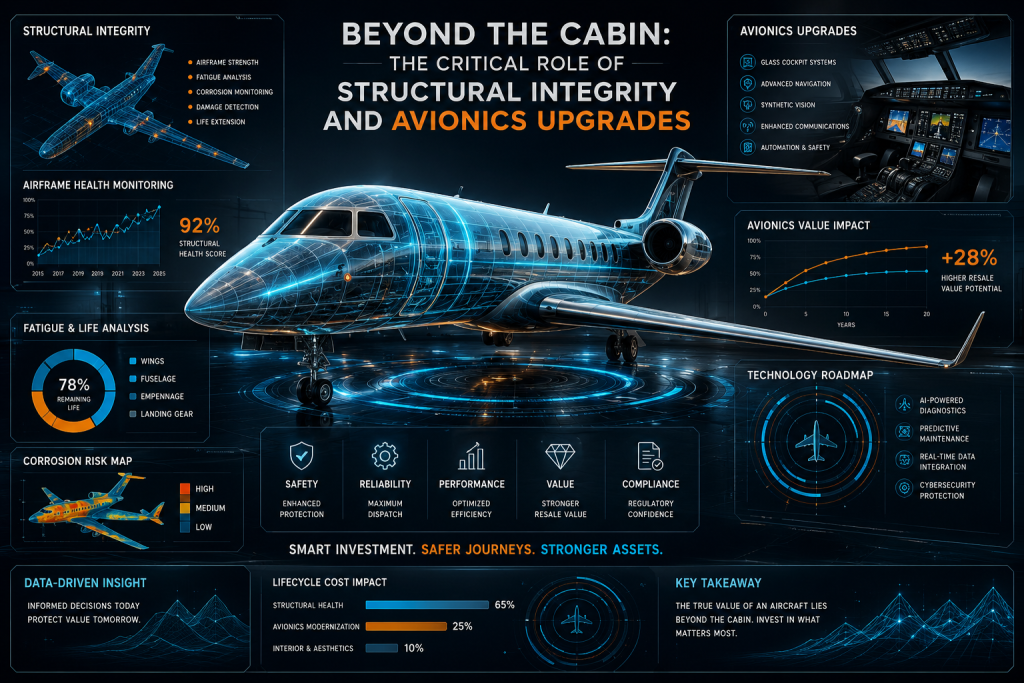
Luxury interiors often dominate conversations in private aviation. Buyers discuss cabin layouts, premium seating, connectivity packages, and bespoke finishes. Yet the most critical factors influencing an aircraft’s safety, reliability, residual value, and long-term ownership experience remain hidden beneath polished veneers and elegant furnishings.
Experienced aircraft investors understand a fundamental truth: an aircraft’s true quality is determined not by what passengers can see, but by what engineers discover during a detailed technical evaluation.
Aircraft structural integrity and avionics upgrades represent two of the most important components of aviation asset assessment. These factors influence operating costs, regulatory compliance, future marketability, safety margins, and investment performance for years after acquisition.
Whether evaluating a light jet, super-midsize aircraft, or ultra-long-range business jet, sophisticated buyers increasingly focus on technical fundamentals before considering aesthetics. A stunning cabin may impress visitors, but a well-maintained airframe and modern flight deck ultimately determine whether an aircraft remains a strategic asset or becomes a financial burden.
Understanding how to evaluate these technical elements can save millions of dollars throughout the ownership lifecycle.
By: PrivateJetio Aviation Advisory Team
Why Structural Integrity Matters More Than Cabin Appearance
Private aircraft are high-value transportation assets operating under extreme environmental conditions. During every flight, the airframe experiences pressure changes, aerodynamic loads, vibration, temperature fluctuations, and structural stress.
Over time, these forces accumulate.
Even the most prestigious aircraft models eventually experience wear that can affect performance, maintenance requirements, and resale value.
Structural integrity refers to the overall condition and strength of the aircraft’s primary structure, including:
- Fuselage
- Wings
- Tail assembly
- Landing gear attachment points
- Pressure vessel components
- Internal support structures
- Engine mounting systems
While cosmetic issues can be corrected relatively easily, structural problems often require extensive repairs, prolonged downtime, and substantial capital expenditure.
For this reason, professional aviation advisors frequently prioritize structural evaluation before discussing interior upgrades or aesthetic enhancements.
The Hidden Cost of Ignoring Structural Health
Many aircraft transactions appear attractive on the surface because the aircraft features a premium interior, recent paintwork, or favorable pricing.
However, hidden structural deficiencies can transform an apparently favorable acquisition into an expensive liability.
Examples include:
- Corrosion hidden beneath panels
- Fatigue cracking
- Improper historical repairs
- Undocumented damage events
- Deferred maintenance items
- Aging structural components
These issues frequently emerge after acquisition when corrective actions become the responsibility of the new owner.
This is precisely why elite buyers conduct extensive technical due diligence before completing a transaction.
Understanding Airframe Fatigue in Business Aviation
One of the most important considerations during any aircraft evaluation is airframe fatigue.
Airframe fatigue develops gradually as repeated stress cycles weaken structural components over time.
Every takeoff, landing, pressurization cycle, and turbulence event contributes to cumulative structural wear.
The impact of airframe fatigue depends on multiple factors:
Flight Hours
Higher flight hours generally indicate greater cumulative usage.
However, hours alone do not tell the complete story.
An aircraft with moderate hours and excellent maintenance practices may present less risk than a lower-hour aircraft with poor maintenance history.
Flight Cycles
Cycles often matter more than hours.
Each pressurization event places stress on the fuselage structure.
Aircraft conducting frequent short flights may accumulate fatigue faster than aircraft operating longer missions.
Environmental Exposure
Aircraft based in coastal environments often face increased corrosion risks due to salt exposure.
Similarly, aircraft operating in extreme climates may experience accelerated material degradation.
Maintenance Quality
Proper inspections and timely repairs significantly extend structural longevity.
Well-managed aircraft frequently maintain excellent structural condition even after decades of operation.
Understanding these variables requires expert analysis rather than reliance on simple flight-hour metrics.
The Importance of a Comprehensive Pre-Purchase Inspection
A professional pre-purchase inspection remains one of the most valuable investments during an acquisition process.
Sophisticated buyers recognize that the purpose of an inspection is not merely identifying problems.
Its real purpose is understanding future risk exposure.
A thorough inspection typically examines:
- Structural condition
- Maintenance compliance
- Engine health
- System functionality
- Historical repairs
- Modification records
- Corrosion presence
- Documentation accuracy
The findings often influence negotiations, purchase pricing, warranty requests, and acquisition strategy.
Key Areas Investigated During Inspection
Corrosion Detection
Corrosion remains one of the most expensive structural threats in aviation.
Inspectors examine vulnerable areas including:
- Wing roots
- Landing gear bays
- Bilge compartments
- Fuselage joints
- Control surfaces
Early detection can prevent substantial future repair expenses.
Repair Verification
Not all repairs are equal.
Professional inspectors review whether previous repairs complied with manufacturer standards and regulatory requirements.
Improper repairs may create future operational and certification issues.
Service Bulletin Compliance
Manufacturers continually issue service bulletins addressing safety, reliability, and performance improvements.
Inspectors verify compliance status and identify future obligations.
Structural Inspection Programs
Certain aircraft require recurring structural examinations as they age.
Reviewing compliance with these programs helps buyers estimate future maintenance commitments.
Aircraft Maintenance Records: The Aviation Asset’s Biography
Aircraft maintenance records tell the story of an aircraft’s life.
Experienced acquisition advisors often compare maintenance documentation to medical records for a patient.
Without complete records, accurate evaluation becomes nearly impossible.
Well-organized documentation provides insight into:
- Historical maintenance quality
- Previous ownership practices
- Component replacements
- Regulatory compliance
- Modification history
- Inspection intervals
- Operational consistency
Missing documentation frequently reduces aircraft value and increases transaction risk.
What Elite Buyers Look For
Sophisticated buyers evaluate maintenance records beyond simple compliance.
They seek evidence of disciplined asset management.
Indicators include:
- Consistent maintenance scheduling
- Complete inspection records
- Detailed corrective action reports
- Accurate component tracking
- Transparent repair history
- Manufacturer-approved modifications
Strong documentation often enhances buyer confidence and supports premium valuations.
The Growing Importance of Maintenance Tracking Systems
Modern business aviation increasingly relies on digital maintenance tracking systems.
These platforms create detailed records of maintenance activities, inspections, component lifecycles, and regulatory requirements.
A robust maintenance tracking system improves operational transparency and reduces compliance risk.
Advantages include:
- Improved maintenance forecasting
- Enhanced regulatory compliance
- Reduced documentation errors
- Better asset valuation support
- Stronger buyer confidence
- More efficient maintenance planning
For acquisition teams, digital records simplify due diligence and improve transaction efficiency.
Aircraft with organized maintenance tracking frequently command stronger market interest because buyers can assess historical performance more confidently.
Beyond Structure: Why Avionics Matter
While structural health protects the aircraft itself, avionics determine how effectively pilots operate the aircraft.
Modern avionics influence:
- Safety
- Situational awareness
- Regulatory compliance
- Operational flexibility
- Pilot workload
- Aircraft desirability
In today’s market, outdated avionics can significantly reduce competitiveness.
Even structurally excellent aircraft may struggle to attract buyers if their flight deck technology no longer aligns with industry expectations.
This reality has accelerated investment in avionics modernization across the business aviation sector.
The Evolution of Flight Deck Technology
Business aviation has experienced a remarkable technological transformation during the past two decades.
Traditional analog instrumentation has gradually been replaced by integrated digital systems capable of delivering unprecedented levels of information and automation.
Modern flight deck technology now includes:
- Large-format displays
- Synthetic vision systems
- Enhanced weather visualization
- Digital navigation platforms
- Advanced autopilot capabilities
- Real-time traffic monitoring
- Integrated performance management
These advancements improve operational efficiency while enhancing safety margins.
More importantly, they help preserve long-term asset competitiveness.
Aircraft equipped with contemporary avionics often experience stronger demand in secondary markets, particularly among corporate flight departments and institutional buyers.
Avionics Modernization as a Strategic Investment
Some owners mistakenly view avionics upgrades as discretionary expenses.
In reality, avionics modernization often represents a strategic investment that can enhance value retention and improve marketability.
Key benefits include:
Enhanced Regulatory Compliance
Global aviation regulations continue evolving.
Modern avionics help operators comply with emerging requirements while avoiding operational restrictions.
Increased Safety
New systems provide pilots with more accurate information and improved decision-making tools.
This reduces operational risk during challenging conditions.
Improved Operational Efficiency
Advanced navigation systems optimize routing and fuel usage.
Over time, these efficiencies can generate meaningful cost savings.
Stronger Buyer Appeal
Many prospective buyers prefer aircraft equipped with contemporary systems rather than facing expensive upgrade projects after acquisition.
As a result, aircraft with recent avionics investments often attract broader market interest.
Evaluating an Aircraft Upgrade Program
Not all upgrades deliver equal value.
The most effective aircraft upgrade program aligns investment with operational objectives, regulatory trends, and future market expectations.
Before approving upgrades, owners should evaluate:
- Mission requirements
- Aircraft age
- Expected ownership duration
- Future resale objectives
- Regulatory developments
- Competitive market positioning
Strategic upgrades can extend asset relevance for years while supporting stronger residual values.
How Avionics Upgrades Influence Aircraft Value Retention
One of the most overlooked factors in private aircraft ownership is the relationship between avionics capability and residual value.
Many owners focus heavily on cosmetic improvements. While a refreshed interior may create a positive first impression, buyers and aviation advisors typically place greater emphasis on technical modernization when evaluating long-term investment quality.
Aircraft value retention is heavily influenced by three factors:
- Structural condition
- Maintenance history
- Avionics relevance
These elements often determine market demand more than aesthetic enhancements.
An aircraft equipped with modern navigation systems, upgraded displays, and current compliance technologies generally attracts more qualified buyers than an identical aircraft with obsolete systems.
This valuation difference can become substantial as aircraft age.
A ten-year-old aircraft with modernized avionics may outperform a newer aircraft with outdated systems because buyers understand the future costs associated with technological upgrades.
The result is often:
- Shorter sales cycles
- Stronger buyer confidence
- Reduced negotiation pressure
- Higher residual values
- Improved financing attractiveness
For sophisticated owners, avionics investments should be viewed as capital preservation strategies rather than simple operational expenses.
Major Avionics Upgrades Worth Evaluating
Not every upgrade generates equal return on investment.
The most valuable upgrades typically improve safety, regulatory compliance, operational flexibility, and pilot efficiency.
ADS-B Compliance Systems
Automatic Dependent Surveillance-Broadcast technology has become a critical requirement across many airspace environments.
Aircraft lacking compliant systems may face operational limitations.
Buyers increasingly view ADS-B capability as a baseline requirement rather than a premium feature.
Synthetic Vision Technology
Synthetic vision creates a three-dimensional digital representation of terrain and obstacles.
The system improves situational awareness during low-visibility operations and challenging approaches.
This capability is particularly attractive for owner-operators and corporate flight departments prioritizing risk reduction.
Enhanced Flight Management Systems
Modern flight management systems improve navigation precision and operational efficiency.
Benefits include:
- More efficient routing
- Reduced pilot workload
- Improved fuel management
- Better airspace integration
These systems can materially improve the operational profile of older aircraft.
Connectivity and Data Integration
Today’s executives increasingly expect aircraft to function as productive business environments.
Modern avionics often integrate with advanced communication platforms, real-time weather services, operational analytics, and digital flight planning systems.
This integration enhances both passenger experience and operational performance.
Structural Red Flags Every Buyer Should Understand
Technical due diligence often reveals warning signs that inexperienced buyers overlook.
Recognizing these indicators early can prevent costly mistakes.
Repeated Corrosion Repairs
Occasional corrosion treatment is normal.
Repeated corrosion findings in the same areas may indicate ongoing environmental exposure or insufficient corrective action.
Persistent corrosion issues deserve detailed investigation.
Incomplete Documentation
Documentation gaps create uncertainty.
Even if an aircraft appears mechanically sound, missing records may affect:
- Value
- Financing eligibility
- Insurance considerations
- Future resale prospects
Documentation risk frequently becomes a negotiation issue during transactions.
Deferred Maintenance Patterns
One deferred maintenance item may be manageable.
A pattern of deferred maintenance often signals broader management concerns.
Buyers should investigate whether maintenance decisions reflected strategic planning or financial pressure.
Unusual Repair History
Major repairs are not automatically problematic.
However, buyers should understand:
- Why the repair occurred
- Who performed the work
- Whether manufacturer procedures were followed
- How the repair affects future inspections
Transparency is critical.
Why Elite Buyers Rely on Independent Technical Advisors
The most successful aircraft acquisitions are rarely driven solely by brokers or sales representatives.
Ultra-high-net-worth buyers often engage independent technical advisors who represent only the buyer’s interests.
These specialists evaluate:
- Structural condition
- Engine status
- Maintenance quality
- Regulatory exposure
- Upgrade opportunities
- Future ownership costs
Independent advisors provide objective assessments that help buyers distinguish between genuine value and marketing presentation.
This perspective becomes particularly important during transactions involving aging aircraft or significant modernization opportunities.
The Financial Impact of Technical Due Diligence
Many buyers focus on acquisition price while underestimating ownership costs.
A lower purchase price may conceal substantial future expenditures.
Technical due diligence helps identify:
- Upcoming inspections
- Component replacements
- Structural repairs
- Avionics modernization requirements
- Regulatory compliance investments
The objective is not merely avoiding bad acquisitions.
The goal is understanding total ownership economics.
In some cases, a higher-priced aircraft with stronger technical fundamentals represents the better financial decision.
Over a five- to ten-year ownership period, reduced maintenance surprises and stronger resale performance can easily outweigh the initial acquisition premium.
Future Trends in Structural Monitoring
Business aviation continues embracing predictive technologies.
Modern aircraft increasingly utilize sensors, analytics platforms, and digital monitoring tools to assess structural health.
These systems provide operators with deeper insights into:
- Usage patterns
- Fatigue development
- Component wear
- Maintenance forecasting
Predictive maintenance strategies allow operators to address issues before they become significant problems.
As technology advances, structural monitoring will likely become a standard expectation across the industry.
Aircraft equipped to support these capabilities may enjoy enhanced market appeal.
The Next Generation of Flight Deck Technology
Avionics innovation continues accelerating.
Several emerging technologies are expected to shape future aircraft valuations.
Artificial Intelligence-Assisted Decision Support
Future systems may assist pilots by analyzing operational data and highlighting potential risks before they become critical.
Advanced Data Connectivity
Aircraft will increasingly integrate with ground systems, maintenance providers, weather services, and operational management platforms.
Enhanced Automation
Automation continues reducing pilot workload while improving consistency and safety.
Cybersecurity Integration
As aircraft become more connected, cybersecurity protections are becoming an essential component of avionics architecture.
Buyers evaluating long-term ownership should consider how current avionics investments position the aircraft for future technological developments.
A Practical Framework for Aircraft Evaluation
When evaluating a prospective aircraft acquisition, experienced advisors often follow a structured framework.
Step 1: Review Maintenance Records
Assess documentation completeness and maintenance consistency.
Step 2: Analyze Structural Health
Evaluate corrosion history, fatigue exposure, repairs, and inspection compliance.
Step 3: Examine Avionics Capability
Determine whether systems meet current and anticipated operational requirements.
Step 4: Forecast Future Costs
Identify upcoming inspections, upgrade requirements, and lifecycle expenses.
Step 5: Compare Market Position
Evaluate how the aircraft compares with competing assets in the marketplace.
This disciplined approach helps investors make informed decisions based on facts rather than appearances.
Why the Best Aircraft Are Often Not the Most Expensive
An important lesson in aviation asset acquisition is that the most expensive aircraft is not always the best aircraft.
Likewise, the least expensive aircraft rarely remains inexpensive.
The strongest acquisitions typically share several characteristics:
- Excellent structural condition
- Complete maintenance history
- Modern avionics suite
- Transparent ownership record
- Consistent operational management
- Strong compliance profile
These attributes reduce uncertainty and support predictable ownership outcomes.
In private aviation, certainty often carries greater value than luxury upgrades.
Conclusion
The most successful aircraft acquisitions begin where most casual observers stop looking.
Beyond handcrafted interiors, premium seating, and luxurious finishes lies the true foundation of aircraft quality: structural integrity and technological relevance.
Aircraft structural integrity determines safety, reliability, longevity, and future maintenance exposure. Meanwhile, avionics modernization influences operational capability, regulatory compliance, market appeal, and long-term asset performance.
Together, these factors form the technical backbone of every aircraft investment decision.
For owners, investors, family offices, and corporate flight departments, evaluating these areas thoroughly can prevent costly surprises and significantly improve long-term ownership outcomes.
Before committing capital to any aircraft acquisition, ensure that your evaluation extends beyond the cabin. The most valuable insights are often found beneath the surface.
At PrivateJetio, we help buyers, owners, and aviation investors conduct independent aircraft due diligence, assess technical risks, evaluate upgrade opportunities, and make informed strategic aviation decisions. When millions of dollars are at stake, expert analysis is not a luxury—it is a necessity.
Frequently Asked Questions
How important is structural integrity when buying a private jet?
Structural integrity is one of the most important factors in aircraft evaluation. It directly affects safety, maintenance costs, reliability, and future resale value.
What is airframe fatigue?
Airframe fatigue refers to the gradual weakening of structural components caused by repeated operational stress over time. It is a normal aspect of aircraft aging but requires careful monitoring.
Are avionics upgrades worth the investment?
In many cases, yes. Modern avionics improve safety, regulatory compliance, operational efficiency, and buyer appeal, often supporting stronger residual values.
What should a pre-purchase inspection include?
A comprehensive inspection should evaluate structure, engines, maintenance records, avionics, corrosion history, repair quality, and regulatory compliance.
Can maintenance records affect aircraft value?
Absolutely. Complete and organized maintenance records improve buyer confidence, reduce perceived risk, and often support higher market valuations.
References:
Federal Aviation Administration (FAA)
https://www.faa.gov
National Business Aviation Association (NBAA)
https://nbaa.org
European Union Aviation Safety Agency (EASA)
https://www.easa.europa.eu
International Civil Aviation Organization (ICAO)
https://www.icao.int
General Aviation Manufacturers Association (GAMA)
https://gama.aero
Aircraft Owners and Pilots Association (AOPA)
https://www.aopa.org


