
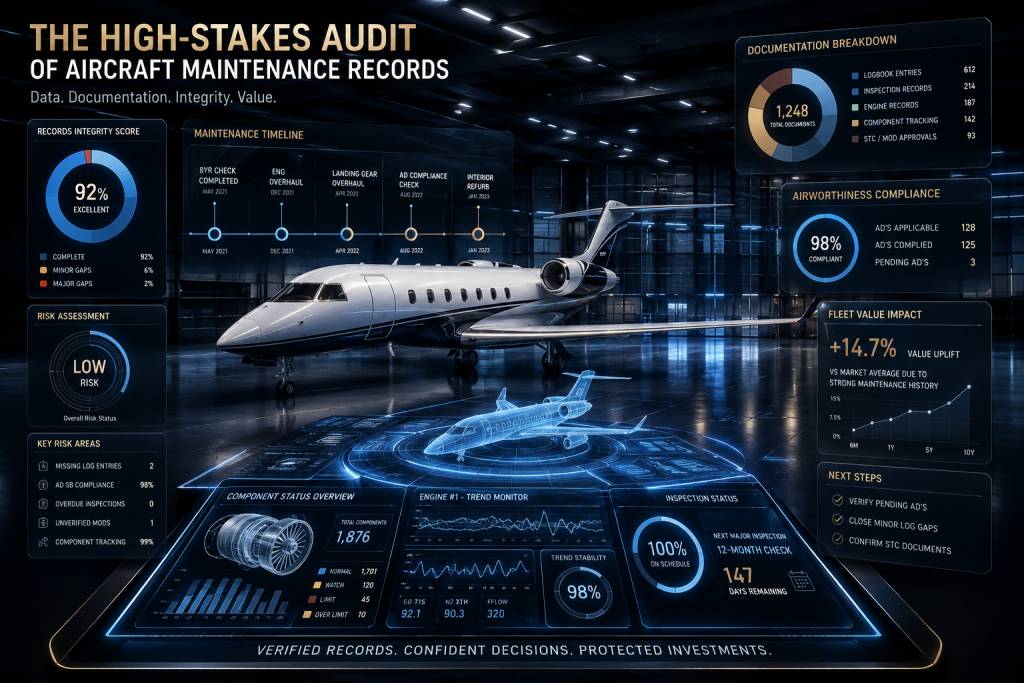
The High-Stakes Audit: Verifying Maintenance Logs for Asset Integrity
In private aviation, a jet’s appearance can be deceiving. Gleaming paint, luxurious interiors, and impressive specifications often capture attention, but sophisticated buyers know the true story of an aircraft lives within its maintenance records. Before millions of dollars change hands, one critical process separates a sound acquisition from a costly mistake: the Aircraft Maintenance Log Audit.
For high-net-worth individuals, family offices, aviation investors, and corporate flight departments, verifying maintenance documentation is not simply an administrative exercise. It is a strategic investigation into asset integrity, regulatory standing, operational reliability, and future financial exposure.
A missing document, an overlooked inspection, or an undocumented repair can dramatically impact an aircraft’s value, insurability, and operational flexibility. In some cases, incomplete records have reduced aircraft market values by hundreds of thousands—or even millions—of dollars.
This guide examines why maintenance log audits have become one of the most important components of modern aircraft transactions and how elite buyers use them to protect capital and preserve long-term value.
By: PrivateJetio Aviation Advisory Team
Why Maintenance Records Matter More Than the Aircraft Itself
An aircraft is unlike most luxury assets.
A luxury vehicle can lose value and still remain usable. A yacht may suffer from incomplete maintenance documentation and still operate. Aircraft operate under an entirely different standard.
Every component, inspection, repair, modification, and overhaul creates a documented history that follows the aircraft throughout its operational life.
Without that history, uncertainty enters the equation.
Buyers begin asking questions:
- Was maintenance performed correctly?
- Were inspections completed on schedule?
- Are all modifications properly approved?
- Does the aircraft satisfy current regulatory requirements?
- Are there hidden liabilities waiting to surface?
The answers determine whether an aircraft is viewed as a premium asset or a potential risk.
In today’s aviation marketplace, complete documentation is often considered as valuable as the physical aircraft itself.
The Relationship Between Records and Asset Integrity
Asset integrity refers to the confidence that an aircraft has been maintained, operated, and documented according to accepted standards throughout its lifecycle.
A well-preserved aircraft demonstrates:
- Mechanical reliability
- Operational consistency
- Regulatory compliance
- Higher residual value
- Lower ownership risk
Maintenance records provide the evidence supporting these conclusions.
Without proper documentation, buyers cannot independently verify the aircraft’s condition regardless of visual appearance.
An aircraft that appears flawless can hide substantial compliance deficiencies.
Conversely, an older aircraft with exceptional documentation may represent a superior investment.
This distinction is why sophisticated aviation investors often spend more time reviewing records than inspecting interiors.
Understanding What Is Included in an Aircraft Maintenance Log Audit
A comprehensive Aircraft Maintenance Log Audit extends far beyond reviewing logbooks.
Professional auditors typically analyze hundreds or thousands of pages of documentation.
Key areas include:
Aircraft Logbooks
These records contain the official maintenance history of the airframe.
Auditors verify:
- Inspection intervals
- Maintenance events
- Flight hours
- Flight cycles
- Service history continuity
Any gaps require immediate investigation.
Engine Records
Engines represent some of the most valuable components of an aircraft.
Reviewers analyze:
- Overhaul history
- Service bulletins
- Component replacements
- Engine trend monitoring
- Maintenance intervals
Incomplete engine records often create significant valuation concerns.
Component Tracking Documentation
Modern aircraft rely on thousands of serialized parts.
Auditors verify:
- Installation dates
- Removal dates
- Life-limited component status
- Remaining service life
- Replacement history
This process often depends on an advanced maintenance tracking system capable of documenting component status accurately.
Airworthiness Directives
Regulators continuously issue mandatory directives designed to address safety concerns.
Auditors verify whether:
- Applicable directives were identified
- Required actions were completed
- Documentation supports compliance
Failure in this area can result in grounding risks.
Maintaining proper airworthiness compliance is therefore one of the most important aspects of the audit process.
Supplemental Type Certificates
Many private jets undergo modifications throughout their lifespan.
Examples include:
- Cabin upgrades
- Connectivity systems
- Avionics improvements
- Performance enhancements
Auditors verify that all modifications have received proper approvals and remain fully documented.
How Missing Records Destroy Aircraft Value
Few issues create greater concern during a transaction than incomplete records.
When documentation disappears, uncertainty replaces confidence.
The market typically responds with immediate discounts.
Reduced Buyer Confidence
Buyers assume risk when documentation is missing.
Because unknown issues may exist, acquisition offers frequently decrease.
Even if no actual maintenance problem exists, uncertainty alone impacts value.
Increased Inspection Requirements
Incomplete records force buyers to perform deeper investigations.
Additional inspections create:
- Higher transaction costs
- Longer acquisition timelines
- Increased legal review
- Technical consulting expenses
The resulting friction often reduces deal momentum.
Financing Challenges
Aircraft lenders rely heavily on documentation quality.
Banks evaluate:
- Asset condition
- Maintenance history
- Regulatory status
- Future collateral value
Missing records can complicate financing approvals or alter lending terms.
Insurance Concerns
Underwriters use maintenance history to evaluate risk.
Documentation gaps may result in:
- Higher premiums
- Additional inspections
- Coverage restrictions
These costs continue long after acquisition.
The Role of Aircraft Due Diligence
Aircraft acquisitions differ from conventional luxury purchases because they involve extensive technical verification.
This process is known as aircraft due diligence.
The objective is straightforward:
Identify all risks before capital is committed.
A comprehensive audit evaluates:
- Maintenance records
- Technical condition
- Ownership history
- Regulatory status
- Operational exposure
- Financial implications
Maintenance documentation serves as the foundation for nearly every other area of review.
Without reliable records, due diligence becomes significantly more difficult.
Why Elite Buyers Never Skip Record Audits
Experienced aviation investors understand a simple reality:
The cost of an audit is insignificant compared to the cost of a mistake.
A maintenance audit may uncover:
- Improper repairs
- Missed inspections
- Tracking errors
- Compliance deficiencies
- Hidden maintenance liabilities
Any one of these discoveries can alter acquisition economics.
Sophisticated buyers view audits as investment protection rather than transaction expenses.
The objective is not simply avoiding bad aircraft.
The objective is identifying the highest-quality asset available.
The Critical Link Between Maintenance History and Asset Valuation
Aircraft pricing models depend heavily on documentation quality.
When analysts determine asset valuation, maintenance history plays a central role.
Several factors influence value:
Inspection Status
Aircraft approaching major inspections often command lower prices.
Recent inspections can increase market attractiveness.
Engine Program Participation
Engines enrolled in recognized maintenance programs often receive stronger valuations because future maintenance costs become more predictable.
Component Life Status
Remaining life on expensive components directly influences pricing.
Buyers analyze these metrics carefully during negotiations.
Documentation Completeness
Complete documentation often produces measurable valuation premiums.
In contrast, missing records may result in substantial discounts.
For premium business jets, the financial difference can be significant enough to influence acquisition strategy.
Maintenance History Verification: Separating Fact from Assumption
Many sellers believe their aircraft records are complete.
However, assumptions do not satisfy sophisticated buyers.
Professional maintenance history verification requires evidence.
Auditors cross-reference:
- Logbooks
- Tracking software
- Maintenance invoices
- Service center records
- Regulatory filings
- Component documentation
This process frequently uncovers discrepancies that were previously unknown.
Most issues are administrative rather than mechanical.
Yet administrative deficiencies can still affect value and transaction outcomes.
The Growing Importance of Regulatory Compliance
Global aviation regulation continues to evolve.
Authorities increasingly emphasize documentation quality, traceability, and accountability.
As a result, regulatory compliance has become a strategic asset rather than a simple operational requirement.
Modern buyers evaluate whether an aircraft can seamlessly operate across:
- North America
- Europe
- Middle East
- Asia-Pacific markets
Documentation deficiencies can create operational limitations that reduce flexibility and value.
The Connection Between Audits and Pre-Purchase Inspections
Many buyers mistakenly believe a pre-purchase inspection replaces a maintenance records audit.
In reality, these processes complement one another.
A physical inspection answers:
“What condition is the aircraft in today?”
A records audit answers:
“How did the aircraft reach this condition?”
Both perspectives are necessary.
An aircraft may pass a physical inspection while still carrying documentation risks.
Likewise, strong records cannot compensate for unresolved mechanical issues.
The most effective acquisition strategies combine both approaches into a unified evaluation framework.
Advanced Audit Methodologies Used by Aviation Experts
Elite aviation advisory firms rarely rely on a simple review of maintenance logs. Modern aircraft transactions often involve highly sophisticated audit methodologies designed to identify risks that may not be immediately visible.
Professional auditors typically perform a layered review process.
Technical Cross-Verification
Rather than reviewing records in isolation, auditors compare multiple sources of information.
These include:
- Manufacturer records
- Maintenance facility records
- Maintenance tracking software
- Regulatory databases
- Engine program documentation
- Historical inspection reports
The objective is to identify inconsistencies before they become liabilities.
Lifecycle Analysis
Every aircraft develops a maintenance pattern over time.
Auditors assess:
- Frequency of repairs
- Recurring maintenance issues
- Unscheduled maintenance events
- Major component replacements
- Long-term operational trends
This broader view provides valuable insight into future ownership costs.
Trend Monitoring
Aircraft with strong maintenance histories often demonstrate predictable maintenance trends.
Unexpected spikes in repair activity may indicate:
- Operational abuse
- Deferred maintenance
- Component reliability concerns
- Environmental exposure
Trend analysis helps buyers understand not only where the aircraft has been, but also where it may be heading.
Digital Records and the Future of Aircraft Documentation
The aviation industry continues moving away from paper-based systems toward fully digital records.
This evolution provides significant advantages.
Enhanced Traceability
Digital systems allow operators to:
- Track maintenance events
- Monitor inspections
- Verify component status
- Access historical records instantly
The result is improved transparency.
Reduced Documentation Risk
Paper records can be:
- Lost
- Damaged
- Misfiled
- Destroyed
Digital records dramatically reduce these risks.
Improved Transaction Efficiency
When records are properly digitized, acquisition teams can perform reviews more quickly and accurately.
Aircraft with organized digital documentation often move through transaction processes faster than those relying exclusively on paper archives.
Common Red Flags Discovered During Maintenance Audits
Even well-maintained aircraft occasionally present documentation concerns.
Certain issues appear repeatedly during transaction reviews.
Missing Logbook Periods
One of the most serious concerns involves gaps in maintenance history.
Questions immediately arise:
- What occurred during the missing period?
- Were inspections completed?
- Was maintenance documented elsewhere?
- Can missing records be reconstructed?
These situations require immediate attention.
Inconsistent Flight Hours
Discrepancies between maintenance records and aircraft hours can create significant concern.
Auditors investigate whether:
- Recording errors occurred
- Documentation was lost
- Maintenance tracking contains inaccuracies
Even minor discrepancies deserve review.
Unverified Repairs
Repairs without supporting documentation create uncertainty.
Auditors seek confirmation regarding:
- Work performed
- Approved procedures
- Replacement components
- Maintenance facility qualifications
Without documentation, verification becomes difficult.
Service Bulletin Non-Compliance
Although not every manufacturer service bulletin is mandatory, failure to address important recommendations can affect marketability.
Buyers frequently review service bulletin status when comparing aircraft opportunities.
Unsupported Modifications
Modifications lacking proper approvals represent a significant risk.
Documentation must clearly demonstrate:
- Approval pathway
- Installation process
- Regulatory acceptance
Unsupported modifications often require corrective action before closing a transaction.
How Maintenance Audits Influence Negotiation Power
One of the most overlooked benefits of a thorough audit is negotiation leverage.
Information creates negotiating strength.
When auditors identify deficiencies, buyers gain clarity regarding actual asset condition.
Potential outcomes include:
Price Adjustments
Documentation deficiencies may justify purchase price reductions.
Examples include:
- Missing records
- Upcoming inspections
- Compliance issues
- Component replacement requirements
Seller Remediation
Rather than reducing price, buyers may require sellers to:
- Complete inspections
- Resolve compliance concerns
- Reconstruct records
- Correct documentation deficiencies
This approach can preserve asset value while reducing buyer risk.
Transaction Structure Changes
In some cases, findings influence deal structure itself.
Buyers may negotiate:
- Escrow provisions
- Holdbacks
- Warranty protections
- Post-closing obligations
These mechanisms help manage uncertainty.
Why Aircraft Owners Should Conduct Audits Before Selling
Maintenance audits are not only beneficial for buyers.
Sellers can gain significant advantages from conducting audits before bringing an aircraft to market.
Faster Transactions
Aircraft with verified records tend to move through due diligence more efficiently.
Buyers gain confidence faster.
Advisors spend less time investigating issues.
Transactions close sooner.
Stronger Market Position
Well-organized documentation signals professionalism.
Buyers often perceive these aircraft as lower-risk opportunities.
This perception can strengthen pricing discussions.
Reduced Last-Minute Surprises
Many deals encounter challenges because documentation issues emerge late in the process.
Pre-sale audits help identify concerns before negotiations begin.
This proactive approach improves transaction certainty.
The Economics of Documentation Quality
Documentation quality directly affects ownership economics.
Consider two identical aircraft:
Aircraft A possesses:
- Complete records
- Strong maintenance tracking
- Verified compliance history
- Organized documentation
Aircraft B possesses:
- Missing records
- Unresolved discrepancies
- Incomplete tracking
- Compliance questions
Despite identical physical condition, market participants frequently assign different values.
Why?
Because risk has value.
Buyers pay premiums for certainty.
They discount uncertainty.
The difference can easily reach six figures and, in larger transactions, substantially more.
Building a Long-Term Asset Preservation Strategy
The most successful aircraft owners think beyond acquisition.
They view documentation management as an ongoing asset preservation strategy.
Best practices include:
- Maintaining digital backups
- Conducting annual record reviews
- Tracking regulatory changes
- Verifying maintenance entries promptly
- Preserving component documentation
- Reviewing maintenance tracking accuracy
These habits help protect long-term value.
Questions Every Buyer Should Ask During a Maintenance Audit
Before acquiring any aircraft, buyers should seek clear answers to several critical questions:
- Are maintenance records complete from manufacture to present day?
- Have all mandatory inspections been completed and documented?
- Is there evidence supporting all major repairs and modifications?
- Are engine records complete and independently verifiable?
- Have all applicable airworthiness directives been addressed?
- Are there unresolved compliance concerns?
- Can documentation support future resale value?
- Does the aircraft demonstrate a consistent maintenance philosophy?
The answers often reveal more than a physical inspection alone.
The Strategic Advantage of Independent Aviation Advisors
Many buyers rely solely on brokers or internal teams during acquisitions.
However, independent aviation advisors provide a valuable external perspective.
Their role includes:
- Reviewing documentation objectively
- Identifying hidden risks
- Assessing future ownership implications
- Supporting negotiation strategy
- Protecting capital allocation decisions
For high-value transactions, independent analysis frequently delivers returns far exceeding advisory costs.
A single overlooked maintenance issue can cost substantially more than a professional review.
Final Thoughts: Asset Integrity Is Proven, Not Assumed
In private aviation, confidence comes from verification.
Every aircraft tells a story through its maintenance records. Those records reveal how the aircraft was operated, maintained, upgraded, and preserved throughout its lifecycle.
The Aircraft Maintenance Log Audit is not simply a regulatory exercise. It is a strategic process that protects capital, strengthens negotiation positions, supports accurate valuation, and reduces acquisition risk.
For ultra-high-net-worth buyers, family offices, corporate flight departments, and aviation investors, documentation quality often determines whether an aircraft represents an opportunity or a liability.
The most successful acquisitions are rarely the result of luck. They are the result of disciplined due diligence, rigorous verification, and informed decision-making.
Before committing millions to an aviation asset, ensure the records tell the same story as the aircraft itself.
Private Jetio provides independent aircraft acquisition advisory, transaction support, maintenance record review, and strategic due diligence services for buyers and sellers worldwide. If you are evaluating a private jet acquisition, a professional maintenance audit can provide the clarity needed to make a confident decision.
FAQ
What is an Aircraft Maintenance Log Audit?
An Aircraft Maintenance Log Audit is a comprehensive review of maintenance records, inspections, repairs, modifications, and compliance documentation to verify the integrity and value of an aircraft.
Why are maintenance records important when buying a private jet?
Maintenance records demonstrate how an aircraft has been maintained over time. Complete records reduce risk, support valuation, and improve buyer confidence.
Can missing maintenance records reduce aircraft value?
Yes. Missing records create uncertainty and often lead to valuation discounts, extended due diligence, financing challenges, and increased buyer concern.
Is a pre-purchase inspection enough without a records audit?
No. A pre-purchase inspection evaluates current physical condition, while a records audit verifies historical maintenance and compliance. Both are essential.
How long does a professional maintenance audit take?
The timeline varies depending on aircraft complexity and documentation quality. Most comprehensive audits require several days to several weeks.
References:
- Federal Aviation Administration (FAA) – Aircraft Maintenance Records
https://www.faa.gov - European Union Aviation Safety Agency (EASA) – Continuing Airworthiness Requirements
https://www.easa.europa.eu - National Business Aviation Association (NBAA) – Aircraft Acquisition and Due Diligence Resources
https://nbaa.org - International Civil Aviation Organization (ICAO) – Airworthiness Standards and Guidance
https://www.icao.int - General Aviation Manufacturers Association (GAMA) – Aircraft Ownership and Maintenance Guidance
https://gama.aero - Aircraft Electronics Association (AEA) – Regulatory and Maintenance Resources
https://aea.net - International Society of Transport Aircraft Trading (ISTAT) – Aviation Asset Management Resources
https://istat.org - FAA Advisory Circulars on Aircraft Recordkeeping and Continuing Airworthiness
https://www.faa.gov/regulations_policies/advisory_circulars/


