
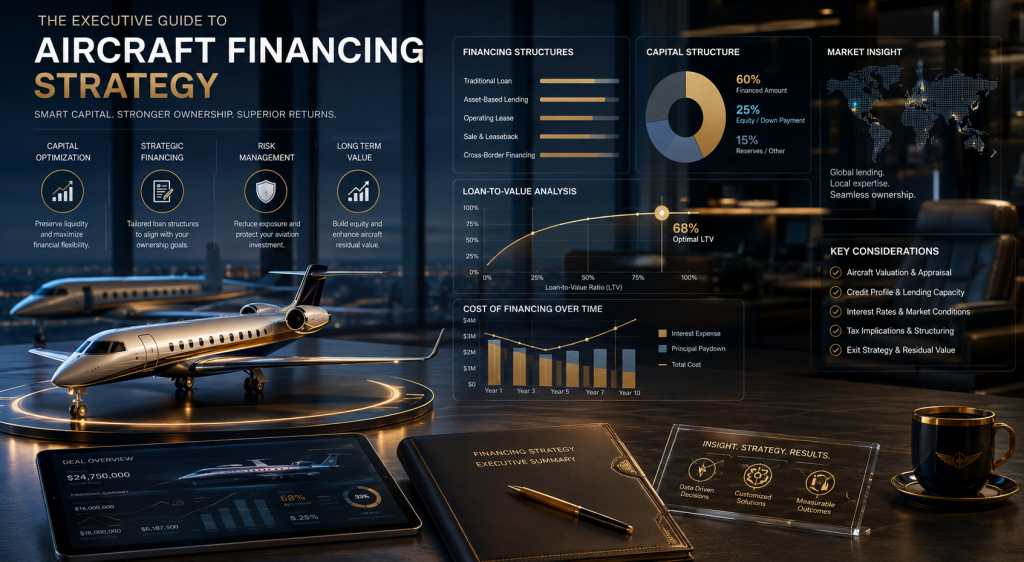
Aircraft financing can be the difference between a highly efficient aviation investment and a costly long-term liability. While many buyers focus on selecting the right aircraft, sophisticated owners understand that financing structure often has a greater impact on total ownership economics than the initial purchase price itself.
Whether acquiring a light jet, a long-range business aircraft, or an entire aviation portfolio, understanding lending dynamics allows buyers to negotiate stronger terms, preserve liquidity, and improve overall asset performance. This guide explores the nuances of aircraft financing and provides practical strategies for securing favorable lending arrangements in today’s business aviation market.
By: PrivateJetio Aviation Advisory Team
Why Aircraft Financing Matters More Than Most Buyers Realize
Private aviation acquisitions frequently involve substantial capital commitments. Even ultra-high-net-worth individuals and corporations with significant cash reserves often utilize financing rather than paying entirely in cash.
The reason is simple: capital efficiency.
When structured correctly, financing allows owners to:
- Preserve liquidity for core investments
- Maintain operational flexibility
- Optimize tax planning opportunities
- Improve portfolio diversification
- Enhance overall return on capital
The most sophisticated aviation investors evaluate financing as a strategic component of the acquisition process rather than a simple funding mechanism.
A poorly negotiated financing package can increase ownership costs by hundreds of thousands or even millions of dollars throughout the life of the aircraft.
Understanding the Aircraft Finance Landscape
Aircraft financing differs substantially from traditional commercial lending.
Aircraft are mobile assets that can cross international borders, operate under multiple regulatory frameworks, and experience unique depreciation patterns. As a result, lenders apply specialized underwriting criteria.
Several financing structures dominate the market.
Traditional Aircraft Loans
Traditional aircraft loans remain the most common financing method for private jet acquisitions.
In this structure, the lender provides funds secured by the aircraft itself. The borrower retains ownership while making scheduled payments over an agreed period.
Advantages include:
- Predictable repayment schedules
- Potential tax benefits
- Long-term ownership control
- Competitive interest rates for qualified borrowers
This approach works particularly well for buyers seeking long-term ownership and stable operating requirements.
Asset-Based Lending
Many lenders offer specialized asset-based lending solutions tailored specifically for aviation assets.
Rather than focusing exclusively on income or corporate cash flow, lenders evaluate the aircraft’s value and marketability.
Asset-based lending can provide flexibility for:
- Family offices
- Entrepreneurs
- Aviation holding companies
- International buyers
This financing method often becomes attractive when borrowers possess substantial assets but have non-traditional income structures.
Aviation Leasing Structures
Aircraft leasing remains a powerful alternative to ownership financing.
Under a lease arrangement, the aircraft is operated by the user while ownership remains with the leasing company.
Benefits may include:
- Lower initial capital requirements
- Improved cash flow management
- Fleet flexibility
- Reduced residual value exposure
For organizations seeking fleet agility, leasing may outperform traditional ownership models.
Cross-Border Financing
International acquisitions frequently require specialized cross-border financing solutions.
These transactions involve:
- Multiple jurisdictions
- Currency considerations
- Tax compliance requirements
- International registration structures
Experienced aviation advisors become particularly valuable when navigating these complex financing environments.
Key Factors Lenders Evaluate
Understanding lender priorities allows borrowers to strengthen their negotiating position.
Borrower Financial Strength
The first assessment focuses on the borrower’s overall financial profile.
Lenders typically analyze:
- Net worth
- Liquidity position
- Debt-to-income ratios
- Corporate cash flow
- Credit history
High-net-worth borrowers with diversified assets generally receive more favorable financing proposals.
Aircraft Type and Marketability
Not all aircraft receive identical treatment from lenders.
Aircraft with strong global demand and proven resale performance typically secure better financing conditions.
Lenders often favor:
- Popular business jet models
- Aircraft with strong manufacturer support
- Aircraft with predictable maintenance costs
- Models with stable secondary markets
A desirable aircraft creates less risk for the lender.
Aircraft Appraisal Quality
A professional aircraft appraisal plays a critical role during underwriting.
Lenders rely on independent valuations to assess collateral quality and loan exposure.
An inaccurate appraisal can negatively impact:
- Loan approval
- Loan-to-value ratios
- Interest rates
- Financing flexibility
Sophisticated buyers frequently commission independent appraisals before entering financing discussions.
Maintenance Status
Aircraft condition significantly affects financing outcomes.
Lenders review:
- Maintenance records
- Engine programs
- Inspection history
- Airframe condition
- Avionics status
Comprehensive documentation improves confidence and strengthens lending terms.
The Importance of Loan-to-Value Ratios
One of the most important financing metrics is the loan-to-value ratio.
This ratio measures the percentage of the aircraft’s value financed by the lender.
For example:
If an aircraft is valued at $20 million and the lender provides $14 million, the loan-to-value ratio is 70%.
Lower ratios generally produce:
- Better interest rates
- Stronger approval prospects
- Increased lender competition
- Reduced financing risk
Borrowers capable of making larger down payments often gain meaningful advantages during negotiations.
How Interest Rates Are Determined
Interest rates vary significantly across aircraft transactions.
Several variables influence pricing.
Credit Quality
Stronger borrowers receive more competitive rates.
Credit strength remains one of the largest pricing drivers in aviation finance.
Aircraft Age
Newer aircraft generally qualify for better financing terms.
Older aircraft may carry:
- Higher rates
- Shorter amortization schedules
- Additional lender requirements
Market Conditions
Interest rate environments affect aviation lending just as they impact broader financial markets.
When benchmark rates rise, borrowing costs typically increase.
Transaction Complexity
Complex ownership structures, international transactions, or unusual collateral arrangements may increase lender risk and influence pricing.
Negotiating Better Lending Terms
Many buyers mistakenly assume financing proposals are non-negotiable.
In reality, substantial flexibility often exists.
Create Competitive Tension
One of the most effective strategies involves obtaining multiple proposals.
Competition encourages lenders to improve:
- Interest rates
- Fees
- Amortization periods
- Covenants
The strongest financing packages often emerge from competitive bidding processes.
Improve Financial Presentation
Lenders reward transparency.
Providing organized documentation can accelerate approvals and strengthen negotiating leverage.
Recommended documentation includes:
- Financial statements
- Tax returns
- Asset schedules
- Business plans
- Ownership structures
Professional presentation reduces perceived risk.
Use Aviation Specialists
General commercial lenders may lack specialized aviation expertise.
Dedicated aviation lenders better understand:
- Aircraft markets
- Residual values
- Operational risks
- Regulatory requirements
This knowledge frequently results in more favorable lending structures.
Negotiate Beyond Interest Rates
Many borrowers focus exclusively on rate discussions.
However, overall financing economics also include:
- Origination fees
- Prepayment penalties
- Covenant requirements
- Closing costs
- Collateral restrictions
A lower rate accompanied by excessive fees may not represent the best overall package.
The Role of Residual Value in Financing
An aircraft’s future market value significantly influences financing decisions.
Lenders analyze residual value projections to estimate future collateral strength.
Aircraft with stronger residual value performance often benefit from:
- Higher financing availability
- Better loan terms
- Reduced lender concerns
Factors influencing residual value include:
- Manufacturer reputation
- Fleet size
- Technology relevance
- Maintenance status
- Market demand
Buyers who understand residual value trends gain a meaningful strategic advantage.
Tax Considerations and Financing Strategy
Financing and tax planning frequently intersect.
Depending on jurisdiction and ownership structure, aircraft acquisitions may create opportunities involving:
- Depreciation deductions
- Interest expense deductions
- Business-use allocations
- Capital planning strategies
However, regulations vary significantly across countries.
Professional tax advisors should participate early in the acquisition process.
Sophisticated ownership structures often integrate financing decisions directly into broader wealth management and corporate planning objectives.
Common Financing Mistakes
Even experienced buyers occasionally make costly financing errors.
Choosing the Wrong Aircraft First
Some buyers select an aircraft before understanding financing implications.
A different aircraft model may offer significantly superior financing terms.
Ignoring Future Exit Strategy
Aircraft financing should align with eventual disposition plans.
Failure to consider future resale dynamics can create unnecessary financial constraints.
Overlooking Operating Costs
Financing represents only one component of ownership economics.
Buyers should also evaluate:
- Fuel costs
- Crew expenses
- Maintenance reserves
- Insurance requirements
- Hangar expenses
Accepting the First Proposal
Many borrowers leave money on the table by failing to compare alternatives.
A competitive financing process often generates substantial savings.
Financing New Aircraft Versus Pre-Owned Aircraft
The financing environment differs significantly between new and pre-owned acquisitions.
New Aircraft Advantages
Lenders typically favor factory-new aircraft because they offer:
- Predictable maintenance profiles
- Warranty protection
- Strong manufacturer backing
- Longer financing terms
These characteristics reduce lender risk.
Pre-Owned Aircraft Opportunities
Pre-owned aircraft often provide superior acquisition value.
However, lenders examine:
- Aircraft age
- Maintenance history
- Upgrade status
- Market liquidity
Thorough due diligence becomes particularly important.
Financing for Corporate Flight Departments
Organizations operating dedicated flight departments face unique financing considerations.
Decision-makers must balance:
- Capital allocation priorities
- Shareholder expectations
- Risk management objectives
- Fleet planning requirements
Corporate acquisitions frequently involve more sophisticated structures than individual purchases.
Common considerations include:
- Multi-aircraft financing
- Portfolio lending
- Fleet replacement cycles
- Treasury management integration
An optimized financing strategy can support broader corporate objectives while reducing long-term ownership costs.
Why Advisory Support Creates Value
Aircraft financing negotiations often involve multiple stakeholders:
- Lenders
- Brokers
- Attorneys
- Tax advisors
- Appraisers
- Aircraft sellers
Without experienced guidance, buyers may struggle to identify hidden risks and missed opportunities.
Professional aviation advisors help clients:
- Evaluate financing structures
- Benchmark lender proposals
- Assess aircraft quality
- Analyze long-term ownership costs
- Protect negotiating leverage
In many transactions, advisory involvement produces savings that exceed advisory fees many times over.
The Future of Aircraft Financing
The aviation finance market continues evolving.
Several trends are shaping future lending activity:
Digital Underwriting
Lenders increasingly utilize advanced analytics to evaluate transactions more efficiently.
Sustainability Considerations
Environmental performance may play a growing role in financing decisions.
Newer, more fuel-efficient aircraft may benefit from favorable financing treatment.
Global Capital Participation
International lenders continue expanding into business aviation markets, increasing competition and creating opportunities for borrowers.
Data-Driven Valuation Models
Enhanced market intelligence is improving underwriting precision and financing flexibility.
Buyers who stay informed about these trends position themselves to capitalize on emerging opportunities.
Conclusion
Aircraft financing is far more than a funding exercise. It is a strategic decision that influences liquidity, risk exposure, tax planning, portfolio performance, and long-term ownership economics.
The most successful aircraft buyers recognize that optimal lending terms emerge from preparation, market knowledge, and disciplined negotiation. Understanding loan-to-value ratios, aircraft appraisal methodologies, residual value dynamics, asset-based lending structures, aviation leasing alternatives, and cross-border financing considerations enables buyers to approach lenders from a position of strength.
Whether acquiring a first aircraft or managing a complex aviation portfolio, securing the right financing structure can create lasting value throughout the ownership lifecycle.
For ultra-high-net-worth individuals, family offices, corporations, and aviation investors, professional advisory support often provides a decisive advantage when evaluating financing options and negotiating with lenders.
Request a confidential consultation with Private Jetio to evaluate financing strategies, compare lending structures, and optimize your next aircraft acquisition.
Frequently Asked Questions
What credit score is typically required for aircraft financing?
Requirements vary by lender, but stronger credit profiles generally secure lower interest rates and more favorable financing structures. Lenders also consider net worth, liquidity, and overall financial strength.
How much down payment is usually required for a private jet?
Most lenders require a down payment ranging from 15% to 40%, depending on aircraft type, borrower profile, and transaction complexity.
Is leasing better than financing a private jet?
The answer depends on operational requirements, tax considerations, ownership goals, and cash flow preferences. Leasing offers flexibility, while financing supports long-term ownership.
Can international buyers obtain aircraft financing?
Yes. Many lenders offer specialized cross-border financing programs for qualified international borrowers, although documentation and compliance requirements may be more extensive.
Why is an aircraft appraisal important?
An independent aircraft appraisal helps establish fair market value, supports lender underwriting, influences loan-to-value ratios, and strengthens transaction transparency.
References:
- Federal Aviation Administration (FAA) — https://www.faa.gov
- National Business Aviation Association (NBAA) — https://nbaa.org
- International Civil Aviation Organization (ICAO) — https://www.icao.int
- Aircraft Owners and Pilots Association (AOPA) — https://www.aopa.org
- International Society of Transport Aircraft Trading (ISTAT) — https://istat.org


