
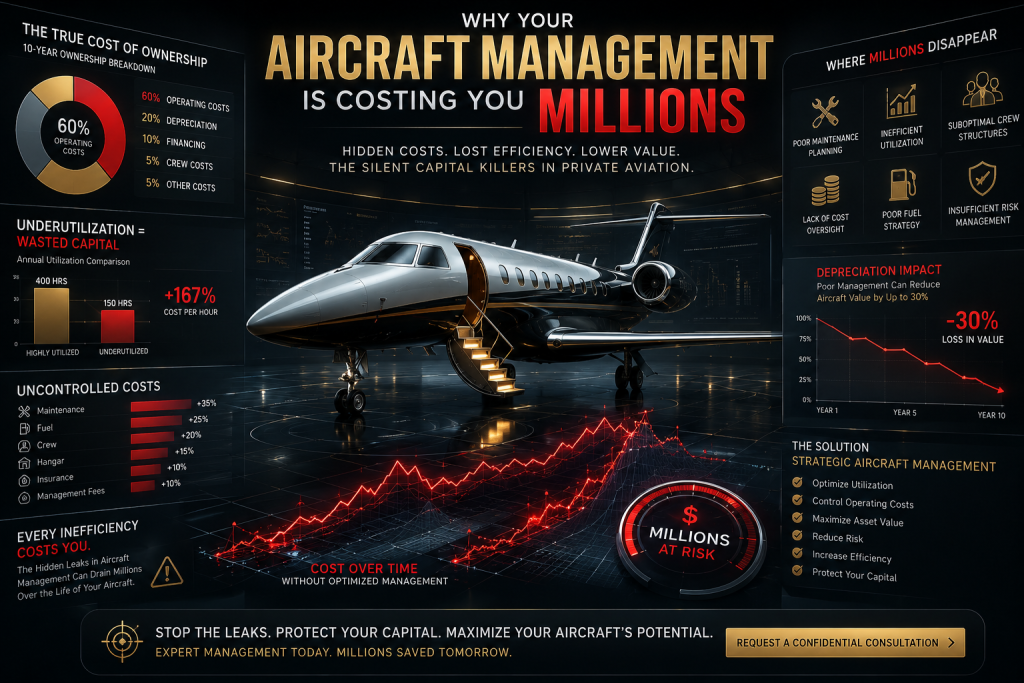
Owning a private jet is often viewed as the pinnacle of convenience, status, and efficiency. Yet many owners unknowingly lose hundreds of thousands—or even millions—of dollars each year because of ineffective aircraft management.
The problem rarely lies with the aircraft itself. More often, the real issue is how the asset is being managed, maintained, utilized, and strategically positioned within a broader financial framework.
Many aircraft owners focus intensely on acquisition costs while overlooking the long-term operational ecosystem surrounding the aircraft. The result is a gradual but substantial erosion of capital through hidden inefficiencies, inflated expenses, poor utilization strategies, and weak oversight.
For ultra-high-net-worth individuals, corporations, family offices, and aviation investors, understanding where capital leaks occur is the first step toward transforming an aircraft from a financial burden into a strategically managed asset.
The Hidden Reality of Aircraft Ownership
A private jet can cost anywhere from several million dollars to more than $80 million before it ever leaves the ground.
Most buyers spend months negotiating purchase prices but surprisingly little time evaluating how the aircraft will be managed after delivery.
This imbalance creates significant financial risks.
The acquisition represents only the beginning of the ownership journey. Over a ten-year ownership cycle, operating expenses frequently exceed the original purchase price.
These expenses include:
- Crew salaries
- Fuel costs
- Hangar expenses
- Insurance
- Maintenance
- Regulatory compliance
- Technology upgrades
- Training requirements
- Management fees
Without sophisticated aircraft management, these costs can escalate dramatically.
Why Aircraft Management Matters More Than Ever
The business aviation sector has become increasingly complex.
Modern aircraft generate enormous amounts of operational data. Regulatory environments continue evolving. Maintenance requirements are becoming more sophisticated. Global fuel markets remain volatile.
In this environment, outdated management approaches are no longer sufficient.
Effective aircraft management now requires expertise in:
Financial Optimization
Every operational decision has a financial impact.
Fuel purchasing strategies, maintenance scheduling, crew deployment, insurance structures, and aircraft utilization directly affect ownership costs.
Risk Management
Aircraft ownership involves significant operational and financial risks.
A professional management framework reduces exposure to:
- Unexpected maintenance events
- Regulatory penalties
- Operational disruptions
- Safety incidents
- Asset value deterioration
Strategic Planning
An aircraft should support broader business and wealth objectives.
The most successful owners treat their aircraft as a managed investment rather than a luxury purchase.
The Biggest Capital Leaks in Aircraft Management
Inefficient Aircraft Utilization
One of the most common problems in private jet ownership is underutilization.
Many owners purchase aircraft based on projected usage that never materializes.
A jet flying only 150 hours annually often generates the same fixed costs as one flying 400 hours.
This creates a dramatically higher cost per flight hour.
Questions every owner should ask include:
- How many hours is the aircraft flying annually?
- Is the aircraft correctly sized for mission requirements?
- Are alternative ownership structures more efficient?
- Is charter revenue being optimized?
When utilization remains low, ownership economics deteriorate rapidly.
Poor Charter Revenue Strategy
Many aircraft owners place their aircraft on charter programs expecting substantial revenue generation.
Unfortunately, many programs fail to maximize opportunities.
Common mistakes include:
- Weak market positioning
- Poor pricing strategies
- Limited broker relationships
- Ineffective scheduling
- Insufficient marketing exposure
Proper charter revenue optimization can significantly offset ownership costs.
However, achieving meaningful charter performance requires expertise, relationships, and active market management.
Simply making an aircraft available for charter does not guarantee profitability.
Excessive Management Fees
Many owners assume management companies always act in their best interests.
The reality can be more complicated.
Some management structures contain hidden layers of cost including:
- Administrative markups
- Vendor commissions
- Fuel surcharges
- Maintenance coordination fees
- Staffing markups
These expenses often accumulate gradually and remain unnoticed.
Regular audits frequently uncover substantial savings opportunities.
Professional aviation asset management includes ongoing fee transparency and cost benchmarking.
Maintenance: The Largest Long-Term Financial Threat
Maintenance represents one of the most significant ownership expenses.
It is also one of the areas most prone to financial inefficiency.
Reactive Maintenance vs Strategic Maintenance
Many operators take a reactive approach.
Problems are addressed after they occur.
This method often leads to:
- Higher repair costs
- Increased downtime
- Emergency service premiums
- Reduced aircraft availability
Strategic maintenance planning produces better outcomes.
By forecasting future maintenance requirements, owners can reduce surprises and negotiate more favorable service arrangements.
Mismanaged Maintenance Programs
Aircraft maintenance programs can provide substantial financial protection.
However, not all programs are equal.
Poorly selected programs often result in:
- Overpayment
- Limited coverage
- Unnecessary reserves
- Reduced flexibility
Experienced business aviation consulting professionals evaluate maintenance programs based on mission profiles, ownership timelines, and residual value objectives.
The right structure can save hundreds of thousands of dollars throughout the ownership cycle.
Deferred Maintenance and Asset Value Destruction
Some owners attempt to reduce expenses by postponing maintenance.
This strategy frequently backfires.
Deferred maintenance can:
- Lower aircraft value
- Increase inspection findings
- Complicate future transactions
- Reduce buyer confidence
Sophisticated buyers immediately identify neglected aircraft.
As a result, deferred maintenance often becomes far more expensive than proactive maintenance.
Crew Management: An Overlooked Cost Center
Flight crews represent a substantial component of operating expenses.
However, inefficient crew structures frequently generate unnecessary costs.
Overstaffing
Some flight departments maintain staffing levels that exceed operational requirements.
Excess personnel increase:
- Salary obligations
- Benefits costs
- Training expenses
- Travel expenses
A properly structured flight department management strategy aligns staffing with actual mission demand.
Understaffing
The opposite problem is equally dangerous.
Insufficient staffing can lead to:
- Pilot fatigue
- Increased turnover
- Scheduling conflicts
- Operational disruptions
Replacing experienced crew members is expensive and time-consuming.
A balanced staffing strategy protects both operational reliability and financial performance.
Training Inefficiencies
Training is mandatory.
Wasteful training spending is not.
Many operators fail to optimize:
- Simulator scheduling
- Recurrent training programs
- Travel arrangements
- Vendor selection
Over time, these inefficiencies create substantial unnecessary costs.
Fuel Management: The Silent Profit Killer
Fuel remains one of the largest variable expenses in aircraft ownership.
Small inefficiencies can have significant consequences.
Lack of Fuel Purchasing Strategy
Many operators purchase fuel at posted rates without leveraging available discounts.
Sophisticated operators negotiate:
- Contract pricing
- Volume discounts
- Preferred supplier agreements
- Strategic fueling locations
The savings can be substantial across hundreds of annual flight hours.
Route Optimization Failures
Poor flight planning increases:
- Fuel burn
- Operating costs
- Crew expenses
- Maintenance exposure
Advanced planning technologies now enable significant efficiency improvements.
Yet many operators continue using outdated planning methodologies.
Insurance Costs That Keep Climbing
Insurance premiums have increased considerably across business aviation.
While market conditions play a role, management quality significantly affects premium levels.
Factors influencing insurance costs include:
- Safety records
- Pilot qualifications
- Maintenance history
- Operational procedures
- Risk management practices
Well-managed operations often secure more favorable insurance terms than comparable operators with weaker management systems.
Technology Gaps That Drain Capital
Modern aircraft generate valuable operational intelligence.
Unfortunately, many owners fail to utilize available data effectively.
Without advanced analytics, operators miss opportunities to improve:
- Fuel efficiency
- Maintenance forecasting
- Crew scheduling
- Asset utilization
- Cost control
Technology-driven aircraft management increasingly separates top-performing operations from inefficient ones.


