
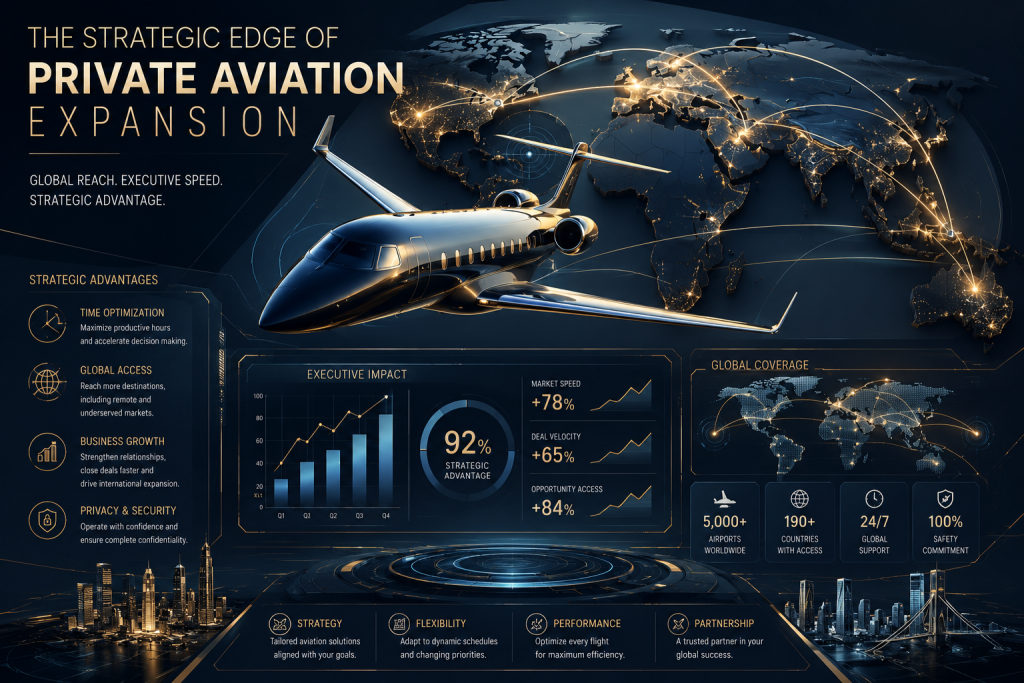
Global expansion has never been more accessible or more competitive. While technology enables companies to communicate instantly across continents, successful expansion still depends on one critical factor: physical presence. Deals are closed face-to-face, partnerships are strengthened through personal interaction, and strategic opportunities often emerge in locations far beyond traditional commercial airline networks.
For executives, investors, family offices, and corporations pursuing international growth, time has become one of the most valuable assets. This reality has elevated private aviation for global expansion from a luxury consideration to a strategic business tool. The ability to move decision-makers efficiently, securely, and predictably across multiple markets creates measurable advantages that often outweigh the costs associated with private aviation.
Organizations that understand how to leverage aviation strategically gain access to opportunities that competitors frequently miss. The question is no longer whether private aviation offers convenience. The question is whether it can become a competitive advantage during international growth initiatives.
By: PrivateJetio Aviation Advisory Team
Why Global Expansion Demands Faster Decision-Making
International growth introduces complexity at every stage.
Executives must evaluate new markets, meet potential partners, inspect facilities, conduct due diligence, negotiate agreements, and oversee implementation. Commercial airline schedules often create unnecessary delays that slow these processes.
A CEO traveling commercially may spend multiple days reaching several destinations, particularly when regional airports are involved. Missed connections, overnight stays, and limited scheduling flexibility create inefficiencies that compound across an expansion project.
Private aviation changes the equation.
Instead of adapting strategic plans around airline schedules, leaders can design travel schedules around business priorities. This flexibility allows companies to respond quickly when opportunities emerge.
In highly competitive markets, speed frequently determines success.
The Cost of Delayed Market Entry
Many organizations underestimate the financial consequences of delayed expansion.
When market opportunities appear, competitors rarely wait. A delay of weeks or even days can affect:
- Market share acquisition
- Partnership opportunities
- Strategic acquisitions
- Regulatory approvals
- Supplier relationships
- Customer contracts
The organizations that mobilize leadership teams rapidly often gain significant advantages over slower competitors.
This is where a well-developed corporate aviation strategy becomes a business accelerator rather than a transportation solution.
How Private Aviation Supports International Business Growth
The relationship between aviation and growth is often misunderstood.
The true value is not found solely in transportation efficiency. Instead, it emerges from the combination of speed, flexibility, productivity, and access.
Access to Underserved Markets
Commercial airlines focus on passenger demand.
Many high-potential business regions lack direct commercial connections. Executives traveling commercially may spend an entire day reaching destinations that a private aircraft can access in a matter of hours.
Private aviation provides access to thousands of airports worldwide that commercial airlines do not serve.
This capability is particularly valuable during:
- Market research missions
- Facility inspections
- Investment evaluations
- Manufacturing audits
- Resource development projects
For organizations pursuing international business growth, access often becomes a decisive advantage.
Multi-City Efficiency
Expansion projects rarely involve a single destination.
Executives frequently need to visit multiple cities or countries within a short timeframe.
Commercial travel often requires:
- Multiple airline bookings
- Overnight hotel stays
- Long layovers
- Airport transfers
- Schedule compromises
Private aviation allows multiple destinations to be visited in a single day.
This capability dramatically improves executive productivity and accelerates decision-making processes.
Executive Time Optimization
Aviation consultants frequently describe time as the most expensive resource aboard an aircraft.
The rationale is simple.
A multinational CEO, private equity principal, or family office executive may oversee assets worth hundreds of millions or billions of dollars.
If private aviation enables that individual to save dozens of hours per month while pursuing expansion opportunities, the economic impact can become substantial.
Executive Travel as a Competitive Weapon
Successful global organizations treat travel differently than their competitors.
Rather than viewing transportation as a cost center, they treat mobility as a strategic asset.
Maintaining Momentum During Negotiations
Major transactions often involve numerous stakeholders across multiple jurisdictions.
Negotiations may require:
- Repeated face-to-face meetings
- Site visits
- Regulatory consultations
- Investor briefings
Private aviation enables executives to maintain momentum without sacrificing schedule flexibility.
Deals that might take months to complete through traditional travel methods can often be accelerated significantly.
Strengthening Relationship Building
International expansion remains fundamentally relationship-driven.
Trust develops faster when executives demonstrate commitment through personal engagement.
Private aviation makes it easier to:
- Visit clients frequently
- Attend strategic meetings
- Respond quickly to concerns
- Maintain executive visibility
These factors contribute directly to stronger business relationships.
The Link Between Global Mobility and Business Performance
Modern enterprises operate within a globally connected economy.
Yet physical movement remains essential.
Mobility Creates Opportunity
Organizations with superior global mobility capabilities often identify opportunities before competitors.
This occurs because leadership teams can:
- Explore emerging markets
- Conduct rapid assessments
- Meet stakeholders quickly
- Evaluate investments firsthand
Information gathered directly in the field is frequently more valuable than data collected remotely.
Reducing Opportunity Costs
Many executives focus on aviation expenses while overlooking opportunity costs.
Opportunity costs may include:
- Missed acquisitions
- Delayed partnerships
- Lost contracts
- Slower market entry
- Reduced executive productivity
Viewed through this lens, private aviation frequently becomes an investment in business performance rather than an operational expense.
Private Aviation and Market Intelligence Gathering
Global expansion requires accurate intelligence.
Executives making major strategic decisions benefit significantly from direct exposure to local conditions.
First-Hand Due Diligence
Reports and presentations provide useful information.
However, they rarely replace firsthand observation.
Private aviation allows leadership teams to conduct:
- Facility inspections
- Supplier evaluations
- Workforce assessments
- Infrastructure reviews
- Regulatory consultations
These activities improve decision quality.
Faster Response to Emerging Risks
Market conditions can change rapidly.
Political shifts, economic developments, regulatory changes, and competitive threats often require immediate executive attention.
Private aviation enables rapid deployment of decision-makers when situations demand urgent action.
For organizations operating internationally, responsiveness can be a significant source of resilience.
Aircraft Acquisition as a Growth Strategy
At a certain scale, organizations begin evaluating whether chartering remains the optimal solution.
The discussion often evolves toward aircraft acquisition.
When Ownership Becomes Strategic
Ownership may become attractive when organizations:
- Fly frequently
- Require consistent availability
- Operate globally
- Value confidentiality
- Need customized capabilities
Aircraft ownership creates greater control over mobility resources.
However, acquisition decisions require careful analysis.
Factors Influencing Acquisition Decisions
Executives evaluating ownership should consider:
- Annual flight hours
- Geographic travel patterns
- Operational requirements
- Capital allocation priorities
- Tax implications
- Residual value expectations
Professional aviation consulting services can help organizations determine whether ownership, chartering, or fractional structures align best with strategic objectives.
Private Jet Ownership and Corporate Growth
There is often a misconception that private jet ownership is primarily a status symbol.
In reality, ownership frequently reflects operational requirements.
Strategic Control
Ownership provides complete control over:
- Scheduling
- Aircraft configuration
- Security protocols
- Crew standards
- Branding considerations
For organizations expanding globally, this level of control can be valuable.
Long-Term Cost Management
Although acquisition costs can be substantial, ownership may offer economic advantages over extended periods depending on utilization levels.
A comprehensive analysis should evaluate:
- Acquisition costs
- Financing structures
- Maintenance expenses
- Crew costs
- Insurance
- Depreciation
- Residual value projections
Strategic ownership decisions require sophisticated financial modeling.
Security and Confidentiality in International Expansion
Global expansion often involves sensitive information.
Mergers, acquisitions, partnerships, and market-entry initiatives can be highly confidential.
Enhanced Privacy
Commercial travel exposes executives to numerous security and confidentiality risks.
Private aviation offers:
- Controlled passenger environments
- Reduced public exposure
- Enhanced operational security
- Greater confidentiality
For high-profile executives and family offices, these advantages may be significant.
Protection of Strategic Discussions
Aircraft cabins often function as mobile boardrooms.
Leadership teams can:
- Conduct meetings
- Review sensitive documents
- Discuss strategic initiatives
- Coordinate expansion efforts
This productivity advantage contributes to the broader business value proposition of private aviation.
Building an Effective Corporate Aviation Strategy
Organizations that achieve the greatest return from aviation typically approach it systematically.
Align Aviation with Business Objectives
Aviation decisions should support strategic goals.
Questions include:
- Which markets are priorities?
- How frequently will executives travel?
- What level of flexibility is required?
- What security standards are necessary?
The answers help define the optimal aviation model.
Evaluate Multiple Solutions
Not every organization requires ownership.
Potential solutions include:
- On-demand charter
- Jet card programs
- Fractional ownership
- Full ownership
- Managed aircraft structures
Each option offers distinct advantages.
Integrate Aviation into Growth Planning
Aviation should be considered during strategic planning rather than after expansion initiatives are launched.
Organizations that align mobility resources with growth objectives often experience better execution outcomes.
The Role of Aviation Consulting in Global Expansion
Many organizations lack internal expertise regarding aviation strategy.
Professional aviation consulting can provide valuable guidance.
Key Areas of Advisory Support
Consultants frequently assist with:
- Fleet selection
- Acquisition support
- Operational analysis
- Cost modeling
- Market intelligence
- Regulatory compliance
- Ownership structures
Independent advisory support helps decision-makers evaluate options objectively.
Avoiding Expensive Mistakes
Aircraft transactions involve significant capital commitments.
Errors in aircraft selection, ownership structure, or operational planning can create substantial costs.
Experienced advisors help reduce these risks through structured evaluation processes.
Future Trends Shaping Private Aviation and Expansion
Several trends continue strengthening the relationship between aviation and global growth.
Expanding Global Business Networks
Companies increasingly operate across multiple regions.
This trend increases demand for efficient executive mobility solutions.
Increased Focus on Time Efficiency
As competition intensifies, executive time becomes more valuable.
Organizations continue seeking methods to maximize productivity.
Private aviation aligns naturally with this objective.
Technology-Driven Decision Making
Advanced analytics now help organizations evaluate aviation strategies with greater precision.
Decision-makers can model utilization, costs, risks, and growth impacts more effectively than ever before.
Growing Demand from Family Offices
Family offices are increasingly using aviation as part of broader global investment strategies.
The ability to evaluate opportunities worldwide creates significant strategic advantages.
Why Private Aviation Remains a Strategic Asset
The conversation around private aviation often focuses on luxury.
This perspective overlooks its most important characteristic.
Private aviation is fundamentally about access, speed, flexibility, and control.
For organizations pursuing international expansion, these capabilities can influence competitive positioning, deal execution, market entry timelines, and executive productivity.
The most successful enterprises understand that mobility is not merely transportation. It is infrastructure for decision-making.
As markets become increasingly global and opportunities emerge faster than ever, organizations that deploy leadership effectively will maintain a significant advantage.
Private aviation enables that deployment.
For executives evaluating expansion opportunities, the critical question is not whether private aviation is expensive. The more relevant question is whether the cost of moving slowly is even greater.
Conclusion
Global expansion rewards organizations that act decisively. Private aviation provides the mobility, flexibility, security, and efficiency necessary to execute growth strategies across borders with greater speed and confidence.
Whether through charter solutions, fractional ownership, or strategic aircraft acquisition, aviation can become a powerful tool for accelerating growth and improving executive effectiveness.
For investors, family offices, corporations, and entrepreneurs seeking a competitive edge, a tailored aviation strategy deserves serious consideration. The right aviation solution is not simply about transportation it is about enabling better business outcomes.
If your organization is evaluating international expansion, aircraft acquisition opportunities, fleet strategy, or executive mobility planning, a confidential consultation can help identify the most efficient path forward.
FAQ
Is private aviation only beneficial for large corporations?
No. Mid-sized companies, private equity firms, family offices, and entrepreneurs can also benefit when frequent international travel supports growth objectives.
When does aircraft ownership make financial sense?
Ownership typically becomes attractive when utilization levels are high and organizations require consistent aircraft availability, security, and operational control.
How does private aviation support international business growth?
It enables faster access to markets, improves executive productivity, strengthens client relationships, and reduces travel-related delays.
What is the difference between chartering and owning a private jet?
Chartering provides flexibility without capital investment, while ownership offers maximum control, availability, and long-term operational customization.
Why should companies use aviation consulting services?
Consultants provide objective guidance on acquisition, ownership structures, operational planning, and cost optimization, helping organizations avoid expensive mistakes.
References:
National Business Aviation Association (NBAA)
https://nbaa.org
General Aviation Manufacturers Association (GAMA)
https://gama.aero
International Civil Aviation Organization (ICAO)
https://www.icao.int
Federal Aviation Administration Business Aviation Resources
https://www.faa.gov
European Union Aviation Safety Agency (EASA)
https://www.easa.europa.eu


