
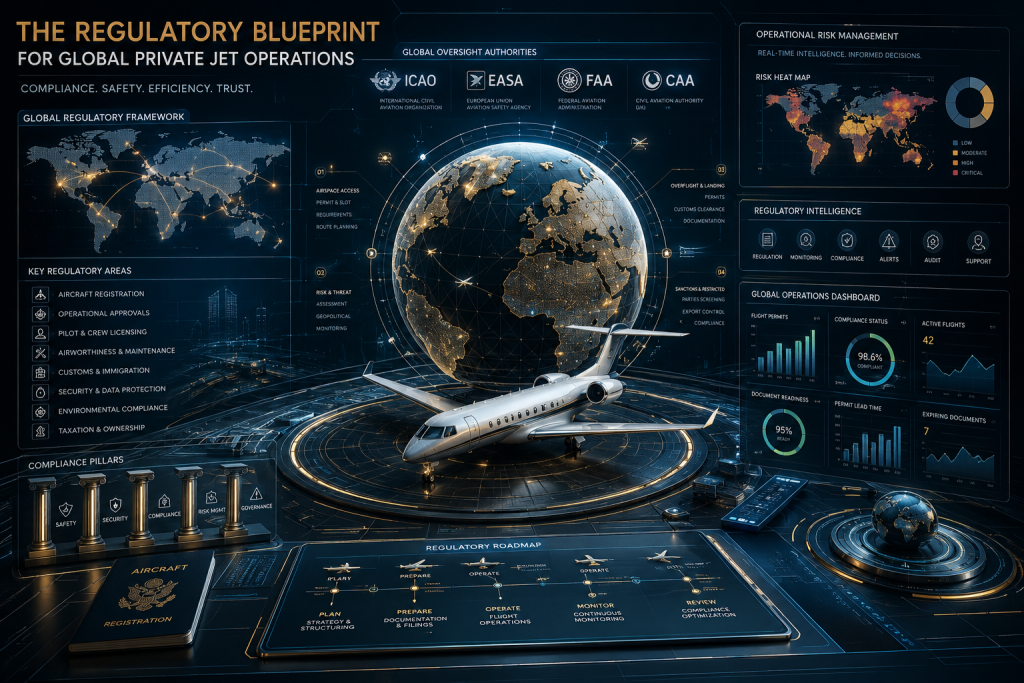
The Regulatory Landscape of Global Private Jet Operations
Operating a private aircraft across international borders delivers unmatched flexibility, efficiency, and strategic value. However, global mobility comes with an increasingly complex web of regulations, compliance obligations, and operational requirements. For aircraft owners, family offices, corporations, and aviation departments, understanding the regulatory landscape is no longer optional. It is a critical component of protecting assets, preserving operational continuity, and minimizing legal and financial exposure.
The modern environment for global private jet operations involves navigating multiple jurisdictions, evolving security requirements, changing tax frameworks, environmental regulations, and increasingly sophisticated reporting obligations. Those who approach these challenges strategically gain a competitive advantage, while those who underestimate regulatory complexity often face costly disruptions.
This guide explores the key regulations governing international private aviation and explains how owners can build a proactive compliance strategy that supports safe, efficient, and unrestricted global travel.
By: PrivateJetio Aviation Advisory Team
Why Regulation Matters More Than Ever
Private aviation has transformed dramatically over the last decade. Increased globalization, geopolitical uncertainty, technological innovation, and environmental scrutiny have expanded regulatory oversight across virtually every aspect of aircraft ownership and operation.
Today, regulators monitor:
- Aircraft registration
- Crew qualifications
- Security protocols
- Maintenance records
- Environmental emissions
- International customs procedures
- Passenger documentation
- Tax reporting requirements
- Flight planning compliance
As a result, successful global private jet operations require much more than simply owning an aircraft. They demand comprehensive regulatory intelligence and continuous oversight.
Failure to comply can result in:
- Flight delays
- Aircraft detentions
- Monetary penalties
- Insurance disputes
- Operational restrictions
- Reputational damage
- Criminal liability in severe cases
For ultra-high-net-worth individuals and corporate operators, the consequences often extend beyond financial loss and impact business continuity and personal privacy.
Understanding the Global Regulatory Framework
Unlike commercial airlines, private aviation operates under a combination of international agreements, national regulations, and local airport requirements.
Several organizations shape the global regulatory environment.
International Civil Aviation Organization (ICAO)
The International Civil Aviation Organization establishes international standards and recommended practices that member states incorporate into national regulations.
ICAO influences:
- Safety standards
- Security protocols
- Air navigation requirements
- Environmental initiatives
- Pilot licensing frameworks
Although ICAO does not directly regulate operators, its standards form the foundation of global aviation governance.
National Aviation Authorities
Each country enforces its own regulations through dedicated aviation authorities.
Examples include:
- Federal Aviation Administration (United States)
- Civil Aviation Authority (United Kingdom)
- European Union Aviation Safety Agency (Europe)
Aircraft operators must comply not only with their home jurisdiction but also with the requirements of every country they enter.
Regional Regulatory Systems
Regional organizations increasingly influence business aviation regulations.
Examples include:
- European aviation safety frameworks
- Schengen border procedures
- Regional environmental regulations
- Air traffic modernization programs
These frameworks often create additional layers of compliance beyond national requirements.
Aircraft Registration: The Foundation of Compliance
One of the most important strategic decisions for aircraft owners involves aircraft registration.
Registration determines:
- Applicable legal framework
- Tax treatment
- Financing flexibility
- Operational privileges
- Reporting obligations
Different jurisdictions offer varying advantages.
Popular Registration Jurisdictions
Owners frequently consider:
- United States
- United Kingdom
- Isle of Man
- Aruba
- Cayman Islands
- Malta
- San Marino
Each registry offers unique benefits and limitations.
Strategic Considerations
Choosing the right registration jurisdiction requires evaluating:
- Intended flight routes
- Tax implications
- Financing requirements
- Privacy considerations
- Maintenance oversight
- Resale strategy
An improperly structured registration can create significant complications during ownership transfers, financing transactions, or international operations.
International Flight Regulations and Cross-Border Operations
Cross-border aviation has become increasingly regulated.
Every international flight typically requires coordination among multiple authorities before departure.
Flight Authorizations
Many countries require:
- Overflight permits
- Landing permits
- Passenger manifests
- Security declarations
- Customs notifications
Permit requirements vary significantly by region.
Some approvals may be obtained within hours, while others require several days or even weeks.
Customs and Immigration Requirements
Private aircraft passengers are subject to immigration controls similar to commercial travelers.
Key considerations include:
- Passport validity
- Visa requirements
- Advance passenger information
- Customs declarations
- Agricultural restrictions
Failure to comply can result in denied entry or substantial fines.
Sanctions and Restricted Destinations
Global sanctions regimes have become increasingly complex.
Operators must monitor restrictions related to:
- Destination countries
- Passenger nationality
- Aircraft ownership structures
- Financial transactions
A route that is compliant today may become restricted tomorrow due to geopolitical developments.
Airspace Restrictions and Sovereign Control
One of the least understood aspects of global private jet operations involves airspace restrictions.
Governments retain full authority over their sovereign airspace.
Temporary Flight Restrictions
Restrictions may arise due to:
- Political events
- Military exercises
- Security concerns
- Natural disasters
- Major public gatherings
These restrictions can appear with little notice.
Conflict Zones
Geopolitical instability creates additional risks.
Operators must evaluate:
- Conflict area overflights
- Missile threats
- Air defense systems
- Political instability
- Insurance coverage limitations
Professional flight departments continuously monitor global risk intelligence before approving routes.
Strategic Route Planning
Effective route planning balances:
- Safety
- Efficiency
- Fuel consumption
- Regulatory compliance
- Insurance requirements
Advanced planning often prevents expensive operational disruptions.
Aviation Compliance and Operational Excellence
Compliance is most effective when integrated into daily operations rather than treated as an isolated administrative function.
Leading operators implement comprehensive aviation compliance programs.
Core Compliance Components
These programs typically include:
- Documentation management
- Regulatory monitoring
- Internal audits
- Crew training
- Maintenance oversight
- Security procedures
- Incident reporting
Compliance culture begins at the leadership level.
Documentation Requirements
Regulators increasingly expect immediate access to:
- Registration certificates
- Airworthiness certificates
- Maintenance records
- Insurance documentation
- Crew licenses
- Operational manuals
Digital record management systems have become essential.
Continuous Monitoring
Regulations evolve constantly.
Operators should monitor:
- Legislative changes
- Regulatory bulletins
- International sanctions
- Security advisories
- Environmental mandates
Proactive monitoring significantly reduces compliance risk.
Crew Licensing and Training Standards
Flight crews operate within one of the most heavily regulated environments in aviation.
Pilot Qualification Requirements
Requirements typically include:
- Valid licenses
- Type ratings
- Medical certificates
- Recurrent training
- Currency requirements
- Simulator evaluations
International operations may require additional approvals depending on destination jurisdictions.
Cabin Crew Requirements
Many jurisdictions now impose specific training standards for cabin personnel.
Training may include:
- Emergency procedures
- Security awareness
- Medical response
- Dangerous goods handling
- Passenger protection protocols
Fatigue Management
Regulators increasingly focus on crew fatigue.
Flight departments must carefully monitor:
- Duty periods
- Rest requirements
- Time zone transitions
- Extended operations
Fatigue violations can result in significant penalties.
Environmental Regulations Reshaping Private Aviation
Environmental oversight is rapidly becoming one of the most influential forces in global aviation policy.
Carbon Emissions Programs
Governments and international organizations are implementing measures to reduce aviation emissions.
Programs increasingly address:
- Carbon reporting
- Offset requirements
- Sustainable aviation fuel usage
- Fleet modernization incentives
Sustainability Reporting
Corporate aircraft operators increasingly face stakeholder expectations regarding environmental performance.
Many organizations now include aviation activity within broader ESG reporting frameworks.
Future Environmental Trends
Industry experts anticipate expansion of:
- Emissions taxes
- Sustainable fuel mandates
- Noise restrictions
- Airport environmental fees
Owners should evaluate these developments when making long-term acquisition decisions.
Taxation and International Ownership Structures
Tax considerations significantly influence aircraft ownership strategies.
Common Tax Areas
Owners must evaluate:
- Sales tax
- Use tax
- Value-added tax (VAT)
- Import duties
- Property taxes
- Income tax implications
Tax treatment varies substantially across jurisdictions.
Ownership Entities
Many aircraft are owned through:
- Limited liability companies
- Trusts
- Holding companies
- Special purpose vehicles
The appropriate structure depends on operational objectives, privacy goals, and regulatory requirements.
Economic Substance Requirements
Authorities increasingly scrutinize ownership arrangements.
Many jurisdictions now require demonstrable economic substance to support tax positions.
Careful planning and ongoing compliance are essential.
Security Regulations and Passenger Privacy
Security requirements have expanded significantly since global aviation security frameworks were strengthened.
Passenger Screening Requirements
Depending on operational circumstances, authorities may require:
- Passenger verification
- Background checks
- Advance reporting
- Security declarations
Requirements vary by country and airport.
Data Protection Laws
Private aviation operators often handle highly sensitive information.
Relevant data includes:
- Passenger identities
- Travel itineraries
- Financial information
- Corporate travel plans
Compliance with privacy regulations has become increasingly important.
Cybersecurity Risks
Modern aircraft rely heavily on digital infrastructure.
Operators should establish safeguards covering:
- Flight planning systems
- Maintenance databases
- Passenger communication networks
- Corporate aviation platforms
Cybersecurity is rapidly becoming a core element of operational risk management.
Managing Regulatory Risk in Global Private Aviation
The most successful operators view regulatory compliance as a strategic advantage rather than a burden.
Building a Regulatory Risk Framework
A comprehensive framework should address:
- Governance
- Compliance oversight
- Risk assessment
- Training
- Reporting
- Technology integration
The Value of Independent Advisory Support
Many owners rely on specialist advisors to navigate regulatory complexity.
Professional advisors help evaluate:
- Registration strategies
- International operations
- Tax structures
- Compliance programs
- Acquisition risks
- Cross-border transactions
Independent expertise often prevents expensive mistakes.
Technology and Compliance Automation
Modern compliance platforms improve oversight through:
- Real-time alerts
- Permit tracking
- Documentation management
- Regulatory monitoring
- Audit preparation
Technology enhances efficiency but should complement experienced human judgment.
The Future of Global Private Jet Operations
The regulatory environment will continue evolving.
Several trends are likely to shape the next decade:
Increased International Coordination
Governments are increasingly sharing information and aligning enforcement efforts.
Greater Environmental Oversight
Environmental compliance will become a larger factor in ownership and operational decisions.
Enhanced Digital Reporting
Authorities are moving toward real-time reporting and digital documentation systems.
More Sophisticated Risk Monitoring
Artificial intelligence and advanced analytics will improve regulatory enforcement capabilities.
Operators who invest in compliance infrastructure today will be better positioned to navigate future requirements.
Conclusion
The regulatory landscape governing global private jet operations has never been more complex. From aircraft registration and international flight regulations to environmental mandates, security obligations, and taxation frameworks, every aspect of private aviation now operates under heightened scrutiny.
For aircraft owners, family offices, and corporate flight departments, regulatory excellence is not merely a legal requirement. It is a strategic asset that protects operational freedom, preserves asset value, and minimizes unnecessary risk.
Successful operators recognize that compliance is not a one-time exercise. It is an ongoing process requiring expertise, vigilance, and proactive planning. Those who build robust compliance frameworks gain greater flexibility, stronger risk protection, and more efficient global mobility.
If you are evaluating an aircraft acquisition, reviewing ownership structures, planning international operations, or assessing regulatory exposure, engaging an independent aviation advisory team can provide the strategic clarity necessary to make informed decisions with confidence.
Frequently Asked Questions
What regulations apply to international private jet flights?
International private flights must comply with aircraft registration requirements, customs procedures, immigration rules, overflight permits, landing permits, security regulations, and destination-specific aviation laws.
How important is aircraft registration when operating globally?
Aircraft registration determines the legal framework governing the aircraft and can affect taxation, financing, operational flexibility, and resale value. It is one of the most important strategic ownership decisions.
What are the biggest compliance risks in private aviation?
Common risks include permit violations, sanctions breaches, documentation deficiencies, crew qualification issues, tax non-compliance, and failures related to environmental or security regulations.
How do environmental regulations affect private jet owners?
Environmental regulations increasingly influence emissions reporting, sustainable aviation fuel adoption, airport access policies, carbon offset programs, and long-term fleet planning decisions.
Should private jet owners use aviation consultants for regulatory matters?
Yes. Regulatory frameworks vary significantly between jurisdictions and change frequently. Independent aviation advisors can help owners structure operations efficiently, reduce risk, and avoid costly compliance mistakes.
References:
- International Civil Aviation Organization (ICAO)
https://www.icao.int - Federal Aviation Administration (FAA)
https://www.faa.gov - European Union Aviation Safety Agency (EASA)
https://www.easa.europa.eu - International Business Aviation Council (IBAC)
https://ibac.org - National Business Aviation Association (NBAA)
https://nbaa.org


