
Introduction
Many aircraft owners focus on engine condition, maintenance history, and cosmetic appearance when preparing an aircraft for sale. While these factors certainly influence valuation, one of the most overlooked contributors to resale performance is avionics modernization.
In today’s private aviation market, sophisticated buyers are no longer evaluating aircraft solely on age, flight hours, or cabin aesthetics. They are assessing technological relevance. Modern flight decks, integrated navigation systems, advanced safety features, and future regulatory compliance increasingly determine how quickly an aircraft sells and at what price.
For aircraft owners seeking to maximize return on investment, avionics modernization represents far more than a maintenance expense. It is often a strategic capital improvement that enhances marketability, reduces buyer objections, shortens sales cycles, and protects long-term asset value.
Understanding the hidden value behind avionics upgrades can help owners make smarter investment decisions and position their aircraft competitively in an evolving marketplace.
By: PrivateJetio Aviation Advisory Team
Why Avionics Matter More Than Ever
The aviation industry has experienced significant technological advancement during the past two decades. Aircraft built in the 1990s and early 2000s often remain mechanically sound, yet many operate with outdated cockpit systems.
Today’s buyers expect modern functionality comparable to current-generation aircraft.
An aircraft equipped with legacy systems may still fly safely and efficiently. However, prospective buyers often view outdated avionics as a future expense waiting to happen.
This perception affects valuation in several ways:
- Reduced buyer pool
- Lower market demand
- Extended time on market
- Increased negotiation pressure
- Higher perceived ownership costs
Modern avionics transform these perceptions.
Rather than purchasing an aircraft requiring immediate investment, buyers acquire an aircraft prepared for contemporary operational requirements.
The Relationship Between Technology and Asset Value
Aircraft ownership is fundamentally an asset management exercise.
Every decision impacts future liquidity and residual value.
Unlike luxury automobiles, private aircraft remain operational for decades. This longevity creates unique challenges because technology evolves much faster than airframes.
An aircraft manufactured twenty years ago may still have decades of useful life remaining. Yet its original avionics architecture could be technologically obsolete.
The result is a disconnect between structural value and market perception.
Avionics modernization bridges that gap.
When buyers see an upgraded aircraft, they view it as a lower-risk acquisition because it aligns more closely with current operational expectations.
This improves both perceived and actual value.
How Modern Flight Decks Influence Buyer Behavior
Aircraft transactions often involve emotional and psychological factors in addition to financial analysis.
Modern flight decks create a powerful first impression.
Large-format displays, integrated systems, digital engine monitoring, enhanced situational awareness tools, and intuitive interfaces communicate professionalism and investment.
Buyers frequently compare multiple aircraft with similar specifications.
When comparing comparable airframes, cockpit technology often becomes the deciding factor.
A modernized aircraft typically conveys:
- Better ownership practices
- Greater operational efficiency
- Reduced future upgrade costs
- Improved safety standards
- Enhanced pilot satisfaction
These factors can substantially influence purchasing decisions.
Regulatory Compliance as a Resale Advantage
One of the most important drivers behind avionics modernization is regulatory compliance.
Aviation regulations continue evolving worldwide.
Aircraft equipped with outdated avionics may require mandatory upgrades before operating in certain airspace environments.
Buyers recognize this risk.
When evaluating an acquisition, they often calculate future compliance expenses into their offer price.
Examples include:
ADS-B Compliance
Automatic Dependent Surveillance-Broadcast requirements have transformed airspace surveillance globally.
Aircraft already equipped with compliant systems eliminate future upgrade concerns for buyers.
Performance-Based Navigation Requirements
Advanced navigation capabilities have become increasingly important across international operations.
Modernized aircraft often meet evolving navigation standards without additional investment.
International Operational Flexibility
Aircraft intended for global operations benefit significantly from avionics systems capable of supporting multiple regulatory environments.
This flexibility enhances buyer appeal and broadens the potential market.
The Impact on Aircraft Valuation
Valuation professionals increasingly consider avionics condition when determining market value.
Although upgrades rarely return 100% of their installation cost, they frequently deliver substantial resale benefits.
Several valuation mechanisms contribute to this outcome.
Increased Market Demand
Aircraft with modern systems attract more qualified buyers.
Higher demand often supports stronger pricing.
Reduced Negotiation Discounts
Outdated avionics provide buyers with leverage.
Modern systems reduce opportunities for aggressive price reductions.
Faster Transactions
Aircraft that require fewer post-purchase investments generally move through the sales process more efficiently.
Better Competitive Positioning
Modernized aircraft stand out among comparable listings.
This differentiation becomes especially valuable during slower market conditions.
Safety Enhancements and Buyer Confidence
Safety remains one of the strongest selling points associated with avionics modernization.
Advanced safety technologies improve operational awareness and reduce pilot workload.
Modern systems frequently include:
- Terrain awareness
- Traffic collision avoidance
- Synthetic vision
- Enhanced weather integration
- Advanced autopilot capabilities
These features increase buyer confidence.
In many cases, buyers place substantial value on technology that improves decision-making during critical flight phases.
Safety-driven purchasing decisions often support stronger resale performance.
Enhancing Operational Efficiency
Operational efficiency has become a major consideration for private aircraft owners and operators.
Modern avionics contribute directly to efficiency through improved routing, navigation precision, and flight planning capabilities.
Aircraft owners increasingly seek solutions that reduce operating expenses without sacrificing performance.
This is where avionics modernization delivers measurable value.
Advanced systems help optimize fuel consumption, improve route management, and streamline pilot workflows.
When evaluating resale opportunities, buyers often prioritize aircraft demonstrating superior operational efficiency because these advantages continue generating savings long after acquisition.
The Role of NextGen and Future Airspace Integration
Airspace modernization programs continue reshaping aviation worldwide.
Programs such as NextGen in the United States and similar initiatives internationally rely heavily on advanced avionics infrastructure.
Aircraft already aligned with these developments enjoy stronger market positioning.
Buyers understand that future readiness reduces uncertainty.
Rather than facing costly modernization projects later, they can immediately benefit from enhanced operational capability.
This future-proofing effect contributes directly to stronger resale value.
Why Older Aircraft Benefit the Most
Interestingly, avionics modernization often produces the greatest impact on older aircraft.
A well-maintained legacy aircraft equipped with advanced technology can become highly attractive to value-conscious buyers.
These buyers gain many benefits associated with newer aircraft while avoiding significantly higher acquisition costs.
The Modernized Legacy Advantage
Many buyers actively seek aircraft that combine:
- Proven airframe reliability
- Established maintenance history
- Modern cockpit technology
- Competitive acquisition pricing
This combination creates an attractive ownership proposition.
Consequently, owners of older aircraft frequently experience meaningful valuation improvements following carefully selected upgrades.
Understanding Buyer Psychology
Aircraft acquisitions involve substantial capital commitments.
Buyers naturally seek reassurance that they are making a prudent investment.
Modern avionics influence this perception in several ways.
First, they reduce uncertainty.
Second, they signal responsible ownership.
Third, they suggest lower future capital expenditure requirements.
These psychological factors may not appear directly in valuation formulas, yet they significantly affect market outcomes.
An aircraft that appears current and technologically relevant often generates stronger buyer engagement.
Digital Transformation and Aviation Assets
The broader aviation industry continues embracing digital cockpit technology and integrated data systems.
Aircraft buyers increasingly expect seamless interaction between navigation, communications, weather data, maintenance monitoring, and flight management systems.
Modern avionics support this transformation.
Rather than viewing technology upgrades as optional enhancements, many buyers now consider them essential infrastructure.
Aircraft that align with digital aviation trends maintain stronger competitiveness in the resale marketplace.
Avionics Upgrades That Deliver Strong Resale Benefits
Not every upgrade produces identical returns.
Owners should focus on modernization initiatives that create meaningful operational and market advantages.
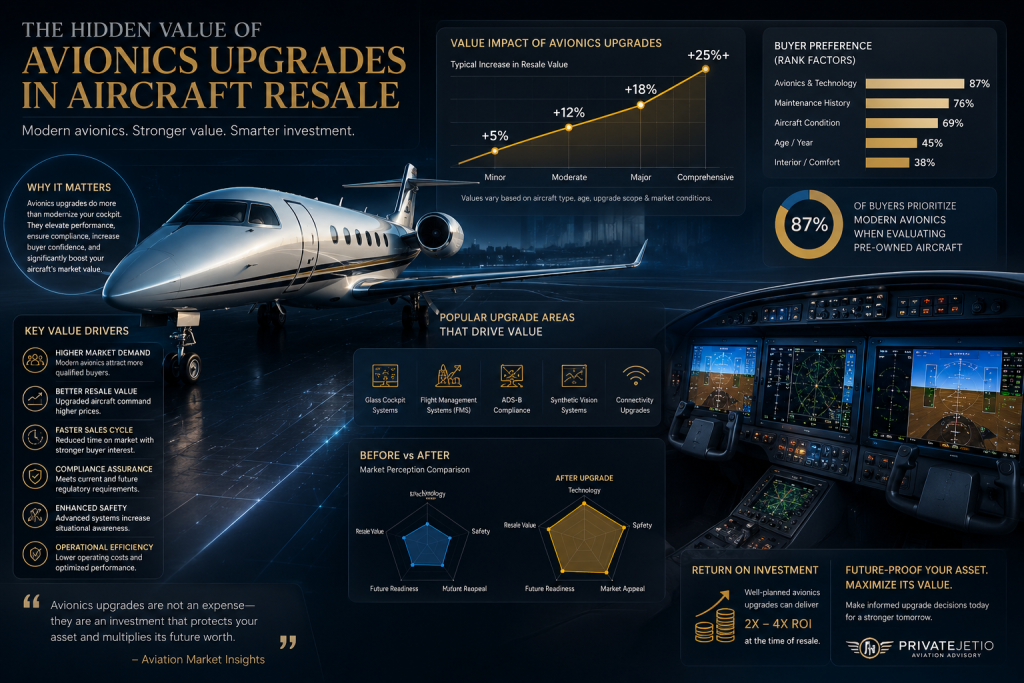
Among the most valuable improvements are:
1. Glass Cockpit Conversions
Replacing analog instrumentation with digital displays significantly modernizes the flight deck environment.
2. Flight Management System Improvements
Advanced FMS capabilities improve navigation accuracy and operational flexibility.
3. Enhanced Safety Systems
Investments in awareness and collision avoidance technologies often generate strong buyer interest.
4. Connectivity Solutions
Modern communication capabilities continue gaining importance among business aviation operators.
5. Navigation and Surveillance Systems
Compliance-driven upgrades often provide lasting resale benefits.
These improvements collectively support stronger aircraft resale value and increased buyer confidence.
The Financial Analysis of Modernization
Owners frequently ask a critical question:
“Will I recover the cost of the upgrade when I sell?”
The answer depends on market conditions, aircraft type, and upgrade scope.
However, focusing solely on direct cost recovery misses the broader financial picture.
Modernization can generate value through:
- Higher asking prices
- Faster sales
- Reduced negotiation pressure
- Larger buyer pools
- Greater market liquidity
Together, these benefits may exceed the simple calculation of upgrade cost versus resale premium.
Market Trends Supporting Modernization
Several industry trends continue increasing the importance of avionics investment.
Rising Buyer Expectations
New aircraft feature increasingly sophisticated systems.
These expectations influence perceptions of pre-owned aircraft as well.
Increased Technology Adoption
Operators continue embracing integrated digital solutions.
Growing Emphasis on Safety
Safety-focused technologies remain highly attractive to buyers.
Global Regulatory Evolution
Future compliance requirements encourage proactive modernization strategies.
These factors collectively strengthen the business case for avionics investment.
Avionics Modernization and Aircraft Appraisal Outcomes
Professional appraisers increasingly analyze technology profiles alongside traditional valuation metrics.
Aircraft equipped with modern systems often receive favorable consideration because they reduce operational limitations.
Strong aircraft appraisal results frequently depend on more than age and maintenance history.
Technology readiness plays an increasingly important role.
Owners who modernize strategically position themselves more effectively during valuation reviews and eventual sale negotiations.
Supporting Long-Term Asset Performance
Aircraft ownership should always be evaluated from a lifecycle perspective.
Every investment decision influences future performance.
Modern avionics contribute directly to asset management objectives by preserving competitiveness and maintaining relevance in evolving markets.
When viewed through a long-term lens, modernization becomes less about immediate resale and more about protecting value throughout ownership.
This perspective aligns closely with institutional investors, corporate flight departments, and sophisticated private owners.
Reducing Obsolescence Risk
Technological obsolescence represents a significant threat to aircraft value.
As systems age, maintenance becomes more difficult and replacement components become less accessible.
Modernization helps mitigate this risk.
Aircraft equipped with current-generation systems are better positioned to adapt to future requirements and maintain operational relevance.
Reducing obsolescence risk enhances buyer confidence and supports stronger transaction outcomes.
The Competitive Advantage During Market Downturns
Economic cycles affect aviation markets.
During slower periods, buyers become increasingly selective.
Aircraft with outdated technology often struggle to attract attention.
Modernized aircraft typically perform better because they offer clear differentiation.
This competitive advantage becomes particularly valuable when inventory levels rise and buyers gain negotiating power.
Owners seeking resilience during market fluctuations should view avionics modernization as a strategic defensive measure.
Working With Aviation Advisors Before Investing
Not every avionics project makes financial sense.
The most successful owners approach modernization strategically.
Before committing capital, they evaluate:
- Aircraft type
- Intended ownership duration
- Target buyer profile
- Market conditions
- Competitive inventory
- Upgrade costs
- Expected valuation impact
Aviation advisors can help identify investments most likely to generate meaningful returns.
This analysis prevents unnecessary spending while maximizing resale potential.
Conclusion
The hidden value of avionics modernization extends far beyond technology itself.
Modern flight decks influence buyer psychology, improve regulatory readiness, enhance safety, support operational efficiency, reduce obsolescence risk, and strengthen competitive positioning in the resale market.
While every aircraft and market environment differs, one principle remains consistent: buyers increasingly reward technological relevance.
Owners who view avionics modernization as a strategic asset enhancement rather than a simple equipment upgrade often achieve stronger valuation outcomes, broader buyer interest, and more efficient sales processes.
For aircraft owners considering acquisition, ownership optimization, or eventual disposition, a professional evaluation of avionics modernization opportunities can reveal substantial untapped value.
At PrivateJetIO, our advisory team helps buyers, sellers, family offices, and corporate flight departments assess aircraft investments, modernization strategies, and resale positioning to maximize long-term aviation asset performance.
Frequently Asked Questions
Does avionics modernization always increase aircraft resale value?
Not always dollar-for-dollar, but strategic upgrades often improve marketability, reduce selling time, and support stronger pricing compared with similar aircraft that have outdated systems.
What avionics upgrades are most attractive to buyers?
Glass cockpit installations, ADS-B compliance systems, advanced flight management systems, synthetic vision technology, and enhanced safety features typically generate the strongest buyer interest.
Is avionics modernization worth it for older aircraft?
In many cases, yes. Older aircraft can become significantly more competitive when paired with modern cockpit technology, making them attractive alternatives to newer, more expensive models.
How does avionics modernization affect aircraft appraisal?
Appraisers increasingly evaluate technology relevance alongside maintenance records, engine condition, and airframe history. Modern systems can positively influence valuation assessments.
When should owners upgrade avionics before selling?
Ideally, modernization decisions should be evaluated several years before a planned sale. This allows owners to benefit operationally while positioning the aircraft more competitively for future resale.
References:
Federal Aviation Administration (FAA)
https://www.faa.gov
National Business Aviation Association (NBAA)
https://nbaa.org
International Civil Aviation Organization (ICAO)
https://www.icao.int
General Aviation Manufacturers Association (GAMA)
https://gama.aero
Aircraft Electronics Association (AEA)
https://aea.net/


