
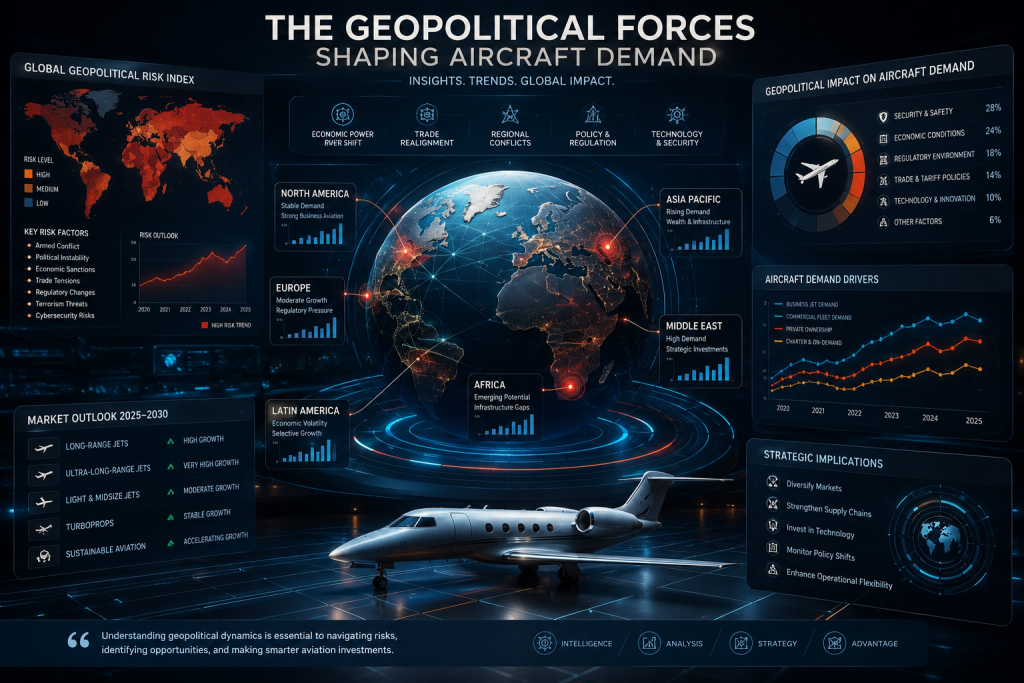
The relationship between geopolitics and aviation has never been more significant. Economic alliances, trade disputes, regional conflicts, sanctions, regulatory shifts, and changing international relationships increasingly influence how aircraft are purchased, operated, financed, and sold. For ultra-high-net-worth individuals, corporations, family offices, aircraft operators, and aviation investors, understanding geopolitical trends on aircraft demand is no longer optional—it has become a strategic necessity.
Aviation has always been connected to global events. However, recent years have demonstrated that geopolitical developments can reshape aircraft demand almost overnight. Travel restrictions, regional instability, sanctions, supply chain disruptions, and shifts in global economic power have all contributed to major changes in purchasing behavior throughout the aviation sector.
The aircraft market now responds not only to traditional economic indicators but also to political developments occurring thousands of miles away. Decision-makers who recognize these patterns gain significant advantages when planning acquisitions, evaluating fleet investments, and positioning aviation assets for future growth.
By: PrivateJetio Aviation Advisory Team
Why Geopolitics Matters More Than Ever in Aviation
The aviation industry sits at the intersection of international commerce, mobility, security, and economic development. Every major geopolitical event creates ripple effects throughout the sector.
Aircraft are global assets. They cross borders, depend on international regulations, require worldwide support networks, and often serve multinational businesses and individuals. As a result, geopolitical changes directly affect operational viability and asset values.
Several factors explain why geopolitics has become increasingly influential:
- Growing globalization of wealth
- Increased cross-border business activity
- Rising regulatory complexity
- Greater focus on national security
- Expanding economic competition between major powers
- Increased volatility in global markets
Aircraft owners must now consider geopolitical risks alongside traditional financial metrics when making strategic decisions.
The Rise of Private Aviation During Global Uncertainty
Periods of geopolitical uncertainty often create unexpected opportunities within the private aviation market.
When international conditions become unpredictable, executives, governments, and wealthy individuals prioritize flexibility, security, and control over transportation. Private aviation offers all three advantages.
During times of disruption, commercial aviation frequently experiences:
- Route reductions
- Airport congestion
- Security delays
- Regulatory restrictions
- Reduced operational flexibility
Private aviation allows travelers to bypass many of these limitations.
As a result, business jet demand frequently increases during periods of geopolitical instability.
This trend became particularly visible during recent global disruptions, where private aviation demonstrated resilience while commercial travel faced significant challenges.
For many organizations, aircraft ownership transformed from a luxury consideration into a strategic business tool.
Regional Conflicts and Their Impact on Aircraft Demand
Regional conflicts represent one of the most powerful drivers of aviation market shifts.
Conflict zones create immediate operational restrictions while simultaneously generating demand in neighboring regions.
Several effects typically emerge:
Airspace Restrictions
When conflicts occur, governments often close airspace or impose operational limitations.
These restrictions force operators to:
- Alter routes
- Increase flight times
- Consume additional fuel
- Reevaluate aircraft capabilities
Longer-range aircraft often become more attractive because they can efficiently navigate around restricted areas.
Safe-Haven Relocation Trends
Wealth migration frequently accompanies geopolitical instability.
High-net-worth individuals often relocate assets, businesses, and residences to more stable jurisdictions.
This movement increases demand for:
- Long-range business jets
- International charter services
- Aircraft management solutions
- Strategic aviation consulting
Aircraft become essential tools for maintaining global mobility during uncertain periods.
Security-Focused Travel
Corporate leaders increasingly prioritize security when traveling internationally.
Private aircraft provide:
- Controlled environments
- Flexible scheduling
- Reduced public exposure
- Enhanced privacy
As security concerns increase, aircraft demand often follows.
Economic Sanctions and Aircraft Markets
Sanctions have become a major geopolitical tool used by governments worldwide.
Their influence on aviation can be profound.
Aircraft ownership structures frequently involve:
- International financing
- Cross-border registration
- Global maintenance providers
- International leasing arrangements
Sanctions can disrupt every element of this ecosystem.
Effects on Aircraft Transactions
Sanctions may restrict:
- Aircraft sales
- Financing arrangements
- Parts availability
- Insurance coverage
- Technical support
Buyers must conduct extensive due diligence before acquisitions.
Impact on Asset Values
Aircraft linked to sanctioned entities may experience significant valuation challenges.
Conversely, aircraft positioned within compliant jurisdictions often become more attractive investment opportunities.
Sophisticated buyers increasingly evaluate geopolitical exposure as part of every acquisition strategy.
Shifting Global Wealth and Aircraft Demand
Global wealth distribution continues to evolve.
Emerging markets increasingly contribute to aviation growth.
Regions experiencing rapid wealth creation often become new centers of aircraft demand.
Middle East Expansion
The Middle East continues to strengthen its position as a major aviation hub.
Factors driving growth include:
- Sovereign wealth expansion
- Infrastructure investment
- Strategic geographic location
- Diversification initiatives
Private aviation activity remains strong throughout the region.
Asia-Pacific Growth
Many analysts view Asia-Pacific as one of the most important long-term growth markets.
Increasing entrepreneurship, family office expansion, and international business activity continue to support aircraft acquisition strategy across the region.
North American Stability
North America remains the world’s largest business aviation market.
Despite global volatility, demand remains supported by:
- Corporate travel requirements
- Wealth concentration
- Mature infrastructure
- Strong financing markets
These factors continue to attract aviation investment.
Trade Relations and Aircraft Manufacturing
Aircraft manufacturing depends heavily on international trade.
Modern aircraft contain components sourced from numerous countries.
When geopolitical tensions affect trade relationships, manufacturers face significant challenges.
Supply Chain Disruptions
Recent years have highlighted vulnerabilities throughout aerospace supply chains.
Challenges include:
- Component shortages
- Logistics disruptions
- Labor constraints
- Export restrictions
- Production delays
These issues affect both new aircraft deliveries and aftermarket support.
Delivery Delays and Buyer Behavior
Extended production timelines often influence purchasing decisions.
Some buyers choose pre-owned aircraft to avoid waiting years for factory deliveries.
Others secure positions in manufacturing queues to preserve future availability.
Both strategies reflect the growing importance of geopolitical awareness.
Energy Markets and Aviation Demand
Energy remains deeply connected to geopolitical developments.
Fuel costs represent one of aviation’s largest operating expenses.
Changes in energy markets directly affect aircraft economics.
Oil Price Volatility
Political instability in energy-producing regions can trigger significant price fluctuations.
Higher fuel prices influence:
- Flight activity
- Fleet planning
- Aircraft selection
- Route optimization
Fuel-efficient aircraft often become more desirable during periods of elevated energy costs.
Sustainability Pressures
Governments increasingly pursue environmental initiatives through regulation.
These policies influence demand for:
- New-generation aircraft
- Sustainable aviation technologies
- Modern engines
- Efficient fleet structures
Environmental regulations now represent an important geopolitical factor affecting aviation industry trends.
Government Policies and Business Aviation Growth
National governments play a crucial role in shaping aviation markets.
Tax incentives, regulatory frameworks, and infrastructure investment all influence demand.
Countries that support aviation development often attract greater investment activity.
Regulatory Competitiveness
Aircraft owners increasingly evaluate jurisdictions based on:
- Tax treatment
- Registration flexibility
- Privacy protections
- Operational efficiency
Governments competing for investment frequently improve aviation-related policies.
Infrastructure Development
Modern airports, fixed-base operators, and maintenance facilities encourage aviation growth.
Infrastructure investment often signals long-term market opportunity.
Investors closely monitor these developments when evaluating aircraft ownership decisions.
The Strategic Importance of Global Mobility
One of the most significant consequences of geopolitical uncertainty is the increasing value of global mobility.
Access to transportation has become a strategic asset.
For corporate leaders and wealthy families, mobility enables:
- Business continuity
- Market access
- Risk diversification
- Emergency response capability
Aircraft ownership increasingly supports broader resilience strategies.
Organizations no longer view aviation solely as transportation.
Instead, they see it as a tool for preserving operational flexibility.
Aircraft Demand Across Different Categories
Geopolitical developments affect aircraft segments differently.
Light Jets
Light jets often benefit from regional business activity and domestic mobility requirements.
Demand tends to remain relatively stable.
Midsize Jets
Midsize aircraft attract organizations requiring efficient international connectivity.
They often perform well during moderate periods of geopolitical uncertainty.
Large-Cabin Jets
Large-cabin aircraft frequently experience increased demand during significant geopolitical disruptions.
Their advantages include:
- Extended range
- Enhanced security
- Greater passenger capacity
- Global operational flexibility
These characteristics align closely with the needs of internationally active organizations.
Ultra-Long-Range Aircraft
The strongest geopolitical demand often emerges within the ultra-long-range segment.
These aircraft enable nonstop connectivity between major business centers while avoiding operational limitations created by regional instability.
How Investors Evaluate Geopolitical Risk
Professional aviation investors increasingly incorporate geopolitical analysis into decision-making.
Several factors receive particular attention.
Political Stability
Investors favor regions demonstrating predictable governance and regulatory consistency.
Currency Strength
Exchange-rate stability influences purchasing power and transaction planning.
Regulatory Outlook
Future regulations can significantly affect aircraft operations and values.
Market Accessibility
Access to financing, maintenance, insurance, and support services remains critical.
These considerations help investors identify both risks and opportunities.
Future Trends That Will Shape Aircraft Demand
Several geopolitical developments are likely to influence aviation over the coming decade.
Multipolar Economic Competition
Competition among major economic powers will continue shaping trade relationships and investment flows.
Increased Strategic Mobility Requirements
Businesses are becoming more geographically diversified.
This trend supports long-term aircraft demand.
Expanded Security Considerations
Security concerns are likely to remain important drivers of private aviation usage.
Continued Wealth Globalization
Despite periodic disruptions, wealth creation remains increasingly international.
This supports demand for sophisticated aviation solutions.
Technology and Sovereignty
Governments increasingly focus on technological independence and supply-chain security.
These priorities will influence aircraft manufacturing and procurement decisions.
Strategic Recommendations for Aircraft Buyers
Aircraft buyers should approach geopolitical uncertainty proactively rather than reactively.
Consider the following framework:
- Monitor geopolitical developments continuously.
- Diversify operational and ownership structures where appropriate.
- Conduct enhanced regulatory due diligence.
- Evaluate aircraft capabilities against future operational scenarios.
- Work with experienced aviation advisors who understand global risk dynamics.
The most successful owners recognize that aviation decisions extend beyond aircraft specifications.
They also involve economics, regulation, security, and international strategy.
Conclusion
The impact of geopolitical trends on aircraft demand extends far beyond headlines and political events. Geopolitical developments influence aircraft valuations, financing opportunities, operational flexibility, manufacturing timelines, and long-term investment performance.
For corporations, family offices, private jet owners, and prospective buyers, understanding these dynamics creates a significant competitive advantage. Aircraft are increasingly strategic assets that support mobility, security, resilience, and business continuity in an unpredictable world.
As geopolitical complexity continues to grow, informed decision-making becomes essential. Organizations that integrate geopolitical intelligence into their aviation planning will be better positioned to protect capital, maximize flexibility, and capitalize on emerging opportunities.
At Private Jetio, we help clients evaluate aircraft acquisitions, ownership structures, fleet strategies, and aviation investments through a strategic global lens. If you are considering an aircraft purchase, sale, or portfolio review, a professional consultation can help align your aviation decisions with the realities of today’s rapidly evolving geopolitical landscape.
FAQ
How do geopolitical events affect private jet demand?
Geopolitical events often increase demand for private aviation because travelers seek greater flexibility, security, and operational control during periods of uncertainty.
Why do sanctions influence aircraft values?
Sanctions can restrict aircraft sales, financing, maintenance support, and registration options, which directly impacts marketability and valuation.
Which aircraft types benefit most from geopolitical uncertainty?
Ultra-long-range and large-cabin business jets often experience the strongest demand because they provide maximum international flexibility and route options.
How do trade tensions affect aircraft manufacturing?
Trade tensions can disrupt supply chains, increase production costs, delay deliveries, and affect component availability across the aerospace industry.
Should geopolitical risk be part of an aircraft acquisition strategy?
Yes. Modern aircraft acquisitions should include geopolitical analysis alongside financial, technical, and operational due diligence.
References:
International Civil Aviation Organization (ICAO)
https://www.icao.int
International Air Transport Association (IATA)
https://www.iata.org
National Business Aviation Association (NBAA)
https://nbaa.org
European Union Aviation Safety Agency (EASA)
https://www.easa.europa.eu
Federal Aviation Administration (FAA)
https://www.faa.gov


