
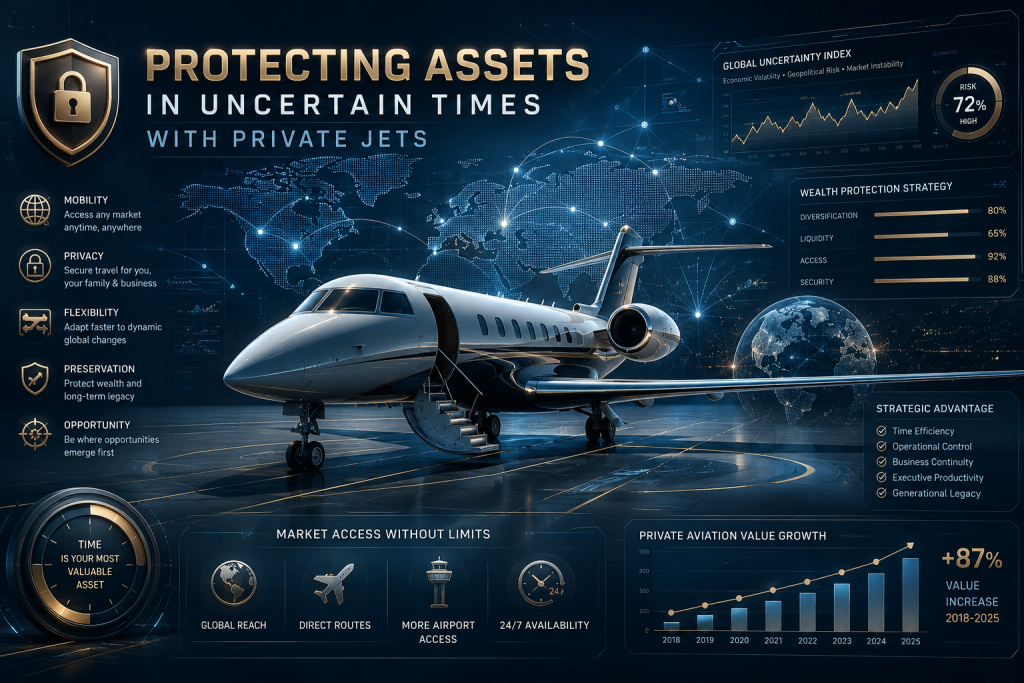
In periods of economic volatility, geopolitical instability, regulatory shifts, and market uncertainty, sophisticated investors consistently seek assets that provide more than financial returns alone. The most resilient assets combine utility, strategic flexibility, wealth preservation characteristics, and operational advantages. For ultra-high-net-worth individuals, family offices, corporate leaders, and global investors, private aviation increasingly occupies this unique category.
While many observers view private jets solely as luxury assets, experienced aviation advisors understand a different reality. A properly selected and strategically managed aircraft can function as a powerful business tool, a mobility asset, a risk management instrument, and a long-term component of broader wealth preservation strategies.
The strategic value of private jets becomes especially apparent during uncertain times. When commercial transportation networks experience disruption, when business opportunities emerge across multiple jurisdictions, or when executives must respond rapidly to changing circumstances, private aviation offers advantages that traditional transportation solutions cannot replicate.
Understanding how private aviation fits into broader asset protection strategies requires looking beyond luxury and examining the practical, financial, and operational realities that make aircraft ownership a compelling consideration for sophisticated decision-makers.
By: PrivateJetio Aviation Advisory Team
Why Uncertain Times Change Asset Allocation Strategies
Periods of stability encourage investors to optimize for efficiency. Periods of uncertainty encourage them to optimize for resilience.
History repeatedly demonstrates that major disruptions often create both significant risks and extraordinary opportunities. During these periods, individuals and organizations capable of moving faster than competitors frequently gain substantial advantages.
Traditional asset classes remain important components of diversified portfolios, yet many investors increasingly seek assets that provide tangible utility alongside financial value. Real estate, infrastructure investments, precious metals, and select alternative assets often attract attention during uncertain periods because they offer characteristics that extend beyond simple market performance.
Private aviation belongs within this broader discussion.
Unlike purely financial instruments, aircraft deliver immediate operational benefits. Their value is not exclusively dependent upon market sentiment. They provide direct access to opportunities, clients, assets, facilities, and markets that may otherwise be difficult to reach efficiently.
This combination of utility and strategic flexibility explains why business aviation often remains resilient even during challenging economic environments.
The Evolution of Private Jets from Luxury to Strategic Asset
The perception of private jets has evolved dramatically over the past two decades.
Historically, aircraft ownership was often viewed primarily as a symbol of success. Today, sophisticated owners increasingly approach aviation through the lens of productivity, efficiency, risk mitigation, and wealth preservation.
This shift reflects broader changes in global business.
Modern executives manage operations across continents. Investors oversee geographically diverse portfolios. Family offices coordinate activities across multiple jurisdictions. Corporate leadership teams operate within increasingly complex and interconnected environments.
As a result, mobility itself has become a strategic advantage.
Private aviation enables decision-makers to maintain direct control over their schedules, respond rapidly to emerging situations, and maximize productive time. These benefits become even more valuable when external conditions are unpredictable.
Organizations that maintain superior mobility often gain a measurable advantage over competitors constrained by commercial travel limitations.
Executive Mobility as a Competitive Advantage
One of the most overlooked aspects of the strategic value of private jets is executive mobility.
Time remains the only truly non-renewable resource available to business leaders. Every hour lost to commercial travel delays, airport congestion, connection schedules, or operational disruptions represents an opportunity cost.
Private aviation fundamentally changes this equation.
Instead of building schedules around airline networks, executives can build travel around business priorities.
This capability becomes especially important during uncertain periods when rapid decision-making may determine the outcome of major transactions, acquisitions, restructurings, investments, or crisis response initiatives.
Consider the practical advantages:
- Direct access to thousands of airports unavailable to commercial carriers.
- Reduced travel time and logistical complexity.
- Enhanced scheduling flexibility.
- Increased productivity during transit.
- Faster response to emerging opportunities.
- Greater operational continuity during disruptions.
These advantages collectively strengthen organizational agility, a critical characteristic during periods of market instability.
For many corporate leaders, the aircraft itself is less important than the strategic mobility it creates.
Wealth Preservation Through Strategic Aviation Planning
The relationship between aviation and wealth preservation is often misunderstood.
A private jet should not be evaluated solely through acquisition cost. Instead, it should be analyzed as part of a broader strategic framework.
When structured correctly, aircraft ownership can support several wealth preservation objectives.
First, it enables direct access to investment opportunities. Investors can evaluate assets, properties, facilities, and acquisitions without relying upon commercial transportation schedules.
Second, it enhances oversight of geographically dispersed operations. Family offices, private equity groups, and multinational businesses benefit from faster access to critical locations.
Third, it supports continuity planning. During periods of disruption, maintaining mobility can preserve operational effectiveness and reduce business interruption risks.
Fourth, it provides tangible utility independent of broader market fluctuations.
These characteristics explain why many sophisticated investors increasingly include business aviation within their broader asset allocation discussions.
Business Aviation During Global Disruptions
Recent global events highlighted the vulnerabilities inherent within commercial transportation networks.
Flight cancellations, route reductions, capacity constraints, regulatory changes, labor shortages, and geopolitical developments exposed significant limitations in traditional travel systems.
Organizations that relied exclusively on commercial aviation often experienced operational challenges.
In contrast, those with access to business aviation maintained a greater degree of control.
Business aviation provides:
• Flexible routing capabilities.
• Direct access to secondary airports.
• Reduced exposure to crowded transportation hubs.
• Enhanced operational continuity.
• Greater travel certainty.
During periods of disruption, certainty itself becomes a valuable asset.
The ability to guarantee transportation for executives, technical teams, investors, advisors, and key personnel can significantly influence business outcomes.
Aviation Asset Management and Long-Term Value
Successful aircraft ownership begins with disciplined aviation asset management.
Not all aircraft perform equally from a financial perspective. Selection, utilization, maintenance quality, market positioning, and ownership structure all influence long-term value.
Sophisticated owners approach aircraft ownership similarly to other major investments.
They analyze:
• Mission requirements.
• Acquisition timing.
• Market conditions.
• Residual value forecasts.
• Maintenance programs.
• Operational costs.
• Exit strategies.
This disciplined approach helps transform aircraft from a simple transportation tool into a strategically managed asset.
Aviation asset management becomes particularly important during uncertain periods when preserving value requires careful planning and informed decision-making.
The most successful owners focus on total lifecycle performance rather than acquisition price alone.
Private Aviation Investment in a Changing Global Economy
The concept of private aviation investment extends beyond purchasing an aircraft.
It encompasses a comprehensive strategy designed to maximize operational utility while managing financial exposure.
Several trends continue to influence aviation markets:
Increasing Demand for Flexibility
Executives increasingly prioritize flexibility over fixed transportation schedules.
Business aviation provides access to destinations and opportunities that commercial carriers cannot efficiently support.
Growth of Global Family Offices
Family offices continue expanding their geographic footprints.
As investment portfolios become more international, mobility requirements naturally increase.
Expansion of Alternative Assets
Investors increasingly allocate capital toward alternative assets that provide diversification and utility.
Aircraft frequently enter these discussions because of their unique combination of operational and strategic value.
Enhanced Focus on Risk Management
Organizations now place greater emphasis on resilience and continuity planning.
Private aviation supports these objectives by providing transportation independence and operational flexibility.
These trends suggest that business aviation will continue playing an important role in strategic planning for sophisticated investors and organizations.
Aircraft Ownership Versus Access Models
Not every organization requires direct ownership.
Modern aviation offers multiple pathways to access private flight capabilities.
Ownership remains attractive for users with consistent travel requirements and specific operational needs. It provides maximum flexibility and control.
However, alternative structures also exist, including charter arrangements, fractional ownership programs, and jet card solutions.
The appropriate model depends upon several factors:
• Annual flight hours.
• Geographic travel patterns.
• Privacy requirements.
• Operational flexibility needs.
• Capital allocation objectives.
• Long-term strategic goals.
Determining the optimal approach requires detailed analysis rather than assumptions.
This is precisely where experienced aviation advisors create substantial value.
The Role of Private Jet Acquisition Strategy
Many aircraft transactions fail to achieve their full potential because buyers focus excessively on acquisition price.
A successful private jet acquisition strategy examines the complete ownership lifecycle.
Key considerations include:
• Market timing.
• Aircraft specifications.
• Maintenance history.
• Future demand trends.
• Regulatory considerations.
• Operating cost projections.
• Residual value expectations.
The best aircraft purchase is not necessarily the cheapest aircraft available.
It is the aircraft that aligns most effectively with mission requirements while preserving long-term value.
Sophisticated buyers understand that strategic alignment often produces significantly better outcomes than short-term cost minimization.
Geopolitical Uncertainty and the Importance of Transportation Independence
Geopolitical events can alter business conditions with remarkable speed.
Trade restrictions, regional conflicts, regulatory changes, sanctions, labor disruptions, and infrastructure challenges may emerge with little warning. Organizations operating internationally must remain prepared to adapt quickly.
Transportation independence has therefore become a strategic consideration rather than a logistical convenience.
Private aviation allows executives, investors, and family office principals to maintain direct access to critical markets regardless of changing commercial airline priorities. While airlines optimize routes based on profitability and demand, private aviation optimizes routes based on strategic necessity.
This distinction becomes extremely important when access to a specific market, facility, supplier, investment target, or operational center directly impacts business performance.
In uncertain environments, mobility is not simply about convenience. It is about maintaining strategic options when others face restrictions.
Private Jets and Business Continuity Planning
Business continuity planning traditionally focuses on cybersecurity, financial resilience, operational redundancy, and crisis management.
Mobility should be included within that framework.
A disruption affecting executive travel can delay acquisitions, disrupt negotiations, postpone site inspections, interrupt client relationships, and slow critical decision-making processes.
Business aviation helps organizations maintain continuity through:
Rapid Executive Deployment
Senior decision-makers can reach key locations without waiting for commercial schedules.
Multi-City Mission Capability
Several locations can be visited within a single day, increasing efficiency and reducing delays.
Operational Reliability
Organizations retain greater control over transportation logistics.
Secure Travel Environment
Private terminals and dedicated operations enhance privacy and security.
When continuity planning is evaluated comprehensively, transportation independence frequently emerges as an overlooked but highly valuable component.
The Strategic Relationship Between Time and Wealth
One of the most compelling arguments for private aviation centers on the relationship between time and wealth.
Many financial discussions focus exclusively on cost.
Sophisticated decision-makers often focus on opportunity cost.
Consider a chief executive responsible for a multibillion-dollar enterprise, a family office managing substantial investments, or an entrepreneur overseeing multiple companies across different regions.
The financial value of a single day may exceed the operating cost of an entire flight.
Private aviation reduces:
• Airport waiting times.
• Security line delays.
• Overnight stays caused by airline schedules.
• Missed opportunities resulting from travel constraints.
• Productivity losses during complex travel itineraries.
The result is more efficient utilization of executive time.
Over years of operation, the cumulative value of this efficiency can become substantial.
Security, Privacy, and Asset Protection
Security concerns continue to influence travel decisions among high-net-worth individuals and corporate leadership teams.
Commercial travel inevitably exposes executives to crowded environments, public schedules, and increased visibility.
Private aviation offers greater control.
Benefits often include:
Confidential Travel Planning
Travel schedules remain significantly more private.
Controlled Passenger Environment
Access is limited to authorized individuals.
Enhanced Information Security
Sensitive conversations can occur without concerns associated with crowded public settings.
Reduced Exposure
Executives minimize unnecessary public visibility.
For organizations operating in highly competitive industries, privacy itself can represent a meaningful strategic advantage.
Asset protection extends beyond financial structures. It includes protecting information, relationships, operational plans, and executive personnel.
How Family Offices Use Private Aviation Strategically
Family offices increasingly view aviation through a strategic lens.
Rather than considering aircraft solely as luxury assets, many family offices incorporate aviation into broader wealth management frameworks.
Common applications include:
Investment Oversight
Rapid access to portfolio companies, properties, facilities, and investment opportunities.
Global Family Mobility
Efficient transportation across multiple residences and jurisdictions.
Succession Planning
Supporting long-term family governance structures and operational continuity.
Asset Diversification
Including tangible assets with direct operational utility.
For globally active families, private aviation often becomes an infrastructure asset supporting broader strategic objectives.
The aircraft enables faster decisions, stronger oversight, and greater flexibility across generations.
Evaluating Aircraft as Alternative Assets
Alternative assets continue attracting attention from investors seeking diversification and resilience.
While aircraft differ significantly from traditional alternative investments, they share several characteristics that appeal to sophisticated investors.
These include:
• Tangible value.
• Global utility.
• Strategic flexibility.
• Operational functionality.
• Potential value preservation when properly managed.
However, aircraft should never be evaluated in isolation.
Their true value emerges when viewed within the context of broader business and investment objectives.
The most successful aviation strategies align transportation requirements, capital allocation goals, operational needs, and long-term planning considerations.
This integrated approach transforms aviation from an expense category into a strategic resource.
Common Mistakes Made by Aircraft Buyers
Many buyers enter the aviation market without fully understanding long-term ownership dynamics.
Several mistakes appear repeatedly.
Buying Based on Prestige
Aircraft should be selected based on mission requirements rather than image.
Ignoring Lifecycle Costs
Acquisition cost represents only one component of ownership economics.
Overlooking Future Resale Considerations
Exit strategy should influence acquisition decisions from the beginning.
Failing to Conduct Proper Due Diligence
Maintenance records, ownership history, and technical evaluations are critical.
Choosing Without Independent Advice
Manufacturers, brokers, and sellers each represent specific interests.
Independent aviation consultants help buyers evaluate opportunities objectively.
Avoiding these mistakes can preserve significant capital while improving long-term outcomes.
Why Independent Aviation Advisory Matters
The private aviation marketplace contains substantial complexity.
Aircraft values fluctuate.
Maintenance requirements evolve.
Regulations change.
Market conditions shift.
Transaction structures vary significantly.
Independent advisory services help clients navigate these variables while maintaining alignment with strategic objectives.
A professional aviation advisor typically assists with:
• Market intelligence.
• Aircraft sourcing.
• Technical due diligence.
• Financial analysis.
• Transaction negotiations.
• Ownership structuring.
• Exit planning.
For high-value transactions, informed guidance often produces outcomes that substantially exceed advisory costs.
The objective is not simply completing a transaction.
The objective is making the right strategic decision.
Future Outlook for Business Aviation
Several long-term trends continue supporting demand for business aviation.
Global business activity remains increasingly decentralized.
Family offices continue expanding internationally.
Private capital markets continue growing.
Executive mobility requirements continue increasing.
Technological advances improve aircraft efficiency, operational reliability, and passenger experience.
At the same time, uncertainty itself appears likely to remain a defining feature of the global business environment.
Organizations capable of maintaining flexibility, resilience, and mobility will remain better positioned to capitalize on opportunities and respond to challenges.
Business aviation supports each of these objectives.
For this reason, private jets are increasingly viewed not as symbols of luxury but as strategic infrastructure assets supporting long-term success.
Conclusion
Periods of uncertainty reveal the true value of strategic assets.
When markets become volatile, when geopolitical conditions shift, and when business environments evolve rapidly, organizations and investors require more than financial resources. They require flexibility, mobility, resilience, and control.
The strategic value of private jets extends far beyond convenience.
Private aviation supports executive mobility, strengthens business continuity, enhances privacy, improves access to opportunities, and contributes to broader wealth preservation strategies. Properly selected, professionally managed, and aligned with long-term objectives, an aircraft can become one of the most effective tools within a sophisticated asset protection framework.
Whether considering aircraft ownership, evaluating access solutions, or planning a future acquisition, informed decision-making remains essential.
At PrivateJetIO, we help buyers, sellers, family offices, and corporate leaders make strategic aviation decisions based on data, market intelligence, and long-term value creation. Our independent advisory approach ensures every recommendation aligns with your operational requirements, financial objectives, and risk profile.
If you are evaluating the role of private aviation within your broader asset protection strategy, request a confidential consultation with PrivateJetIO and discover how informed aviation decisions can protect value while expanding opportunity.
Frequently Asked Questions
Are private jets considered a good asset during economic uncertainty?
Private jets can provide strategic value during uncertain periods because they combine operational utility with enhanced mobility, flexibility, and business continuity. Their effectiveness depends on acquisition strategy, utilization, and long-term management.
Is aircraft ownership better than chartering?
The answer depends on annual flight hours, travel patterns, privacy requirements, and financial objectives. Some users benefit from ownership, while others achieve better results through charter or fractional solutions.
How do private jets support wealth preservation?
Private aviation can support wealth preservation by enabling faster access to investment opportunities, improving oversight of assets, reducing operational disruption, and preserving executive productivity.
What factors affect aircraft resale value?
Aircraft age, maintenance history, engine programs, avionics upgrades, market demand, utilization patterns, and overall condition significantly influence resale performance.
Why should buyers use an independent aviation consultant?
Independent consultants provide objective guidance during aircraft transactions. They help evaluate opportunities, identify risks, negotiate terms, and align aviation decisions with long-term strategic goals.
References:
National Business Aviation Association
https://nbaa.org
General Aviation Manufacturers Association Annual Industry Reports
https://gama.aero
Federal Aviation Administration
https://www.faa.gov
International Civil Aviation Organization
https://www.icao.int
European Union Aviation Safety Agency
https://www.easa.europa.eu


