
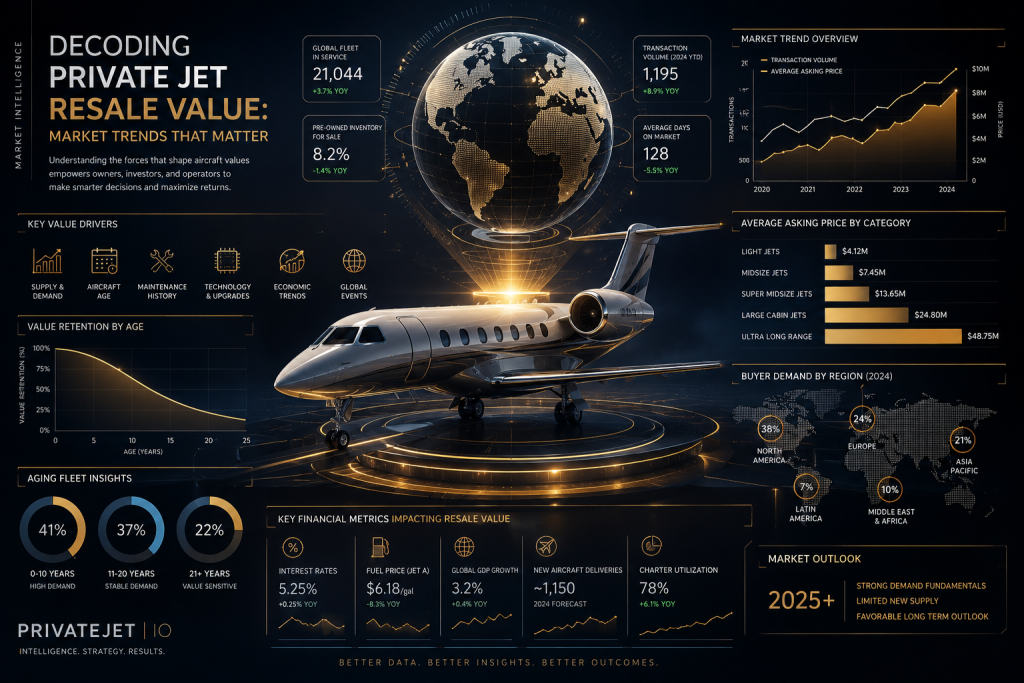
In private aviation, acquisition often receives most of the attention. Yet experienced owners, family offices, and aviation investors understand that the true financial story begins long before an aircraft enters the market for sale. The ability to preserve and maximize private jet resale value can determine whether ownership becomes a strategic asset decision or an expensive capital drain.
Every aircraft eventually reaches a point where its owner considers selling, upgrading, restructuring a fleet, or reallocating capital. At that moment, market conditions become just as important as the aircraft itself. Two identical jets can achieve dramatically different sale prices depending on timing, demand cycles, maintenance status, regulatory developments, and broader economic trends.
Understanding these influences allows owners to make smarter decisions years before a sale occurs. The aircraft market rewards preparation, transparency, and strategic positioning. It penalizes neglect, poor timing, and incomplete records.
For high-net-worth individuals, corporations, and aviation operators, understanding what drives private jet resale value is no longer optional. It is a critical component of long-term aviation asset management.
By: PrivateJetio Aviation Advisory Team
Why Resale Value Matters More Than Most Owners Realize
Many first-time buyers focus heavily on acquisition price. While purchase negotiations are important, sophisticated aviation investors often pay even closer attention to future exit value.
A private jet is not merely a transportation tool. It is a capital asset subject to market forces, depreciation cycles, regulatory pressures, and changing buyer preferences.
The difference between a well-positioned aircraft and a poorly managed one can easily reach millions of dollars at resale.
When evaluating ownership economics, buyers should consider:
- Initial acquisition cost
- Financing expenses
- Operating expenses
- Maintenance expenditures
- Upgrade investments
- Future resale opportunities
The final resale figure often determines the actual long-term cost of ownership.
Owners who monitor market trends throughout the ownership cycle frequently outperform those who only begin thinking about resale shortly before listing their aircraft.
The Supply and Demand Equation
At its core, the aviation market follows the same fundamental principle that governs virtually every asset class: supply and demand.
When inventory levels decline and buyer demand increases, values rise. When available aircraft flood the market, prices soften.
Inventory Levels Matter
One of the strongest indicators of future pricing is the number of available aircraft relative to the active fleet.
Historically, when market inventory falls below approximately 10% of the worldwide fleet, sellers gain negotiating leverage. Buyers face fewer choices and often move more aggressively.
Conversely, inventory above historical averages tends to increase price competition among sellers.
Aircraft owners should regularly monitor:
- Fleet inventory percentages
- Days-on-market statistics
- Asking price trends
- Transaction volume
These metrics provide valuable insight into future pricing conditions.
Demand Drivers
Demand in the private aviation market is influenced by several factors:
- Economic growth
- Corporate profitability
- Wealth creation
- Stock market performance
- Geopolitical uncertainty
- Commercial airline disruptions
Periods of strong economic expansion often generate increased aircraft transactions and stronger resale performance.
Economic Cycles and Their Impact on Aircraft Values
Private aviation is deeply connected to global economic conditions.
During periods of economic optimism, businesses expand, travel increases, and aircraft demand rises.
During downturns, discretionary spending contracts, financing becomes more difficult, and aircraft transactions slow.
The Post-Pandemic Example
The aviation industry witnessed a remarkable example following the COVID-era disruption.
Private aviation demand surged as travelers sought flexibility, privacy, and reliability. Inventory levels fell dramatically across many categories.
Aircraft that might have remained on the market for months sold within weeks.
In some segments, values rose substantially despite aircraft traditionally being depreciating assets.
This unusual period demonstrated that market dynamics can temporarily override traditional aircraft depreciation models.
Interest Rates and Capital Costs
Interest rates play an increasingly important role in resale value.
Higher rates affect:
- Aircraft financing availability
- Borrowing costs
- Investor behavior
- Corporate capital allocation
When financing becomes more expensive, buyer pools may shrink.
As a result, resale values can face downward pressure even if aircraft demand remains relatively stable.
Aircraft Age: More Than a Number
Aircraft age remains one of the most visible valuation factors.
However, age alone rarely determines market performance.
Buyers increasingly focus on a broader picture.
A twenty-year-old aircraft with exceptional maintenance history may command stronger pricing than a newer aircraft with inconsistent records.
The Age Sweet Spot
Different segments experience different value curves.
Light jets, midsize jets, and large-cabin aircraft each follow unique depreciation patterns.
Typically:
- Initial depreciation occurs during early ownership years.
- Depreciation gradually stabilizes.
- Major maintenance events influence value significantly.
- Aging technology can accelerate value declines.
Owners who understand these cycles can plan upgrades and sales strategically.
Aircraft Maintenance Records: The Silent Value Driver
Among all variables affecting aircraft valuation, maintenance quality consistently ranks near the top.
Buyers view maintenance history as a direct indicator of risk.
Incomplete records immediately raise concerns.
Comprehensive documentation builds confidence.
What Buyers Want to See
Professional buyers and advisors carefully examine:
- Logbooks
- Inspection records
- Component tracking
- Service bulletins
- Compliance documentation
- Repair history
Strong aircraft maintenance records often shorten transaction timelines and reduce negotiation friction.
Deferred Maintenance Can Be Expensive
Some owners postpone maintenance expenditures before a sale.
This strategy frequently backfires.
Buyers typically discount aircraft more aggressively than the actual maintenance cost.
A deferred maintenance issue costing $100,000 to correct may reduce market value by substantially more.
Modernization and Cabin Upgrades
Today’s buyers compare aircraft against contemporary expectations.
Technology evolves rapidly.
Cabins that appeared luxurious a decade ago may now feel dated.
Avionics Modernization
Flight deck technology strongly influences marketability.
Upgraded avionics can improve:
- Safety
- Operational efficiency
- Regulatory compliance
- Buyer appeal
Aircraft requiring major avionics investments often attract lower offers.
Cabin Enhancements
Modern buyers increasingly prioritize:
- Connectivity
- High-speed internet
- Cabin management systems
- Premium interiors
- Entertainment solutions
Well-executed upgrades can help preserve residual value and differentiate an aircraft from competing listings.
The Growing Importance of Sustainability
Environmental considerations increasingly influence purchasing decisions.
While private aviation faces ongoing scrutiny regarding emissions, manufacturers and operators continue investing in sustainability initiatives.
Aircraft capable of supporting future environmental requirements may enjoy stronger long-term demand.
Key considerations include:
- Fuel efficiency
- Sustainable Aviation Fuel compatibility
- Modern engine technology
- Environmental compliance
Younger, more efficient aircraft often benefit from these trends.
Brand Reputation and Manufacturer Strength
Not all aircraft brands perform equally in secondary markets.
Manufacturer reputation significantly affects resale performance.
Aircraft produced by established manufacturers with strong support networks typically command stronger pricing.
Examples include aircraft from leading business aviation manufacturers such as:
- Gulfstream Aerospace
- Bombardier
- Dassault Aviation
- Embraer
Buyers value:
- Global support infrastructure
- Parts availability
- Service center networks
- Brand prestige
- Product reliability
These factors often translate directly into stronger resale outcomes.
The Business Jet Market Is Not One Market
One of the most common mistakes owners make is assuming that all aircraft follow the same pricing trends.
In reality, the business jet market consists of multiple independent segments, each responding differently to economic and industry conditions.
A light jet buyer has different priorities than a large-cabin buyer. Corporate operators evaluate aircraft differently than family offices. Charter companies often focus on entirely different performance metrics.
As a result, a market slowdown affecting one category may have little impact on another.
Light Jets
Light jets typically attract:
- Entrepreneurs
- Small business owners
- First-time aircraft buyers
- Regional charter operators
This segment tends to be more sensitive to interest rates and financing conditions.
Midsize and Super-Midsize Jets
These aircraft often represent the broadest buyer pool.
Many operators view them as the optimal balance between:
- Operating cost
- Range
- Cabin comfort
- Acquisition price
Because demand remains relatively broad, these aircraft often demonstrate stable liquidity.
Large-Cabin and Ultra-Long-Range Aircraft
This category serves:
- Family offices
- Fortune 500 executives
- Ultra-high-net-worth individuals
- Sovereign and governmental buyers
While transaction volumes are lower, values can remain remarkably resilient when inventory is constrained.
Understanding which segment your aircraft occupies is essential when forecasting future resale performance.
Charter Demand Can Support Resale Values
Aircraft capable of generating charter revenue frequently attract additional buyer interest.
Many purchasers evaluate not only transportation utility but also revenue-generating potential.
An aircraft that integrates efficiently into charter operations may command stronger demand than a comparable aircraft with limited charter appeal.
Why Charter Capability Matters
Buyers increasingly analyze:
- Charter utilization potential
- Market demand for the aircraft type
- Operating economics
- Cabin configuration flexibility
Aircraft commonly used in charter fleets often benefit from greater market visibility and stronger buyer familiarity.
This can positively influence private jet resale value over time.
Fleet Popularity Creates Market Confidence
Aircraft with strong charter adoption frequently enjoy:
- Greater operational data availability
- Broader maintenance expertise
- Larger support ecosystems
- Consistent demand
These factors help reduce perceived acquisition risk.
Global Geopolitical Events Influence Aircraft Pricing
Private aviation is a global industry.
Aircraft transactions occur across borders, jurisdictions, and currencies.
Consequently, geopolitical developments can affect valuations in unexpected ways.
Regulatory Changes
Changes involving:
- Import duties
- Registration requirements
- Tax structures
- Export controls
- Aviation regulations
can alter buyer behavior rapidly.
Aircraft that can easily move between jurisdictions generally maintain stronger liquidity.
Currency Fluctuations
Aircraft transactions are frequently denominated in U.S. dollars.
Significant currency movements can affect purchasing power for international buyers.
A favorable exchange rate may encourage foreign acquisitions and strengthen demand.
Conversely, currency weakness can temporarily reduce buyer participation.
The Influence of Technology Cycles
Technology has become a major differentiator in modern aviation.
Today’s buyers expect connectivity, efficiency, and digital integration.
Aircraft lacking contemporary systems often require significant investment after acquisition.
Connectivity Expectations
High-net-worth travelers increasingly demand:
- Global internet access
- Video conferencing capabilities
- Secure communications
- Seamless digital integration
Connectivity has evolved from a luxury feature into a market expectation.
Data-Driven Ownership
Modern operators increasingly use analytics to optimize:
- Maintenance scheduling
- Fuel consumption
- Flight efficiency
- Fleet utilization
Aircraft capable of supporting these technologies often attract stronger interest from sophisticated buyers.
Documentation Quality Can Add or Destroy Value
Many aircraft owners underestimate the importance of documentation.
Buyers do not purchase only the aircraft itself.
They purchase the confidence created by transparency.
Essential Documentation
Professional transactions require:
- Complete maintenance logs
- Airworthiness documentation
- Inspection records
- Ownership history
- Modification records
- Compliance certifications
Gaps in documentation create uncertainty.
Uncertainty reduces value.
Due Diligence Is Becoming More Aggressive
Today’s buyers and advisors conduct increasingly detailed reviews.
Professional acquisition teams routinely investigate:
- Historical ownership structures
- Operational history
- Maintenance quality
- Regulatory compliance
Aircraft that pass due diligence smoothly generally achieve better outcomes.
How Aircraft Depreciation Really Works
The phrase aircraft depreciation often causes concern among prospective owners.
However, depreciation is not a straight line.
Certain aircraft outperform expectations while others experience accelerated declines.
Factors That Accelerate Depreciation
Several conditions can increase value erosion:
- Oversupply
- Aging technology
- Poor maintenance
- Limited manufacturer support
- Regulatory challenges
Factors That Slow Depreciation
Aircraft often retain value better when they feature:
- Strong market demand
- Modern avionics
- Excellent maintenance history
- Popular cabin configurations
- Global support infrastructure
The objective is not to eliminate depreciation.
The objective is to manage it strategically.
Timing the Market: The Overlooked Advantage
Many owners focus on preparing the aircraft while ignoring market timing.
Yet timing often represents one of the most powerful value drivers.
Selling during favorable market conditions can create significant financial advantages.
Indicators Worth Monitoring
Sophisticated owners track:
- Fleet inventory levels
- Economic growth forecasts
- Interest rates
- Transaction volume
- Manufacturer order backlogs
- New aircraft delivery schedules
These indicators help identify potential shifts before they become obvious.
Why Waiting Can Be Costly
Some owners delay selling because they hope for a higher price.
Unfortunately, aviation markets can change rapidly.
A seller who misses a favorable window may encounter:
- Rising inventory
- Lower demand
- Increased competition
- Longer marketing periods
Strategic timing often matters as much as aircraft condition.
The Importance of Residual Value Planning
Elite aircraft owners frequently think about exit value before acquisition.
This mindset differentiates strategic ownership from emotional ownership.
What Is Residual Value?
Residual value represents the expected future worth of an aircraft at a specific point in time.
It serves as a cornerstone of intelligent aviation investment planning.
Building a Residual Value Strategy
Owners should evaluate:
- Future maintenance requirements
- Upgrade opportunities
- Market demand forecasts
- Fleet replacement cycles
- Manufacturer product roadmaps
Every ownership decision should support future marketability.
How Sophisticated Owners Maximize Private Jet Resale Value
The highest-performing aircraft sellers rarely rely on luck.
They follow a deliberate strategy throughout ownership.
Best Practices
Successful owners typically:
- Maintain meticulous records
- Complete maintenance proactively
- Upgrade technology thoughtfully
- Monitor market conditions regularly
- Work with experienced aviation advisors
- Prepare years before selling
This long-term approach often results in superior outcomes.
Think Like an Investor
The most successful aircraft owners evaluate decisions through an investment lens.
They ask:
- Will this upgrade improve marketability?
- Will this maintenance decision preserve value?
- Will this configuration appeal to future buyers?
Those questions compound into stronger resale performance.
Common Mistakes That Reduce Aircraft Value
Even exceptional aircraft can suffer valuation penalties when owners overlook key details.
The most common mistakes include:
- Delaying required maintenance
- Incomplete documentation
- Ignoring avionics modernization
- Over-customizing interiors
- Poor market timing
- Unrealistic pricing expectations
Many of these issues are preventable through proactive planning.
Strategic Exit Planning Starts Years Before Sale
The most successful transactions begin long before the aircraft enters the market.
Owners who prepare early gain flexibility, negotiating leverage, and access to a wider buyer pool.
A strategic exit plan should include:
- Market analysis
- Maintenance forecasting
- Upgrade evaluation
- Timing assessment
- Transaction structuring
- Buyer targeting
Waiting until the final year of ownership often limits available options.
Conclusion
Understanding private jet resale value requires far more than tracking aircraft age or reviewing historical prices. Modern aircraft markets are influenced by a complex combination of supply and demand, economic cycles, technology evolution, maintenance quality, geopolitical developments, and buyer preferences.
The strongest-performing aircraft are rarely the newest or the most expensive. They are the aircraft that have been managed strategically, maintained meticulously, and positioned intelligently within the market.
For ultra-high-net-worth individuals, family offices, corporations, and aviation investors, resale value should be viewed as a critical component of ownership strategy rather than an afterthought.
At PrivateJetIO, we help buyers and sellers evaluate market timing, analyze aircraft positioning, assess value drivers, and structure transactions with long-term financial outcomes in mind. Before acquiring, upgrading, or divesting an aviation asset, professional advisory insight can help protect capital and maximize opportunity.
Request a confidential consultation with PrivateJetIO to evaluate your aircraft’s market position and develop a tailored resale value strategy.
Frequently Asked Questions
What affects private jet resale value the most?
The most significant factors include maintenance history, market demand, aircraft age, avionics upgrades, manufacturer reputation, and overall economic conditions.
How important are aircraft maintenance records?
Extremely important. Complete and well-organized aircraft maintenance records increase buyer confidence and can significantly improve transaction outcomes.
Do all private jets depreciate at the same rate?
No. Different aircraft categories experience different depreciation curves based on demand, support infrastructure, technology, and market conditions.
Can upgrades increase aircraft value?
Yes. Modern avionics, connectivity systems, and well-executed cabin refurbishments can improve marketability and support stronger resale pricing.
When is the best time to sell a private jet?
The ideal timing depends on inventory levels, economic conditions, aircraft condition, and buyer demand within the specific aircraft segment.
References:
- National Business Aviation Association (NBAA)
https://nbaa.org - Federal Aviation Administration (FAA)
https://www.faa.gov - General Aviation Manufacturers Association (GAMA)
https://gama.aero - Aircraft Bluebook Market Data
https://www.aircraftbluebook.com - International Civil Aviation Organization (ICAO)
https://www.icao.int - European Union Aviation Safety Agency (EASA)
https://www.easa.europa.eu - JetNet Aviation Market Intelligence
https://www.jetnet.com - J.P. Morgan Business Jet Market Outlook
https://www.jpmorgan.com


