
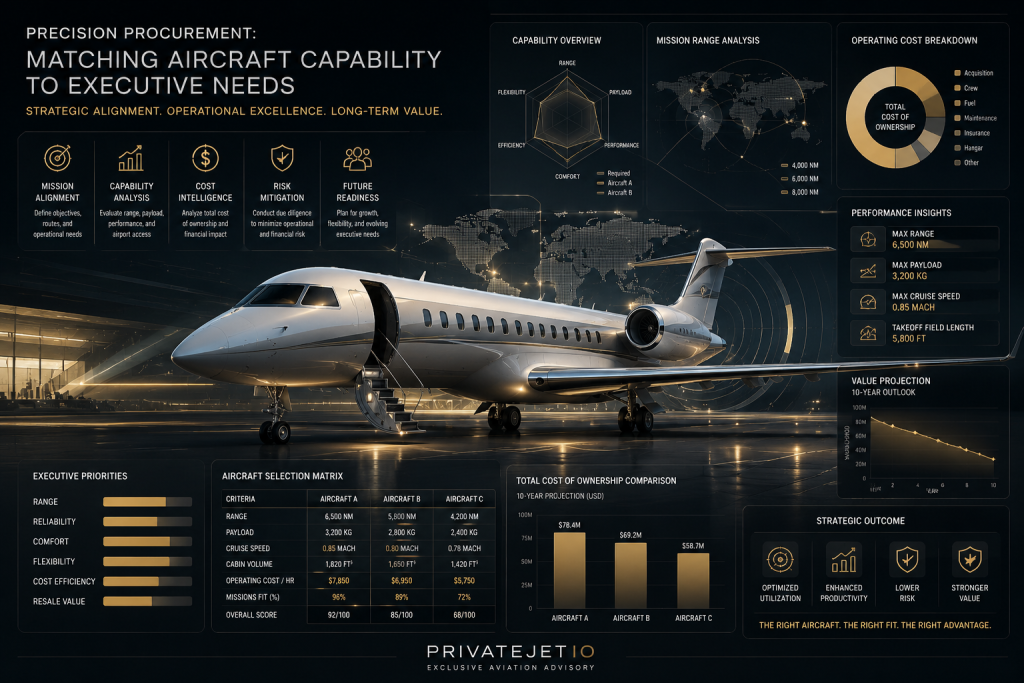
The acquisition of a private aircraft is rarely a transportation decision. For sophisticated buyers, it is a strategic capital allocation exercise that influences productivity, security, operational flexibility, brand perception, and long-term asset performance.
Yet one of the most common mistakes in private aviation is surprisingly simple: purchasing an aircraft based on prestige rather than operational requirements.
The most successful acquisitions begin with precision procurement a disciplined process that aligns aircraft capability with actual executive needs. Rather than asking, “Which jet do I want?” experienced buyers ask, “Which aircraft best supports my mission?”
This distinction often separates highly efficient aviation assets from expensive liabilities.
In today’s market, where acquisition costs routinely range from several million dollars to more than $80 million, aligning capability with requirements has become more important than ever. A properly structured Aircraft Acquisition Strategy can generate substantial operational and financial advantages throughout the ownership lifecycle.
By: PrivateJetio Aviation Advisory Team
Why Precision Procurement Matters More Than Ever
Private aviation has evolved dramatically during the past decade.
Executives now demand greater flexibility, international reach, enhanced privacy, connectivity, and operational resilience. At the same time, aircraft technology, regulatory frameworks, and operating economics have become increasingly complex.
As a result, selecting the right aircraft requires far more than reviewing manufacturer brochures.
Every aircraft purchase creates consequences across:
- Capital allocation
- Operating expenses
- Crew requirements
- Maintenance obligations
- Resale value
- Regulatory compliance
- International mobility
- Passenger experience
An aircraft that appears perfect on paper may prove unsuitable after several months of actual operation.
Precision procurement reduces this risk by establishing a clear relationship between mission requirements and aircraft capability before negotiations begin.
Understanding the Executive Mission Before Selecting an Aircraft
The foundation of successful procurement is defining the mission.
Every aviation asset should be acquired to serve a specific operational purpose.
Unfortunately, many buyers begin by comparing aircraft models rather than analyzing requirements.
That approach often leads to overspending, underutilization, or operational limitations.
The Mission Profile Framework
An aircraft mission profile identifies how the aircraft will actually be used.
A comprehensive aircraft mission profile typically includes:
- Average trip length
- Maximum trip length
- Annual flight hours
- Passenger loads
- International destinations
- Airport accessibility requirements
- Cargo capacity needs
- Connectivity requirements
- Security considerations
A chief executive traveling primarily between New York, Chicago, and Miami has fundamentally different requirements than a family office operating across Europe, the Middle East, and Asia.
Without a clearly defined aircraft mission profile, even experienced buyers can make costly acquisition mistakes.
Understanding Executive Travel Requirements
Every executive organization develops unique travel patterns.
Some prioritize speed.
Others prioritize flexibility.
Some focus on passenger capacity, while others require nonstop international range.
Analyzing executive travel requirements allows advisors to identify the aircraft characteristics that create genuine value.
Questions often include:
- How many passengers typically travel?
- What percentage of trips exceed four hours?
- How frequently are international missions conducted?
- Are secondary airports important?
- Is overnight crew accommodation required?
- Are confidential meetings conducted onboard?
- Is family travel a significant factor?
The answers establish the operational framework for aircraft selection.
The Hidden Cost of Buying Too Much Airplane
Many buyers assume larger aircraft automatically represent superior value.
In reality, oversized aircraft often generate significant inefficiencies.
A long-range jet operating primarily on short domestic routes may create:
- Higher fuel consumption
- Increased maintenance costs
- Larger crew expenses
- Greater hangar costs
- Higher insurance premiums
The result is a substantial increase in total cost of ownership without corresponding operational benefits.
In many cases, a super-midsize aircraft delivers identical mission effectiveness at dramatically lower operating costs.
Precision procurement seeks optimization rather than maximization.
The Hidden Risk of Buying Too Little Airplane
The opposite mistake can be equally expensive.
Aircraft selected solely on acquisition price frequently encounter operational limitations.
Examples include:
Range Restrictions
Aircraft lacking sufficient range may require technical stops that increase travel time and operating costs.
Passenger Constraints
Cabin capacity limitations can create logistical challenges as executive teams grow.
Airport Performance Issues
Aircraft with limited runway performance may struggle to access strategic destinations.
Future Growth Limitations
Business expansion can quickly render an initially adequate aircraft obsolete.
When this occurs, owners often face early replacement costs and accelerated depreciation.
Strategic procurement anticipates future requirements rather than focusing solely on present needs.
Conducting Aircraft Performance Analysis
A critical stage of precision procurement involves detailed aircraft performance analysis.
This process moves beyond marketing materials and examines real-world capabilities.
Experienced advisors evaluate:
Range Performance
Published range numbers frequently reflect ideal conditions.
Real-world operations involve:
- Weather variations
- Passenger loads
- Fuel reserves
- Air traffic restrictions
Actual operational range can differ substantially from brochure claims.
Runway Performance
Many executives prioritize access to secondary airports.
Short-field performance becomes essential when operating from:
- Resort destinations
- Mountain airports
- Urban business centers
- Remote industrial locations
Runway analysis ensures the aircraft can reliably access intended destinations.
Payload Capability
An aircraft may achieve impressive range figures only when lightly loaded.
Aircraft performance analysis examines the balance between:
- Passenger count
- Baggage volume
- Fuel requirements
- Range objectives
Understanding these relationships prevents operational surprises.
Aligning Cabin Design with Executive Productivity
Aircraft procurement extends beyond technical specifications.
The cabin environment directly influences executive effectiveness.
Modern aircraft serve as:
- Mobile offices
- Boardrooms
- Communication centers
- Family travel environments
The most effective acquisitions evaluate how cabin configuration supports mission objectives.
Connectivity Requirements
Today’s executives expect uninterrupted communication.
Cabin connectivity assessments typically examine:
- Global internet coverage
- Video conferencing capability
- Secure communications
- Bandwidth availability
Connectivity limitations can significantly reduce operational value.
Cabin Layout Optimization
Cabin design affects productivity, privacy, and comfort.
Potential configurations include:
- Conference seating
- Private suites
- Crew rest areas
- Dining arrangements
- Convertible sleeping spaces
Optimal layouts depend entirely on intended use cases.
The Role of Business Aviation Consulting
Aircraft procurement has become increasingly specialized.
Few buyers possess sufficient experience to independently evaluate:
- Aircraft markets
- Maintenance histories
- Operational economics
- Regulatory considerations
- Resale dynamics
This explains the growing importance of business aviation consulting.
Independent advisors help buyers avoid conflicts of interest that frequently arise during transactions.
Unlike brokers representing inventory or sellers, advisory firms focus on aligning acquisition decisions with client objectives.
A professional business aviation consulting engagement typically generates value far exceeding advisory fees by reducing acquisition risk and improving long-term ownership economics.
Evaluating New Versus Pre-Owned Aircraft
One of the most important procurement decisions involves choosing between new and pre-owned aircraft.
The answer depends entirely on strategic priorities.
Advantages of New Aircraft
Benefits may include:
- Latest technology
- Manufacturer warranties
- Cabin customization
- Predictable maintenance
However, buyers must also consider initial depreciation exposure.
Advantages of Pre-Owned Aircraft
Pre-owned aircraft often provide:
- Lower acquisition costs
- Reduced depreciation risk
- Faster delivery timelines
- Greater negotiating leverage
Sophisticated buyers frequently discover exceptional value within carefully selected pre-owned aircraft portfolios.
Flight Department Planning Before Acquisition
Aircraft ownership affects far more than transportation.
It creates operational infrastructure requirements that must be addressed before closing.
Effective flight department planning examines:
- Pilot recruitment
- Training requirements
- Scheduling systems
- Maintenance support
- Safety management
- Regulatory compliance
Failure to plan these elements can create significant operational inefficiencies immediately after acquisition.
The Strategic Value of Independent Advisory Services
The highest-performing acquisitions rarely occur by accident.
They result from structured evaluation processes that prioritize mission effectiveness over emotional decision-making.
Professional private jet advisory firms help buyers:
- Define operational requirements
- Evaluate aircraft alternatives
- Analyze lifecycle costs
- Conduct due diligence
- Negotiate acquisition terms
- Plan long-term ownership strategy
For ultra-high-net-worth individuals, family offices, and corporate flight departments, this strategic perspective frequently determines whether an aircraft becomes a productive asset or an expensive burden.
Due Diligence: The Most Undervalued Stage of Aircraft Procurement
Aircraft acquisitions often fail not because the wrong model was selected, but because insufficient due diligence was performed before closing.
An aircraft can appear attractive based on age, flight hours, and asking price while concealing significant operational or financial risks.
Sophisticated buyers understand that every aircraft possesses a history. The objective is to uncover that history before ownership transfers.
Comprehensive due diligence generally examines:
- Maintenance records
- Damage history
- Ownership history
- Regulatory compliance
- Modification documentation
- Engine status
- Component tracking
- Operational utilization
The deeper the investigation, the lower the probability of post-acquisition surprises.
Reviewing Maintenance Records
Maintenance documentation represents the operational biography of an aircraft.
Missing records can dramatically impact both value and future marketability.
Experienced acquisition teams scrutinize:
- Scheduled inspections
- Major maintenance events
- Airworthiness directives
- Service bulletin compliance
- Engine maintenance history
- Parts replacement schedules
Even minor documentation deficiencies can affect resale value years later.
Assessing Damage History
Not all damage events are equal.
Certain repairs have minimal impact on future operations, while others may affect long-term valuation.
The objective is not necessarily to avoid every aircraft with a repair history but to understand:
- Nature of the event
- Quality of repair work
- Regulatory approval
- Future implications
Proper evaluation prevents emotional reactions while ensuring informed decision-making.
Understanding Market Cycles Before Purchasing
Aircraft values fluctuate based on economic conditions, financing availability, fuel costs, and supply-demand dynamics.
Buyers who understand market cycles often acquire substantially more value from the same capital investment.
Timing matters.
A disciplined Aircraft Acquisition Strategy considers both operational needs and market conditions.
Several factors influence market pricing:
New Aircraft Production Levels
When manufacturers increase deliveries, secondary market inventory often rises.
This can create opportunities for buyers seeking late-model aircraft.
Economic Conditions
Periods of economic uncertainty sometimes generate motivated sellers.
Conversely, strong economic environments can increase demand and support higher valuations.
Interest Rate Environment
Financing costs directly influence acquisition economics.
Higher borrowing costs may reduce buyer activity and create favorable negotiating conditions.
Fleet Modernization Trends
Corporate operators frequently upgrade fleets to newer platforms.
These transitions can produce attractive acquisition opportunities for informed buyers.
Precision procurement recognizes that buying the right aircraft at the wrong time can still reduce overall investment performance.
The Importance of Future Resale Planning
Many buyers focus exclusively on acquisition.
Elite buyers focus on acquisition and exit simultaneously.
The most successful owners begin planning resale strategy before taking delivery.
This mindset influences:
- Aircraft model selection
- Cabin configuration choices
- Upgrade investments
- Maintenance decisions
- Operational practices
Future buyers often evaluate the same factors considered during the original acquisition process.
Maintaining broad market appeal helps preserve residual value.
Characteristics of Strong Resale Aircraft
Historically, aircraft that retain value effectively often possess:
- Proven market demand
- Strong manufacturer support
- Global service networks
- Desirable cabin layouts
- Efficient operating economics
- Strong dispatch reliability
No aircraft is immune to depreciation.
However, certain platforms consistently demonstrate stronger value retention than others.
How Technology Is Transforming Procurement Decisions
The private aviation industry increasingly relies on data-driven decision-making.
Modern procurement processes incorporate analytical tools that were unavailable only a decade ago.
These tools improve precision across multiple dimensions.
Market Intelligence Platforms
Advanced databases provide insights regarding:
- Historical transactions
- Asking prices
- Inventory levels
- Days on market
- Fleet demographics
This intelligence improves negotiating leverage.
Predictive Maintenance Analytics
Aircraft equipped with modern monitoring systems generate operational data that can help forecast maintenance requirements.
Buyers increasingly evaluate:
- System health indicators
- Component trends
- Reliability metrics
This information supports more accurate ownership cost projections.
Utilization Forecasting
Advanced modeling helps owners estimate future operational requirements.
Rather than relying on assumptions, buyers can evaluate multiple growth scenarios.
This approach reduces the risk of selecting an aircraft that becomes unsuitable within several years.
The Human Side of Aircraft Procurement
While technical and financial analysis remains essential, procurement ultimately serves people.
Aircraft should support executive effectiveness, organizational goals, and lifestyle objectives.
A technically perfect aircraft can still fail if it does not align with user expectations.
Successful acquisitions balance quantitative analysis with qualitative considerations.
Examples include:
- Passenger comfort
- Cabin atmosphere
- Noise levels
- Brand perception
- Service experience
- Family preferences
These factors influence satisfaction throughout the ownership lifecycle.
Common Procurement Mistakes Executive Buyers Should Avoid
Even sophisticated organizations occasionally make avoidable mistakes.
The most frequent errors include:
Purchasing Based on Prestige
The most expensive aircraft is not automatically the most appropriate aircraft.
Mission suitability should always outweigh image considerations.
Ignoring Operating Economics
Acquisition cost represents only one portion of ownership expenses.
Long-term operational costs often exceed initial purchase considerations.
Understanding total cost of ownership remains essential.
Skipping Independent Advice
Relying exclusively on sellers or transaction participants can create conflicts of interest.
Independent private jet advisory services provide objective perspectives.
Underestimating Growth
Business requirements evolve.
Selecting an aircraft based solely on current needs may create future limitations.
Inadequate Due Diligence
Incomplete investigations can expose buyers to unexpected costs and operational disruptions.
Thorough verification protects capital.
Building a Procurement Framework for Long-Term Success
The most effective acquisitions follow a repeatable framework.
Rather than beginning with aircraft models, successful buyers begin with objectives.
A practical procurement framework typically follows these stages:
1. Define Strategic Objectives
Clarify why the aircraft is being acquired.
Determine operational, financial, and organizational goals.
2. Develop the Mission Profile
Create a detailed analysis of expected utilization.
Identify both current and future requirements.
3. Evaluate Candidate Aircraft
Compare multiple aircraft against mission criteria.
Focus on suitability rather than marketing claims.
4. Conduct Financial Analysis
Assess acquisition costs, operating costs, financing, and residual value expectations.
5. Perform Due Diligence
Investigate technical, operational, and regulatory factors.
6. Negotiate Transaction Terms
Structure the acquisition to maximize value and reduce risk.
7. Implement Operational Planning
Establish support systems, crews, training, and maintenance infrastructure.
8. Monitor Asset Performance
Continuously evaluate whether the aircraft remains aligned with organizational objectives.
This disciplined process forms the foundation of world-class procurement practices.
Why Strategic Advisory Creates Competitive Advantage
For ultra-high-net-worth individuals, multinational corporations, family offices, and aviation investors, aircraft acquisitions represent significant strategic decisions.
The financial implications often extend far beyond the purchase price.
Professional advisory support introduces:
- Market intelligence
- Transaction experience
- Technical expertise
- Risk mitigation
- Negotiation leverage
- Long-term planning
The result is a more informed decision-making process and a greater probability of ownership success.
In many cases, advisory guidance identifies opportunities and risks that remain invisible to inexperienced buyers.
That insight often produces returns that substantially exceed advisory costs.
Conclusion
Private aviation procurement is no longer a simple exercise in selecting a desirable aircraft. It has become a sophisticated process that requires alignment between operational requirements, financial objectives, executive expectations, and long-term ownership strategy.
The most successful buyers do not begin with aircraft manufacturers or cabin brochures. They begin with a clear understanding of mission requirements and build their acquisition strategy around those needs.
Precision procurement ensures that every element of the decision-making process from aircraft mission profile development and aircraft performance analysis to due diligence and resale planning supports measurable value creation.
Whether the objective is executive mobility, family office efficiency, international business expansion, or portfolio diversification, the right aircraft is the one that aligns precisely with the mission.
At PrivateJetIO, our independent consulting approach helps buyers navigate complex acquisition decisions with clarity, confidence, and strategic discipline.
If you are evaluating a private aircraft purchase, considering a fleet transition, or exploring aviation investment opportunities, request a confidential consultation to ensure your next acquisition delivers both operational excellence and long-term value.
Frequently Asked Questions
How do I determine which private jet is right for my needs?
Start by analyzing your aircraft mission profile, including trip distances, passenger counts, destinations, annual utilization, and future growth expectations. The ideal aircraft is the one that best supports those requirements rather than the most expensive option.
Why is an Aircraft Acquisition Strategy important?
An Aircraft Acquisition Strategy helps align operational needs, financial objectives, and long-term ownership goals. It reduces procurement risk and improves overall asset performance.
What is the biggest mistake first-time jet buyers make?
Many buyers focus on prestige or acquisition price rather than mission suitability. This often results in higher costs, operational inefficiencies, or future replacement requirements.
Should I buy a new or pre-owned aircraft?
The answer depends on your priorities. New aircraft offer the latest technology and warranties, while pre-owned aircraft may provide superior value, lower depreciation exposure, and faster delivery.
Why should I use an independent aviation advisor?
Independent advisors provide objective guidance without inventory-driven conflicts of interest. They help evaluate aircraft options, conduct due diligence, negotiate transactions, and optimize long-term ownership outcomes.
References:
FAA Business Aviation Resources
National Business Aviation Association (NBAA)
International Business Aviation Council (IBAC)
General Aviation Manufacturers Association (GAMA)
Aircraft Bluebook Market Data
JetNet Market Intelligence
Aviation Week Intelligence Network
Corporate Jet Investor
Honeywell Business Aviation Outlook
J.P. Morgan Business Aviation Market Reports


