
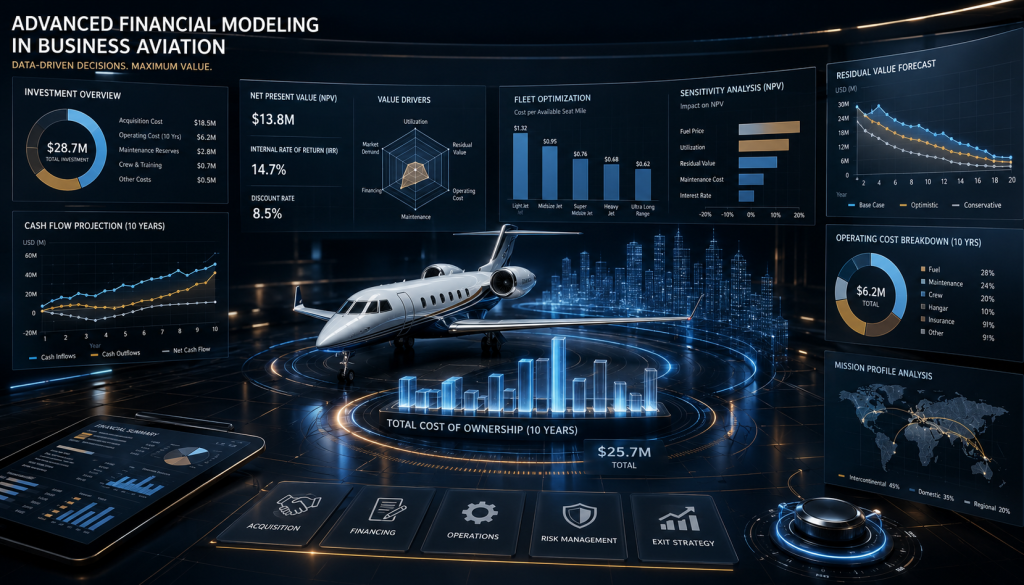
Business aviation has evolved far beyond a transportation decision. For ultra-high-net-worth individuals, family offices, corporations, and aviation operators, an aircraft represents a strategic financial asset that requires sophisticated analysis. The difference between a successful aviation investment and a costly mistake often comes down to one factor: the quality of the financial model behind the decision.
Modern business aviation financial modeling enables decision-makers to evaluate acquisition opportunities, forecast operating costs, analyze depreciation scenarios, compare ownership structures, and optimize long-term capital allocation. In an industry where a single transaction can involve tens of millions of dollars, intuition alone is no longer sufficient.
The most successful aircraft owners treat aviation decisions with the same analytical rigor applied to private equity investments, real estate portfolios, and corporate acquisitions. Advanced financial modeling provides the framework necessary to make informed decisions while protecting capital and maximizing strategic value.
By: PrivateJetio Aviation Advisory Team
Why Financial Modeling Has Become Essential in Business Aviation
Private aviation markets have become increasingly complex. Aircraft values fluctuate based on macroeconomic conditions, manufacturer production rates, technological innovation, regulatory developments, and global demand patterns.
A business jet purchased today may represent an outstanding investment or a significant financial burden depending on dozens of variables that extend far beyond the purchase price.
Sophisticated investors now expect detailed forecasts that examine:
- Capital deployment requirements
- Multi-year operating costs
- Residual value projections
- Financing structures
- Tax implications
- Risk-adjusted returns
- Exit opportunities
Without advanced modeling, these variables remain difficult to evaluate accurately.
The challenge is particularly significant because aircraft ownership combines characteristics of several asset classes simultaneously.
An aircraft is:
- A transportation asset
- A capital asset
- A depreciating asset
- A strategic business tool
- A luxury asset
- A potential income-generating asset
This unique combination requires specialized analytical frameworks.
The Foundation of Business Aviation Financial Modeling
At its core, Business Aviation Financial Modeling seeks to answer one critical question:
“What is the true economic impact of owning, operating, financing, and eventually disposing of an aircraft?”
The answer requires integrating multiple financial disciplines into a unified model.
Capital Expenditure Analysis
The acquisition price represents only the beginning of the investment.
A complete model evaluates:
- Purchase price
- Pre-purchase inspection costs
- Legal expenses
- Registration costs
- Interior upgrades
- Connectivity enhancements
- Initial maintenance requirements
These costs often add millions of dollars beyond the advertised acquisition value.
Operating Cost Analysis
One of the most underestimated areas in aviation planning is ongoing operating expenses.
Advanced models forecast:
- Fuel consumption
- Crew salaries
- Maintenance reserves
- Insurance costs
- Navigation fees
- Hangar expenses
- Training requirements
- Subscription services
These expenses vary significantly depending on aircraft utilization.
A jet flying 600 hours annually operates under a completely different cost structure than one flying 250 hours per year.
Revenue and Productivity Impact
Aircraft ownership creates value beyond direct transportation.
Many organizations quantify:
- Executive productivity gains
- Reduced travel delays
- Increased deal flow
- Improved customer access
- Enhanced operational flexibility
While these benefits can be difficult to measure precisely, they often represent a substantial portion of the overall economic value.
Understanding Total Cost of Ownership
One of the most important concepts in aviation finance is Total Cost of Ownership.
Many buyers focus excessively on acquisition price while underestimating lifetime ownership costs.
A modern financial model evaluates ownership across the entire lifecycle of the aircraft.
Direct Costs
Direct costs include expenses directly linked to flight activity.
Examples include:
- Fuel
- Maintenance
- Engine reserves
- Landing fees
- Catering
- Crew travel
These costs generally increase with utilization.
Indirect Costs
Indirect costs remain relatively fixed regardless of flight hours.
Examples include:
- Hangar rental
- Insurance
- Management fees
- Administrative support
- Regulatory compliance
Understanding the balance between direct and indirect expenses is essential when determining optimal utilization levels.
Lifecycle Cost Projection
The most sophisticated models extend projections over periods ranging from five to fifteen years.
Variables may include:
- Inflation assumptions
- Fuel price forecasts
- Labor cost growth
- Maintenance escalation
- Regulatory changes
- Technology upgrades
- Residual value estimates
This long-term perspective provides a more accurate picture of ownership economics.
Aircraft Depreciation: The Silent Value Driver
Aircraft depreciation remains one of the largest determinants of financial performance.
Aviation investors frequently discover that depreciation has a greater impact on total returns than operating costs.
Factors Influencing Depreciation
Aircraft values are affected by:
- Age
- Total flight hours
- Maintenance status
- Market demand
- Manufacturer support
- New model introductions
- Regulatory developments
Each factor influences future resale value.
Linear vs Market-Based Depreciation
Traditional accounting models often use straight-line depreciation.
However, market behavior rarely follows a straight line.
Aircraft values may experience:
- Rapid early depreciation
- Mid-life stabilization
- Late-life acceleration
Advanced models account for these patterns.
Predicting Residual Value
Residual value forecasting combines historical data with forward-looking market intelligence.
Analysts evaluate:
- Fleet population
- Production rates
- Replacement cycles
- Secondary market demand
- Economic indicators
Even small forecasting improvements can significantly impact investment outcomes.
For a $40 million aircraft, a 5% difference in residual value projection can represent $2 million in future value.
Aviation Investment Analysis for Strategic Buyers
Professional investors rarely evaluate aircraft solely as transportation tools.
Instead, they perform a comprehensive aviation investment analysis.
This approach examines opportunity costs and alternative uses of capital.
Comparing Capital Allocation Options
Before purchasing a jet, investors often compare expected outcomes against:
- Private equity investments
- Commercial real estate
- Public market portfolios
- Infrastructure investments
- Alternative assets
The goal is determining whether aviation ownership creates sufficient strategic and financial benefits.
Net Present Value (NPV)
NPV analysis remains one of the most valuable modeling tools.
It evaluates future cash flows using a discount rate that reflects risk and opportunity cost.
Benefits include:
- Comparing ownership structures
- Evaluating fleet decisions
- Assessing replacement timing
- Measuring investment attractiveness
Internal Rate of Return (IRR)
IRR helps decision-makers evaluate expected returns under different scenarios.
Advanced aviation models frequently generate:
- Conservative case
- Base case
- Optimistic case
This framework provides a realistic range of outcomes.
Aircraft Acquisition Strategy Through Financial Modeling
Acquiring an aircraft without a financial model is similar to acquiring a company without due diligence.
Professional buyers evaluate multiple acquisition paths before committing capital.
New Aircraft vs Pre-Owned Aircraft
The decision often depends on financial objectives.
New aircraft offer:
- Latest technology
- Full warranties
- Predictable maintenance
Pre-owned aircraft may provide:
- Lower acquisition costs
- Reduced depreciation exposure
- Faster availability
Advanced models quantify these tradeoffs.
Ownership vs Leasing
Many organizations assume ownership is automatically superior.
In reality, leasing can create substantial financial advantages under certain conditions.
Models evaluate:
- Capital preservation
- Tax considerations
- Flexibility requirements
- Utilization forecasts
The optimal solution varies by client profile.
Timing the Market
Aircraft markets move in cycles.
Sophisticated acquisition strategies consider:
- Inventory levels
- Interest rates
- Manufacturer backlogs
- Economic outlook
Timing alone can save millions during large transactions.
Fleet Optimization Through Advanced Modeling
For organizations operating multiple aircraft, financial modeling extends beyond acquisition decisions. The focus shifts toward fleet optimization and capital efficiency.
A poorly structured fleet can create millions of dollars in unnecessary expenses every year.
An optimized fleet aligns aircraft capability with mission requirements while minimizing ownership and operating costs.
Matching Aircraft to Mission Profiles
Not every trip requires a large-cabin aircraft.
Advanced modeling evaluates:
- Average passenger count
- Mission length
- Airport accessibility
- Annual utilization
- International requirements
The analysis often reveals opportunities to replace a single large aircraft with a more efficient combination of assets.
Fleet Right-Sizing
Many corporations maintain larger fleets than operationally necessary.
Financial models identify:
- Underutilized aircraft
- Redundant capabilities
- Excess capacity
- Scheduling inefficiencies
The result is a leaner fleet structure that preserves operational flexibility while reducing capital commitments.
Replacement Planning
Aircraft replacement decisions should never be reactive.
Sophisticated models forecast:
- Maintenance cost escalation
- Depreciation trends
- Technology obsolescence
- Future market conditions
This allows operators to identify the optimal exit point before costs accelerate significantly.
Aviation Asset Management: Beyond Ownership
Elite aircraft owners increasingly view aviation through the lens of aviation asset management.
This perspective recognizes that an aircraft is part of a broader wealth strategy rather than an isolated transportation tool.
Portfolio Integration
Family offices often manage diversified portfolios containing:
- Equities
- Fixed income
- Real estate
- Private businesses
- Alternative investments
- Aviation assets
Financial models evaluate how aircraft ownership affects overall portfolio performance.
Risk Diversification
While aircraft ownership is not traditionally considered an investment asset, it still carries economic risk.
These risks include:
- Residual value declines
- Regulatory changes
- Economic downturns
- Manufacturer issues
- Technology disruption
Asset management frameworks help quantify and manage these exposures.
Performance Monitoring
Leading aviation advisors continuously monitor:
- Aircraft value trends
- Cost performance
- Utilization efficiency
- Market conditions
This transforms ownership from a passive experience into an actively managed strategy.
Scenario Analysis and Stress Testing
One hallmark of advanced financial modeling is scenario analysis.
The future is uncertain. Effective decision-making requires understanding how different outcomes affect ownership economics.
Base Case Scenario
The base case reflects the most likely assumptions.
Typical variables include:
- Average annual flight hours
- Historical fuel inflation
- Normal maintenance events
- Expected residual values
This scenario forms the foundation of the investment thesis.
Upside Scenario
The optimistic scenario evaluates favorable conditions.
Examples include:
- Strong aircraft resale markets
- Lower operating costs
- Increased utilization efficiency
- Favorable financing conditions
Understanding upside potential helps quantify opportunity.
Downside Scenario
The downside scenario protects investors from surprises.
Potential assumptions include:
- Economic recession
- Reduced demand
- Fuel price spikes
- Residual value deterioration
- Regulatory changes
Many sophisticated buyers place greater emphasis on downside protection than upside potential.
The Role of Financing in Aviation Models
Financing structure can dramatically influence aircraft economics.
The cheapest aircraft is not always the one with the lowest purchase price.
Sometimes the best opportunity is created through superior financing terms.
Debt vs Cash Acquisition
Financial models compare:
- Cash purchases
- Traditional loans
- Aviation financing structures
- Lease arrangements
Each option carries different implications for liquidity and returns.
Interest Rate Sensitivity
Interest rates have become increasingly important in aviation transactions.
A modest increase in borrowing costs can significantly impact:
- Monthly cash flow
- Total ownership cost
- Investment returns
Advanced models stress-test multiple interest-rate environments.
Liquidity Considerations
Ultra-high-net-worth individuals often prioritize liquidity preservation.
A financial model evaluates whether capital deployed into aircraft ownership could produce higher returns elsewhere.
This opportunity-cost perspective frequently shapes acquisition decisions.
Tax Strategy and Financial Modeling
Tax considerations can substantially affect aircraft economics.
However, tax planning should support strategic objectives rather than drive them.
Depreciation Benefits
In some jurisdictions, aircraft owners may benefit from accelerated depreciation schedules.
These provisions can create meaningful cash-flow advantages.
Financial models quantify:
- Timing benefits
- Tax savings
- Net present value impacts
Cross-Border Considerations
International ownership introduces additional complexity.
Factors include:
- VAT exposure
- Import duties
- Registration structures
- Cross-border operations
Sophisticated models account for these variables from the outset.
Ownership Structures
Aircraft may be owned through:
- Individuals
- Corporations
- Holding companies
- Trust structures
- Special-purpose entities
Each structure carries unique financial implications.
Financial Modeling for Family Offices
Family offices have become major participants in business aviation.
Their approach differs significantly from traditional corporate ownership.
Multi-Generational Planning
Family offices often evaluate aircraft over extended time horizons.
Models may incorporate:
- Estate planning objectives
- Family mobility requirements
- Wealth preservation goals
- Succession planning considerations
This perspective changes acquisition and disposal strategies.
Privacy and Strategic Value
For many family offices, the value of private aviation extends beyond measurable financial returns.
Benefits include:
- Privacy
- Security
- Flexibility
- Family access
Advanced models increasingly incorporate qualitative value factors alongside quantitative metrics.
Integrated Wealth Management
The most sophisticated family offices evaluate aviation decisions within the broader context of wealth management.
This approach improves capital allocation decisions and supports long-term financial objectives.
The Future of Business Aviation Financial Modeling
Technology is rapidly transforming aviation analytics.
The next generation of financial models will become increasingly data-driven and predictive.
Artificial Intelligence and Predictive Analytics
Modern systems can analyze:
- Historical aircraft transactions
- Maintenance trends
- Market cycles
- Fuel price behavior
- Utilization patterns
This improves forecasting accuracy and decision quality.
Real-Time Market Intelligence
Future models will continuously update based on:
- Aircraft inventory levels
- Financing conditions
- Economic indicators
- Fleet activity
Static spreadsheets are gradually being replaced by dynamic decision-support platforms.
Integrated Decision Frameworks
The future belongs to integrated systems that combine:
- Financial analysis
- Operational planning
- Risk assessment
- Market intelligence
These platforms will provide executives with a comprehensive view of aircraft ownership economics.
Common Financial Modeling Mistakes in Business Aviation
Even experienced buyers make costly mistakes.
The most common include:
- Focusing only on acquisition price.
- Underestimating maintenance escalation.
- Ignoring residual value risk.
- Using unrealistic utilization assumptions.
- Overlooking opportunity costs.
- Failing to model downside scenarios.
- Relying on generic industry averages.
- Ignoring financing sensitivity.
- Neglecting tax implications.
- Making emotional rather than analytical decisions.
Avoiding these mistakes can save millions over an aircraft’s lifecycle.
The Strategic Advantage of Professional Aviation Advisory
Business aviation transactions involve significant complexity.
Aircraft values, financing structures, tax considerations, and operational variables interact in ways that are difficult to evaluate without specialized expertise.
Professional advisors bring:
- Market intelligence
- Transaction experience
- Financial modeling expertise
- Industry relationships
- Risk assessment capabilities
The cost of professional analysis is often insignificant compared with the value it creates during major transactions.
Conclusion
Business aviation is no longer simply about acquiring an aircraft. It is about making a sophisticated capital-allocation decision that aligns with long-term strategic objectives.
Advanced financial modeling transforms uncertainty into clarity. It enables buyers, owners, corporations, and family offices to understand the true economics of ownership, evaluate competing opportunities, manage risk, and maximize value throughout the aircraft lifecycle.
Whether evaluating a first aircraft acquisition, restructuring a fleet, planning a future sale, or optimizing an existing ownership strategy, the quality of the financial model often determines the quality of the outcome.
The most successful aviation investors recognize a simple truth: aircraft transactions should be approached with the same analytical discipline applied to any major investment decision.
If you are considering an aircraft acquisition, disposition, fleet restructuring, or ownership optimization strategy, PrivateJetio provides independent advisory services, market intelligence, and executive-level financial analysis designed to support informed decision-making.
Frequently Asked Questions
What is business aviation financial modeling?
Business aviation financial modeling is the process of evaluating aircraft ownership economics through detailed projections of acquisition costs, operating expenses, financing, depreciation, taxes, and future resale values.
Why is financial modeling important before buying a private jet?
A comprehensive model reveals the true cost of ownership, identifies financial risks, and helps buyers compare ownership structures before committing significant capital.
How accurate are aircraft residual value forecasts?
No forecast is perfect, but advanced models that incorporate market data, fleet trends, and economic indicators generally provide significantly more reliable estimates than simple depreciation schedules.
Can financial modeling reduce private jet ownership costs?
Yes. Proper modeling frequently identifies opportunities to optimize financing, reduce operating expenses, improve fleet utilization, and avoid costly acquisition mistakes.
Who should use advanced aviation financial modeling?
Ultra-high-net-worth individuals, family offices, corporations, aircraft operators, and investors considering significant aviation-related capital decisions can benefit from professional financial modeling.
References:
National Business Aviation Association (NBAA)
https://nbaa.org
Federal Aviation Administration (FAA)
https://www.faa.gov
International Business Aviation Council (IBAC)
https://ibac.org
European Union Aviation Safety Agency (EASA)
https://www.easa.europa.eu
General Aviation Manufacturers Association (GAMA)
https://gama.aero
International Civil Aviation Organization (ICAO)
https://www.icao.int
Corporate Jet Investor Market Intelligence
https://www.corporatejetinvestor.com
J.P. Morgan Business Aviation Outlook Reports
https://www.jpmorgan.com
Rolls-Royce CorporateCare Program Information
https://www.rolls-royce.com
Jet Support Services, Inc. (JSSI) Maintenance Insights
https://www.jssi.com


